
Adventure Guide Portfolio vs Resume: Key Differences

When applying for adventure guide roles, you need two key tools: a resume and a portfolio. Both serve different purposes and can significantly impact your chances of landing a job.
- Resume: A concise document listing your certifications (like Wilderness First Responder), work experience, technical skills (e.g., GPS navigation), and education. It's essential for demonstrating your qualifications and meeting hiring standards. Resumes are typically 1–2 pages and are optimized for quick scanning by hiring managers or Applicant Tracking Systems (ATS).
- Portfolio: A visual showcase of your outdoor experience, including photos, videos, trip reports, and client testimonials. It highlights your hands-on skills, leadership, and problem-solving abilities. Portfolios are flexible in format, often digital, and updated frequently to reflect your latest achievements.
When to Use Each:
- Use a resume for entry-level roles or initial application screenings.
- Use a portfolio for specialized or senior roles where employers want to see detailed evidence of your skills.
Quick Comparison:
| Feature | Resume | Portfolio |
|---|---|---|
| Purpose | Summarize qualifications | Showcase real-world experience |
| Length | 1–2 pages | Multi-page, highly visual |
| Content | Text-based, certifications | Photos, videos, trip reports |
| Update Frequency | Periodically | Frequently |
| Use Case | Entry-level roles | Specialized or senior-level roles |
For entry-level jobs, a resume often suffices. For advanced or niche positions, pairing your resume with a portfolio can give you a competitive edge. Together, these tools help you stand out in the growing outdoor recreation industry.
Not sure what outdoor role fits you?
Take our 2-minute career quiz to get matched with outdoor jobs that align with your goals, salary target, and lifestyle.
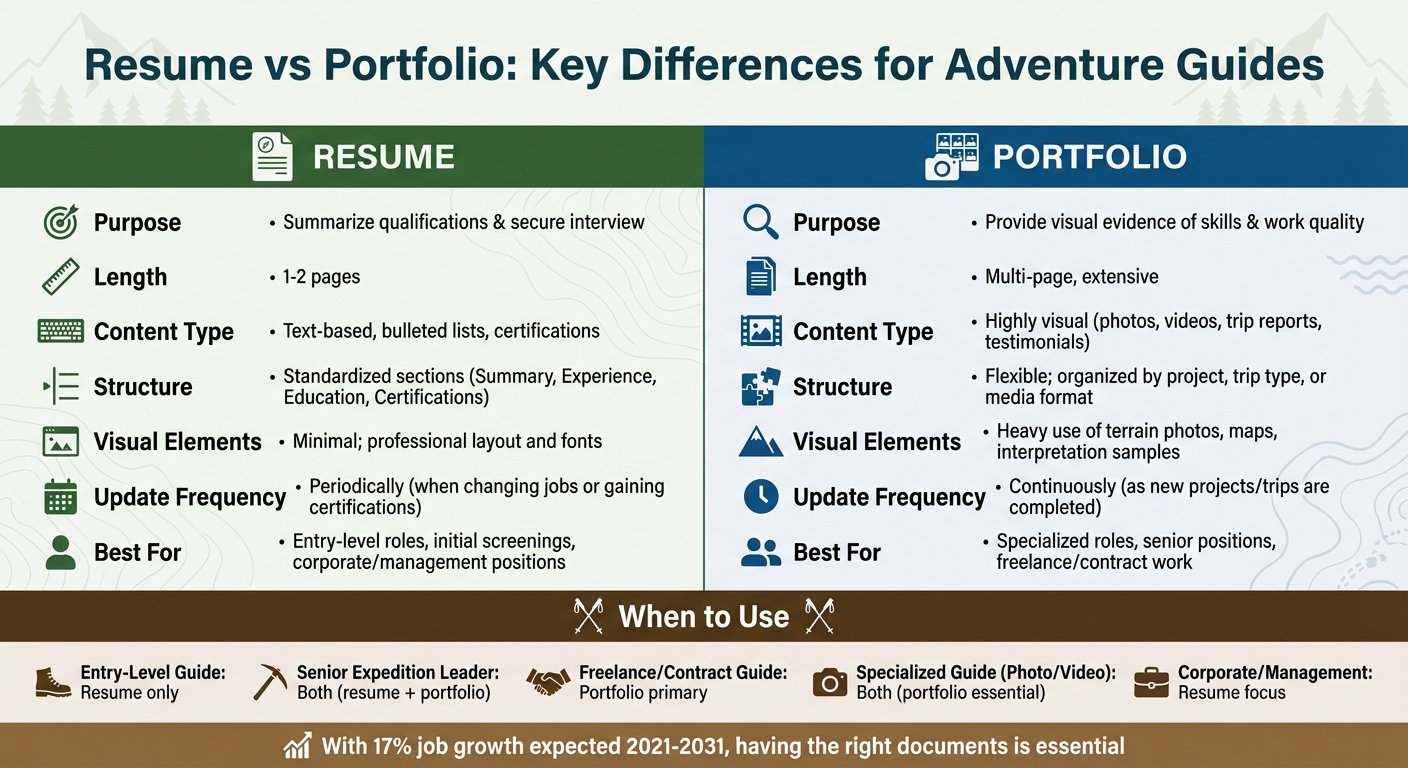
Adventure Guide Resume vs Portfolio Comparison Chart
How to Create a PROFITABLE Adventure Photography Portfolio
sbb-itb-9d004f0
What is a Resume for Adventure Guides?
A resume for adventure guides is a snapshot of your experience, skills, and safety certifications, tailored to show your readiness to lead groups safely in outdoor settings. Unlike a corporate resume, this document focuses heavily on technical certifications, risk management skills, and your commitment to outdoor safety and stewardship.
Since hiring managers typically spend just 10–15 seconds scanning resumes, yours needs to immediately highlight the essentials: safety credentials, years of experience, and the environments where you’ve worked. As Amy Gallo, Contributing Editor at Harvard Business Review, explains:
This may be your best chance to make a good first impression, so you've got to get it right.
For adventure guides, the resume isn’t just a formality - it’s your proof of meeting the mandatory safety standards employers require. Certifications like Wilderness First Responder (WFR) are critical, as they appear on approximately 24.8% of outdoor guide resumes.
Main Elements of a Resume
An effective adventure guide resume includes several key sections that together showcase your qualifications. Here’s a breakdown:
- Contact Information: Start with your full name, professional email, and phone number.
- Summary Statement: Provide a concise overview of your experience, the types of environments you’ve guided in (e.g., alpine, desert, marine), and your leadership approach.
- Work Experience: List your guiding roles in reverse-chronological order. Focus on group management, safety protocols, and instruction.
- Technical Skills: Highlight skills like GPS navigation, rock climbing, kayaking, and wilderness first aid.
- Certifications and Licenses: Include essential credentials like Wilderness First Responder, AMGA certifications, CPR/AED, and Leave No Trace Master Educator status.
- Education: Mention relevant degrees, such as a Bachelor of Science in Outdoor Recreation or Environmental Science.
- Achievements: Add quantifiable accomplishments, such as the number of participants you’ve guided or challenging terrains you’ve navigated.
These components ensure your resume is a strong contender in fast-paced hiring environments.
Benefits of Using a Resume
Resumes serve as a standardized format that helps hiring managers quickly compare candidates’ qualifications, particularly when faced with a high volume of applications. They’re easy to tailor to specific roles and allow recruiters to scan for critical certifications at a glance.
The structured format also makes resumes ideal for Applicant Tracking Systems (ATS), which many outdoor employers and federal agencies use to filter applications. Sticking to simple fonts like Arial or Calibri and avoiding overly complex language can improve your chances of getting through these systems.
With the job outlook for Outdoor Recreation Workers expected to grow 17% from 2021 to 2031, well above the average for other occupations, having a polished and scannable resume is more important than ever.
While resumes focus on certifications and experience, portfolios can later showcase your hands-on achievements in the field.
What is a Portfolio for Adventure Guides?
A portfolio for adventure guides is more than just a collection of your qualifications - it's a showcase of your skills, experience, and achievements, brought to life with photos, videos, trip reports, and client testimonials. While a resume lists what you've done, a portfolio shows how you’ve done it. It highlights your decision-making, leadership, and problem-solving in real-world scenarios, giving employers a clearer picture of who you are beyond your credentials.
These portfolios can be digital - hosted on platforms like Squarespace, Wix, or LinkedIn - or physical. Digital formats are often preferred because they’re easy to share and can include interactive elements like videos or clickable case studies.
Main Elements of a Portfolio
A strong adventure guide portfolio typically includes 10–20 examples that demonstrate your range of abilities. Start with an "About Me" section that features a photo and describes your guiding philosophy. This personal touch helps employers connect with you on a deeper level before diving into the technical details.
Visuals are key. Include photos or videos with short captions that provide context. For instance, a photo of you leading a group across a glacier could include details about the weather, group size, and any safety challenges you managed. These snapshots make your experience feel more tangible.
Case studies are another powerful tool. Use the STAR method (Situation, Task, Action, Result) to break down specific expeditions and highlight how you handled complex scenarios. Pair these with client testimonials or satisfaction surveys to emphasize your interpersonal skills. Don’t forget to include copies of essential certifications like Wilderness First Responder, CPR, First Aid, or any other credentials relevant to your discipline.
Additional elements might include sample itineraries, detailed trip reports, safety protocols you’ve developed, or letters of appreciation from past clients or employers. If you’ve written blog posts or given talks on outdoor education, these can also be included as writing samples to showcase your communication skills. Together, these elements paint a comprehensive picture of your expertise and set the stage for meaningful conversations during interviews.
Benefits of Using a Portfolio
A well-crafted portfolio does more than just list your accomplishments - it brings them to life. It provides concrete proof of your technical skills, leadership, and adaptability, allowing potential employers to see you in action. Amanda Baker, a Certified Professional Resume Writer, explains it perfectly:
A portfolio goes beyond the simple listing of past jobs by showcasing actual work. It provides evidence of your abilities and achievements through detailed examples.
For adventure guiding roles, where hands-on experience and practical skills are essential, portfolios are particularly effective. They not only highlight your expertise but also give insight into your personality and passion for the outdoors - qualities that a standard resume might miss.
Portfolios also serve as powerful tools during interviews, offering tangible examples to discuss when talking about your experience. They’re equally valuable for networking at industry events or when meeting potential freelance clients. By keeping a master portfolio updated with your latest trips and evaluations, you can easily adapt it to fit specific job applications, ensuring you always put your best foot forward.
Resume vs Portfolio: Main Differences
The key difference between a resume and a portfolio boils down to telling versus showing. A resume conveys your professional experience through concise text and bullet points. In contrast, a portfolio demonstrates your abilities with visual examples like photos, trip reports, and client testimonials. Tulane University explains it well:
"A resume is mostly about telling, not showing. While every job applicant should talk about their 'wins' in a resume, a portfolio lets you show those wins to hiring managers." – Tulane University
This distinction highlights differences in format, depth, and how often each document is updated.
Resumes stick to a standard 1–2 page layout optimized for applicant tracking systems (ATS). Portfolios, on the other hand, allow for creative expression, often taking the form of digital or physical multi-page presentations. While a resume acts as a high-level overview of your career - featuring certifications like Wilderness First Responder (WFR) or AMGA credentials - a portfolio dives deeper. For example, it could detail how you led a 10-day backpacking trip through tough terrain or managed a backcountry emergency.
When it comes to updates, resumes are refreshed periodically - typically when you switch jobs or earn a new certification. Portfolios, however, are updated more frequently, reflecting new trips, projects, or testimonials. To bridge the gap, you can include a clickable link to your portfolio in your resume’s contact section, making it easy for hiring managers to review both.
Comparison Table: Resume vs Portfolio
| Aspect | Resume | Portfolio |
|---|---|---|
| Primary Purpose | Summarize qualifications and secure an interview | Provide visual evidence of skills and work quality |
| Length | 1–2 pages | Variable; often extensive and multi-page |
| Content Type | Text-based; bulleted lists of roles and certifications | Highly visual; includes photos, videos, and trip reports |
| Structure | Standardized sections: Summary, Experience, Education, Certifications | Flexible; organized by project, trip type, or media format |
| Visual Elements | Minimal; professional layout and fonts | Heavy; includes terrain photos, maps, and naturalist interpretation samples |
| Update Frequency | Updated when changing jobs or gaining new certifications | Continuously updated as new projects/trips are completed |
| Typical Use Case | Commonly required for most job applications | Essential for creative or specialized guiding roles |
When to Use a Resume vs a Portfolio
A resume is almost always a must-have unless a job posting explicitly states otherwise. Understanding when to include a portfolio, however, depends on the role and career stage you're targeting.
For entry-level positions - like day guides, camp counselors, or shuttle drivers - a simple 1–2 page resume does the job. These roles typically focus on certifications such as Wilderness First Responder (WFR) and basic customer service experience, which can be effectively communicated in a concise format.
On the other hand, portfolios become indispensable for specialized or senior-level roles. Take a senior Tour Director, for example, responsible for managing 20–30 guests and coordinating complex logistics. In this case, a portfolio showcasing trip itineraries, terrain photos, and client testimonials provides a level of detail that a resume alone cannot match.
For specialized positions - such as high alpine guiding, swiftwater rescue, or photography-guiding - a portfolio is essential to display technical expertise. It allows you to include trip logs, route maps, and evidence of risk management skills, offering hiring managers the depth they need to evaluate your qualifications.
A smart tip? Hyperlink your portfolio in the contact section of your resume. This way, hiring managers can easily access it after the initial Applicant Tracking System (ATS) screening. While resumes are key for that first screening phase, portfolios often come into play during or after the interview process to provide a more comprehensive view of your skills.
Comparison Table: Best Choice by Job Type
| Job Scenario | Optimal Document | Rationale |
|---|---|---|
| Entry-Level Guide | Resume | Highlights required certifications, basic training, and education to meet minimum hiring criteria. |
| Senior Expedition Leader | Both | Resume showcases experience and safety certifications; portfolio demonstrates leadership and logistics expertise. |
| Freelance/Contract Guide | Portfolio (Primary) | Clients prioritize visual proof of past trips and testimonials over formal employment history. |
| Specialized Guide (e.g., Photo/Video) | Both (Portfolio Essential) | Portfolio proves technical media skills visually, while the resume covers guiding and safety qualifications. |
| Corporate/Management Roles | Resume | Structured career milestones and achievements are what traditional hiring managers emphasize. |
How to Customize Resumes and Portfolios for Adventure Guiding
Crafting a resume and portfolio that stand out in the adventure guiding industry requires tailoring them to meet specific job requirements. Here's how to align your documents with expectations and highlight your expertise.
Matching Your Documents to Get Outdoor Jobs Listings
To catch the attention of employers on platforms like Get Outdoor Jobs, incorporate relevant industry keywords directly from job postings. Phrases such as "Wilderness First Responder", "Risk Management", "Safety Procedures", and "Customer Service" often appear in listings and can help your resume pass initial screenings.
Make sure your certifications section reflects the credentials sought in each listing. For example, certifications like WFR, WEMT, AMGA, AIARE, or Swiftwater Rescue are frequently requested. If you're applying for government roles through platforms like USAJobs.gov, be prepared to adapt your resume format to meet their specific requirements, which differ from those of private operators.
If your career includes seasonal or freelance roles, consider grouping them under a single heading like "Freelance Adventure Guide, 2022–2025" instead of listing each contract separately. This approach creates a cohesive narrative, helping you avoid a fragmented work history. It also aligns well with Get Outdoor Jobs' advanced filters, allowing you to present varied experience in a streamlined way.
This keyword and formatting strategy sets you up to effectively showcase your practical skills and expertise.
Highlighting Your Skills and Experience
After aligning your resume with job descriptions, focus on making your portfolio a vivid representation of your technical abilities. Highlight practical skills like GPS navigation and topographical map reading. Use action shots in your portfolio to demonstrate these capabilities - whether it's reading maps in the field, setting up a high ropes course, or navigating whitewater rapids.
In many guiding roles, knowledge of natural history is just as important as survival skills. Include evidence of your ability to deliver interpretive talks about local flora, fauna, or geology .
When incorporating multimedia into your portfolio, focus on quality over quantity. Select 5–10 standout projects and lead with your strongest work, as recruiters often make quick decisions . Keep videos concise - 1–2 minutes is ideal to maintain attention . Add captions to photos or videos that briefly explain the challenge, the techniques you used, and the results. This provides insight into your problem-solving abilities and technical expertise .
Conclusion: Choosing Between a Resume and Portfolio
Deciding between a resume and a portfolio depends on your career stage and the specific role you're pursuing. For entry-level positions like day-trip guides or camp counselors, a well-crafted resume highlighting your Wilderness First Responder (WFR) certification and customer service skills is usually enough. Larger employers often rely on resumes for their initial screening process .
However, for roles that require specialized technical expertise, a portfolio becomes a must-have. Boutique expedition companies and high-end tour operators want to see visual proof of your skills - trip logs, AMGA or AIARE certifications, and naturalist interpretation abilities. As Wildland Trekking puts it:
Obtaining advanced certifications will show potential employers that you are serious about the position and possess the skills for the job.
Experienced guides often take a combined approach: a resume that lists certifications and work history paired with a portfolio showcasing leadership and program development. Together, these documents provide both credentials and concrete evidence of your abilities. This combination is especially useful when moving into management or operations roles, where employers value both administrative know-how and field experience.
With the outdoor recreation sector expected to grow 17% from 2021 to 2031 - much faster than the average - thousands of new opportunities are on the horizon. Whether you're guiding day trips or leading multi-day expeditions, having the right documents can help you take advantage of this growth. Tailor your resume and portfolio to match the skills and certifications highlighted in Get Outdoor Jobs listings. Check out current openings at Get Outdoor Jobs (https://getoutdoorjobs.com) and use your customized resume or portfolio to land roles that align with your experience and career aspirations.
FAQs
What should I include in my adventure guide resume?
To craft a standout adventure guide resume, focus on highlighting your experience, certifications, and skillset relevant to outdoor leadership. Showcase your expertise in leading activities like kayaking, rock climbing, or backpacking. Be sure to emphasize your ability to maintain safety standards and promote responsible outdoor practices. Including a professional summary at the top is a great way to give a quick snapshot of your qualifications and years of experience.
Certifications such as Wilderness First Responder, CPR, First Aid, and proficiency with navigation tools like GPS are essential to include. When detailing your work experience, list specific guiding roles and responsibilities, such as leading group tours, mentoring team members, and coordinating with land management agencies. If you have education in outdoor recreation or a related field, make sure to include that as well. Keep your resume clear, concise, and tailored specifically to the adventure guiding profession.
How does a portfolio help me stand out when applying for senior adventure guide positions?
A portfolio serves as a powerful tool to distinguish yourself by presenting real examples of your skills, accomplishments, and expertise in adventure guiding. While a resume offers a brief overview of your experience, a portfolio goes further by providing concrete evidence of what you can do. This might include photos from trips, detailed itineraries you've crafted, certifications you've earned, or glowing client feedback.
For senior-level positions, employers often prioritize candidates who can showcase leadership, originality, and a history of success. A thoughtfully assembled portfolio brings these traits to life, offering hiring managers a clearer picture of your abilities and leaving a lasting impression.
When should I use a portfolio instead of a resume?
A portfolio is an excellent tool for showcasing the depth and quality of your work through real examples. For careers in adventure guiding or other outdoor-focused roles, it can emphasize your hands-on skills, such as guiding experience, certifications, and specific project accomplishments - things that a resume alone may not fully capture.
Portfolios are particularly useful for positions that rely on creative, technical, or experiential expertise. Adding visuals like photos, videos, or detailed case studies can set you apart by offering clear evidence of your abilities. While a resume gives a snapshot of your qualifications, a portfolio allows you to share a richer, more detailed narrative of your professional journey.