
Remote Admin Jobs in Outdoor Industry

The outdoor industry is increasingly offering remote admin jobs, aligning with trends in flexible work. While 66% of U.S. companies provide location flexibility, only 8% of admin roles are fully remote. These roles allow professionals to work from anywhere, manage digital operations, and earn between $45,000 and $85,000 annually. Onsite roles remain dominant (80%) but are less flexible, while hybrid roles (12%) balance remote and in-person tasks. Each setup has pros and cons, with remote jobs offering freedom, onsite roles ensuring collaboration, and hybrid positions blending both. Choose based on your lifestyle and career goals.
1. Remote Administrative Roles
Flexibility
Remote administrative roles in the outdoor industry offer a unique perk: the freedom to work from virtually anywhere. With salaries typically ranging between $45,000 and $85,000, these positions provide a solid income while allowing professionals to choose their ideal backdrop - whether that’s a cozy cabin in the woods, a beachside retreat, or a bustling city apartment.
Not sure what outdoor role fits you?
Take our 2-minute career quiz to get matched with outdoor jobs that align with your goals, salary target, and lifestyle.
This flexibility isn’t just about location. Remote workers often have the freedom to design their schedules around personal priorities. Want to start your day early so you can squeeze in an afternoon hike? Or take a mid-morning break for some fresh air? That’s entirely possible. This adaptability seems to pay off for employers too. Studies show that fully remote workers are 13% less likely to quit within the first three months of being hired, which can save companies up to $84,000 annually in replacement and productivity costs for technical roles.
Responsibilities
Remote administrative roles are centered on managing digital operations. Typical responsibilities include tasks like coordinating permits for summer camps (with pay ranging from $41,600 to $52,000), overseeing customer service, supporting sales operations, and assisting with marketing efforts. For example, the American Alpine Club offers an Executive Assistant position that pays between $55,000 and $59,000. This role involves handling tasks such as managing calendars, organizing Board of Directors meetings, tracking project progress, and processing expense reports - all of which can be done online.
These positions heavily rely on digital tools like GSuite, Slack, and Zoom, which account for about 90% of daily work. Unlike onsite roles that might involve managing physical inventory or shipping gear, remote administrators focus on digital logistics. This could mean processing permits, managing online reservations, or coordinating virtual communications with field staff and customers. While the work is primarily digital, it plays a crucial role in keeping operations running smoothly.
Benefits and Challenges
One of the standout advantages of remote administrative work is the chance to stay connected to the outdoor industry’s mission without sacrificing personal lifestyle choices. Companies like Patagonia, REI, and The North Face, as well as nonprofits like The Sierra Club and National Wildlife Federation, frequently offer these roles. Many of these positions come with perks such as discounts on outdoor gear through pro deals.
That said, remote work isn’t without its hurdles. Liz Wilke, Principal Economist at Gusto, highlights the complexities of remote setups:
Hybrid, flexible, and remote work models challenge organizations to coordinate work and require innovative tools to build culture, foster professional development, and enhance the work experience.
Building strong relationships with colleagues and accessing mentorship opportunities can be more challenging when you’re not physically sharing a workspace. While the flexibility of remote roles is appealing, some workers may feel a sense of disconnect from their company’s culture, making it essential to put extra effort into staying engaged with the team.
sbb-itb-9d004f0
2. Onsite Administrative Roles
Flexibility
Onsite administrative jobs in the outdoor industry stick to fixed schedules - typically Monday through Friday, 8:00 AM to 4:00 PM or 9:00 AM to 5:00 PM. Unlike remote roles that allow for personal schedule adjustments, these positions require employees to be present during business hours. This ensures quick responses to guests and seamless in-person teamwork.
Take Hatch River Expeditions in Flagstaff, Arizona, for example. In March 2022, they posted an Administrative Specialist role with a strict 40-hour work week and no remote option. The focus was on hands-on collaboration and in-person training - key elements of the job.
Responsibilities
Onsite roles blend digital tasks with physical responsibilities. Typical duties include managing retail inventory, shipping guest gear, ordering supplies, and keeping the office organized. For instance, an Operations Coordinator position in Flat Rock, North Carolina, involved handling permits, creating summer manuals, and taking on-call shifts during busy seasons.
These roles also require troubleshooting IT issues and acting as a bridge to the IT department. A job posting from the REI Cooperative Action Fund in Seattle, Washington, for a Senior Administrative Assistant in June 2022, highlighted the need for in-person coordination, ruling out telecommuting. Pay varies: administrative specialists earn $26–$34 per hour, operations coordinators make around $46,500 annually, and senior roles range from $40,700 to $74,900 per year.
Benefits and Challenges
One of the perks of working onsite is the immediate collaboration that face-to-face interaction brings. Employees often enjoy perks like significant discounts on outdoor gear, free equipment rentals, and the chance to join trips at no extra cost.
But there are challenges. While 80% of administrative and customer support roles require full-time onsite presence, only 16% of professionals see a fully in-office job as their ideal setup for 2026. Maciej Sikora, Senior Copywriter at NordLayer, explains:
A return to secure office environments is often mandatory for teams handling highly sensitive data or complex physical hardware. This isn't about micromanagement - it's about reducing risk and protecting critical company assets.
Onsite roles also come with location constraints. Employees need to live near the base of operations, which is often in rural areas close to parks or recreation sites. This can limit housing options and create hurdles for families with two working professionals. Comparatively, 76% of hybrid workers and 85% of fully remote employees report enjoying a better work-life balance.
3. Hybrid Administrative Roles
Flexibility
Hybrid roles strike a balance between the freedom of remote work and the collaboration of in-person settings. These positions often require employees to live near outdoor hubs like Boulder, Colorado, or Charlotte, North Carolina, allowing for easy access to physical operations when needed. Unlike fully remote jobs that let you work from anywhere, hybrid roles combine telecommuting with occasional onsite responsibilities.
The flexibility of hybrid schedules can vary widely. While 55% of professionals consider hybrid work their ideal setup, preferences differ - some favor spending just 1–2 days in the office, while others prefer 3–4 days. Many companies now embrace "microshifting", where employees structure their day in non-linear blocks. For instance, someone might handle payroll in the morning, enjoy a midday hike, and return to tackle marketing emails in the afternoon.
Frank Weishaupt, CEO of Owl Labs, highlights this evolving trend:
Our latest report shows that workplace flexibility has entered a new era: it's no longer just about where we work, but also when.
The approach to hybrid work is changing. In 2023, only 23% of hybrid employees were required to be in the office four days a week, but that number climbed to 34% by 2025. This mix of remote and in-person work aligns naturally with the specialized tasks often associated with hybrid administrative roles.
Responsibilities
Hybrid administrative roles involve a mix of tasks that require both remote and onsite coordination. You might process up to 1,500 field faculty contracts annually, oversee professional certifications, or manage budgets reaching $1 million.
Other duties include maintaining reservation systems like Arctic Reservations, responding to guest inquiries via phone or email, and updating website content. Marketing responsibilities often involve managing social media accounts on platforms like Facebook and Instagram, as well as creating email campaigns using tools like Mailchimp. Proficiency in Google Sheets and Excel for payroll tracking is essential, along with familiarity with virtual communication tools such as Zoom, Microsoft Teams, and Google Meet .
Hybrid roles also connect employees to physical locations for key logistical tasks. These might include securing permits (e.g., ADOT or Hualapai permits) or coordinating with on-site teams . Some roles even involve outdoor training activities, such as river trips, to help employees better understand the experiences they support.
Benefits and Challenges
Hybrid roles come with a mix of perks and hurdles. On the plus side, 88% of employers now offer some form of hybrid work. Research suggests this flexibility reduces the likelihood of employees quitting within three months of being hired by 13%.
Engagement levels also tend to be higher among hybrid workers. Only 30% of remote and hybrid employees report feeling disengaged, compared to 46% of those working full-time in an office. The outdoor industry sweetens the deal with extras like pro-deal discounts on gear, discounted or free trips, and even dog-friendly office environments . To explore these opportunities, job seekers can visit Get Outdoor Jobs (https://getoutdoorjobs.com), which posts daily listings across the outdoor industry.
However, hybrid roles do come with challenges. These positions often require living within commuting distance of an office hub, limiting housing options compared to fully remote jobs. While the average distance between home and work has risen by 6% since the pandemic, most administrative and customer support roles remain location-dependent. Only 12% are hybrid, while around 80% are fully onsite.
Flexibility in scheduling is another critical factor. A significant 37% of employees say they would turn down a job offer without flexible working hours. If you’re considering a hybrid role, it’s worth negotiating not just the number of remote days but also flexible start and end times.
Advantages and Disadvantages
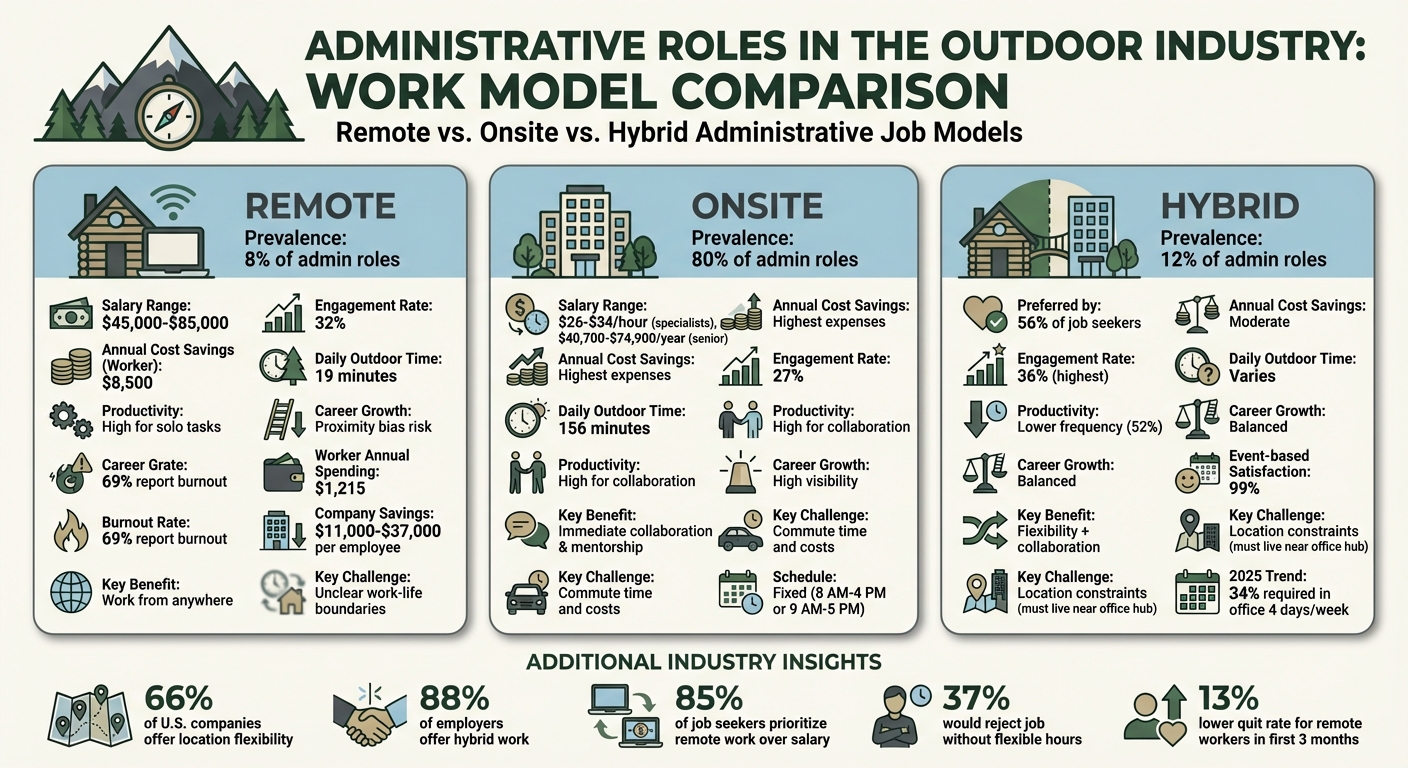
Remote vs Onsite vs Hybrid Admin Jobs in Outdoor Industry Comparison
Every work arrangement comes with its own set of trade-offs, and understanding these can help both employers and employees make informed decisions. For instance, remote administrative roles offer unmatched flexibility by cutting out daily commutes, which saves workers an average of $8,500 annually. However, this setup isn't without its challenges. Managers often prefer onsite staff for promotions due to proximity bias, and 69% of remote employees report burnout from unclear boundaries between work and personal life. Surprisingly, in the outdoor industry, remote employees spend only 19 minutes outdoors daily, compared to 156 minutes for their onsite counterparts.
Onsite roles, on the other hand, have their own perks and drawbacks. Immediate access to physical tools, spontaneous collaboration, and structured mentorship are all clear advantages. Plus, the separation between work and home life is more defined. But there’s a downside - onsite employees spend significant time commuting and report lower engagement levels, with only 27% feeling highly engaged, compared to 32% for remote workers.
Hybrid roles aim to combine the best of both worlds. These positions offer a mix of flexibility and face-to-face interaction. For example, 36% of hybrid employees report high engagement, and 99% express satisfaction with event-based office meetings, where they come in only for specific occasions rather than adhering to a fixed schedule. Still, hybrid roles have their challenges; they rank lowest in consistent productivity, with just 52% of hybrid workers reporting frequent productivity. These nuances help employers and job seekers align work models with individual and organizational priorities.
In the outdoor industry, remote work stands out for enabling employees to live closer to recreational areas, regardless of a company’s headquarters. However, some roles, like those involving physical gear management or facility oversight, still require an onsite presence. For companies, the financial appeal of remote work is hard to ignore - they save between $11,000 and $37,000 annually per remote employee, while remote workers themselves spend as little as $1,215 a year on essentials. Additionally, 85% of job seekers now prioritize remote work over salary, highlighting its growing importance in today’s workforce. These financial and lifestyle factors are reshaping how the outdoor industry approaches administrative roles.
| Feature | Remote | Onsite | Hybrid |
|---|---|---|---|
| Annual Cost Savings | $8,500 (worker) | Highest expenses | Moderate |
| Engagement Rate | 32% | 27% | 36% |
| Daily Outdoor Time | 19 minutes | 156 minutes | Varies |
| Career Growth Risk | Proximity bias | High visibility | Balanced |
| Productivity | High for solo tasks | High for collaboration | Lower frequency (52%) |
Conclusion
Your choice of work model should align with your career stage, lifestyle, and personal goals. For seasoned professionals who prioritize flexibility, remote roles can be a great fit. Meanwhile, onsite positions - still accounting for 80% of administrative jobs - are particularly beneficial for entry-level candidates, offering direct mentorship and hands-on collaboration opportunities. Hybrid arrangements, however, remain the most popular option, with 56% of job seekers favoring this balance.
The industry itself is adapting to these shifting preferences. For example, the outdoor industry has experienced a 35% rise in remote job availability since 2020. Whether you thrive in the independence of remote work, the structured environment of an office, or a mix of both, each option comes with distinct advantages tailored to specific roles.
Get Outdoor Jobs is a great resource, featuring thousands of listings from conservation organizations, adventure travel companies, and outdoor brands. With over 4,209 active roles currently available, the platform offers daily updates, customizable job alerts, and advanced filters to help you find positions that suit your ideal work model and lifestyle.
As administrative professionals navigate this evolving landscape, the abundance of options makes it easier than ever to build careers that align with personal values and aspirations. By identifying the work model that suits you best and leveraging the right tools, you can take meaningful steps toward securing your ideal role.
FAQs
Which outdoor admin tasks can be fully remote?
Many outdoor-related administrative roles can be done entirely remotely, offering the freedom to work from virtually anywhere. Tasks often include scheduling appointments, managing correspondence, data entry, customer service, booking management, and coordinating logistics.
Jobs like travel planners, marketing coordinators, and finance officers are commonly remote because they rely heavily on digital tools and online communication. These roles reflect the increasing shift toward remote work within the outdoor industry.
What skills and tools do remote admin jobs require?
Remote admin jobs in the outdoor industry call for a mix of strong organizational skills, clear communication, and effective time management. Success in these roles often hinges on being comfortable with digital tools such as email, shared calendars, and project management software.
Some essential tools include:
- Collaboration platforms like Slack and Zoom for team communication.
- Cloud-based document sharing tools such as Google Drive for easy access and file management.
- CRM systems for managing customer relationships and data.
To thrive in a remote environment, you’ll also need to be self-motivated and able to handle tasks independently while staying adaptable to changing priorities.
How can I avoid burnout and stay visible for promotions remotely?
Working remotely has its perks, but it can also blur the lines between work and personal life, leading to burnout if you're not careful. To keep your energy up and your career on track, it's essential to set boundaries and stay connected.
Start by defining clear work-life boundaries. This could mean designating a specific area in your home for work, avoiding work tasks in personal spaces, or setting strict start and end times for your day. Communication is another key area - let colleagues know when you're available and when you're not. And don’t forget to prioritize self-care, whether that’s taking breaks, exercising, or simply stepping away from screens.
Staying visible while working remotely is just as important. Make sure your contributions are noticed by sharing updates on your work, participating in team discussions, and building relationships with colleagues and leaders. Highlighting your achievements ensures that your efforts don’t go unnoticed, even from a distance.
Balancing productivity with your well-being is the real secret here. When you manage both effectively, you can continue to grow in your career while avoiding the stress and exhaustion that often come with overwork.