
How Conservation Apprenticeships Work

Conservation apprenticeships offer paid, hands-on training programs that combine fieldwork, classroom learning, and mentorship to prepare participants for careers in land management and natural resource stewardship. These programs are designed for young adults, recent graduates, and individuals from underrepresented communities, providing fair wages and career-building certifications.
Key highlights include:
- Paid Opportunities: Programs like the Westchester Land Trust offer $22/hour for summer apprenticeships.
- Skill Development: Training includes habitat restoration, trail maintenance, and prescribed fire management, with fieldwork making up 65% of the program.
- Career Advancement: Certifications like Public Lands Corps eligibility and mentorship from organizations such as the U.S. Fish & Wildlife Service help participants secure long-term roles.
- Program Durations: Ranges from 9 weeks to 11 months, with options for specialized tracks like forestry or ecological monitoring.
These apprenticeships are a practical gateway to outdoor careers, offering real-world experience, certifications, and networking opportunities. Platforms like Get Outdoor Jobs help candidates find and apply for these programs.
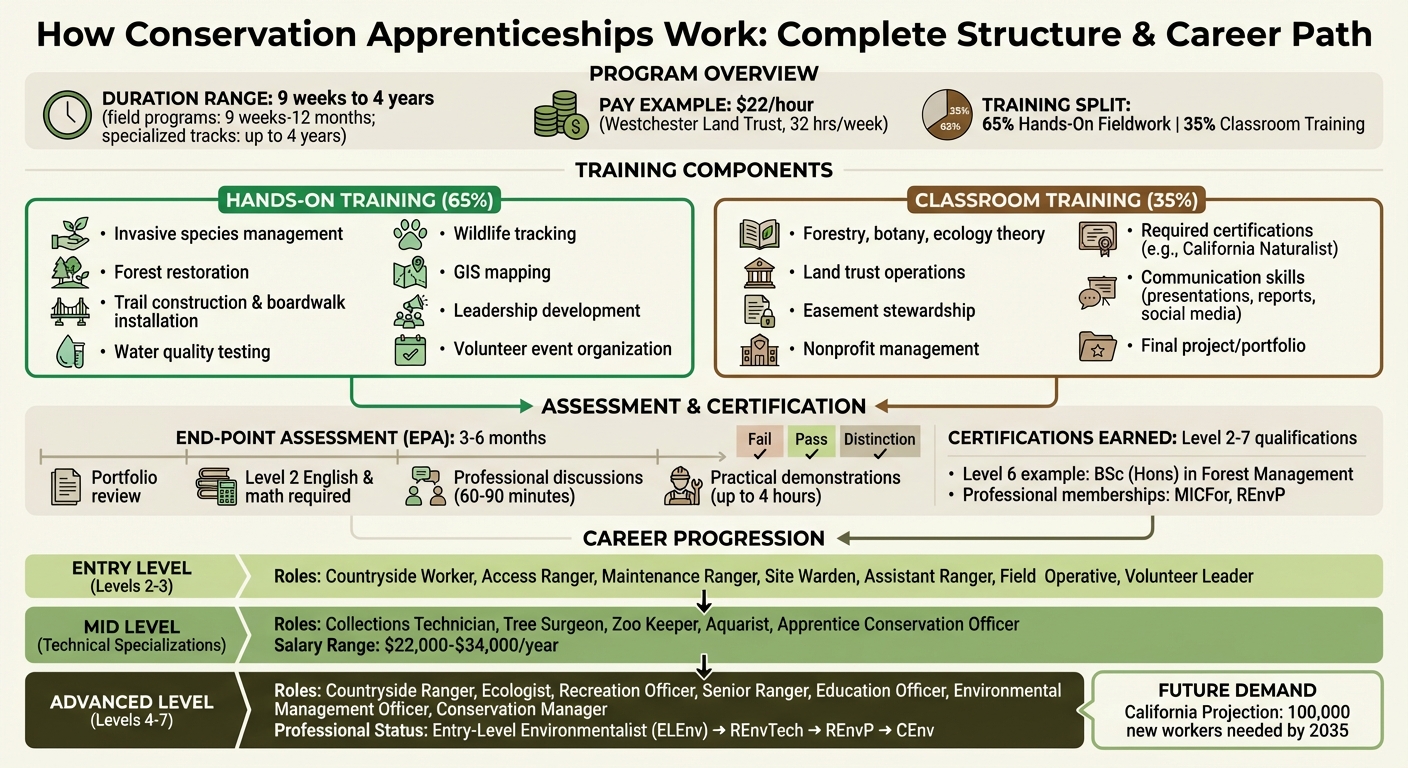
Conservation Apprenticeship Structure: Training Components and Career Pathway
How Conservation Apprenticeships Are Structured
Not sure what outdoor role fits you?
Take our 2-minute career quiz to get matched with outdoor jobs that align with your goals, salary target, and lifestyle.
Program Length and Experience Levels
Conservation apprenticeships vary widely in duration, ranging from short-term field programs to long-term specialized tracks. Field-based stewardship programs typically last between 9 weeks and 12 months, while more specialized paths, like art conservation, can stretch up to 4 years. For instance, the Westchester Land Trust began accepting applications in January 2026 for a 9-week paid Conservation Apprenticeship. This program, running from June through August 2026, offers $22/hour for a 32-hour work week. On the other hand, the All Hands Ecology Prescribed Fire Apprenticeship spans 11 months and has trained 15 participants since 2023, focusing on wildland fire management, leadership, and ecological skills.
The Forest Stewards Guild showcases how program lengths align with specific goals. In 2025, they conducted a year-long initiative in St. Paul, Virginia, emphasizing oak forest restoration and prescribed fire, alongside a shorter, 12-week program at New River Gorge National Park centered on ecological monitoring. Pre-apprenticeship programs, often designed for youth or career changers, typically last 6 to 7 months, combining 800 to 900 hours of training. Following these introductory phases, apprentices dive into immersive, hands-on experiences that emphasize practical skills.
Hands-On Training
Once program lengths and experience levels are determined, apprentices transition to intensive fieldwork. This practical component forms the backbone of most conservation apprenticeships, making up 65% of the total program time. Participants collaborate closely with professionals from organizations such as the National Park Service, U.S. Forest Service, and state conservation agencies, gaining skills through real-world projects.
Field tasks are diverse and challenging. At Westchester Land Trust, apprentices focus on invasive species management and forest restoration. The Redwoods Rising program, which plans to hire 14 apprentices for the 2026 season, assigns participants to specialized tracks like forestry, aquatics, ecological monitoring, and road management. Activities such as trail construction and boardwalk installation help develop tool and carpentry skills, while technical tasks like water quality testing, wildlife tracking, and GIS mapping enhance scientific expertise.
Many programs also emphasize leadership development, with apprentices organizing volunteer events or spearheading community outreach efforts. This leadership training equips participants for advanced roles within the field.
Classroom Training
To balance the hands-on experience, apprenticeships include structured academic instruction, which accounts for 35% of the program schedule. This classroom component provides the theoretical knowledge needed to support fieldwork. It enables participants to apply academic concepts from areas like forestry, botany, and ecology to on-the-ground restoration projects.
Beyond technical training, apprentices gain a broad range of professional skills. At Westchester Land Trust, for example, they learn about land trust operations, easement stewardship, and nonprofit management. Many programs also require certifications, such as California Naturalist training, to prepare apprentices for roles in state and national parks. Communication skills are another key focus, with participants creating presentations, writing reports, managing social media, and contributing to newsletters.
Dr. Erin Kelly, a professor at Cal Poly Humboldt, highlighted the holistic benefits of this approach:
"Apprentices... have the opportunity to apply their academic skills out in the field and they return from their apprenticeships full of knowledge of and love for the ecosystems they will one day steward".
Most programs culminate in a final project or portfolio, helping apprentices develop critical thinking and project management skills essential for advancing their careers.
sbb-itb-9d004f0
Mentorship and Support
What Supervisors Do
Supervisors handle technical training and prioritize team safety. Crew Leaders take charge of field operations, deciding on weather-related safety measures, equipment usage, and teaching crucial skills like trail building, habitat restoration, and prescribed fire techniques. For instance, at the Student Conservation Association's Cleveland Urban Green program, Crew Leaders - aged 21 and older - have been guiding high school and young adult crews since 2015. Their work focuses on urban forestry and habitat restoration projects throughout Northeast Ohio.
Beyond field training, supervisors introduce apprentices to the inner workings of conservation organizations. At the Westchester Land Trust’s 2026 program, two apprentices collaborate closely with the stewardship team. They gain experience leading volunteer events and completing impactful final projects. Additionally, they shadow staff in areas like fundraising, community outreach, and nonprofit management to better understand the operational side of conservation work.
"The apprenticeship was a beautiful training ground. Being a practitioner really means putting foundational skills into practice. Stepping into leadership is a big part of what's drawing me back." - Chase Whitener, Prescribed Fire Practitioner, All Hands Ecology
While supervisors guide the day-to-day, broader mentorship ensures support extends well beyond fieldwork.
Additional Mentor Support
Apprentices benefit from long-term mentorship provided by senior conservation leaders and specialists. A great example is the U.S. Fish & Wildlife Service's MENTOR program. From April 4–19, 2024, 12 international Fellows participated in a Manizales workshop focused on "One Health" strategies for bat–human coexistence. This mentorship doesn’t end with the workshop - it continues throughout the Fellows’ careers, offering ongoing guidance and support.
Financial backing for professional development further strengthens this mentorship model. The Placer Resource Conservation District’s Forestry and Natural Resources Career Mentorship Program, launched in 2022 with a $250,880 CAL FIRE grant, provides students with up to $600 per academic year to cover travel, conference fees, and lodging for forestry-related events. Over nine months, students are paired with mentors and gain access to resume workshops, career panels, and live job listings. This mix of personal mentorship and practical resources equips apprentices with the tools and connections they need for lasting career growth.
Testing and Certification
End-Point Assessment
The End-Point Assessment (EPA) is the final step in confirming an apprentice’s skill mastery. Before this stage begins, employers ensure that apprentices have met all prerequisites, including completing their portfolio, achieving Level 2 English and math, and fulfilling the required training hours.
"End-point assessment (EPA) is the final stage of an apprenticeship. It provides an objective evaluation of an apprentice's knowledge, skills, and behaviours to confirm that they are fully competent in their occupational role." - Icon (Institute of Conservation)
The EPA is conducted by independent organizations, such as the Institute of Conservation, and typically spans three to six months. It includes role-specific evaluations like professional discussions and practical demonstrations. For instance, a Collections Technician participates in a 60-minute discussion featuring at least 10 portfolio-based questions and a project presentation. On the other hand, a Stained Glass Craftsperson undergoes a 90-minute discussion followed by a 4-hour practical observation, covering 24 key skills.
Assessments are graded as Fail, Pass, or Distinction. To earn an overall Distinction, apprentices usually need to achieve Distinction in every individual component. If a component is failed, apprentices can resit the assessment after addressing identified gaps with their employer.
Upon passing the EPA, apprentices formally document their skills and knowledge through industry-recognized certifications.
Certifications Earned
Apprentices who successfully complete their programs earn certifications ranging from Level 2 to Level 7 qualifications. Some higher-level apprenticeships also include academic degrees. For example, the Level 6 Professional Forester apprenticeship awards a BSc (Hons) in Forest Management in addition to the apprenticeship certificate.
These certifications pave the way for professional recognition. Graduates of the Professional Forester apprenticeship, for instance, can apply for membership with the Institute of Chartered Foresters (MICFor). They can also register as a Registered Environmental Practitioner (REnvP) through the Society for the Environment using a streamlined application process. These credentials not only validate expertise but also enhance career prospects in conservation and related fields.
Career Options After Completing an Apprenticeship
Typical Job Roles
Completing an apprenticeship can open doors to a variety of roles in conservation. For those starting out (Levels 2–3), positions like Countryside Worker, Estate Worker, Access Ranger, Maintenance Ranger, Site Warden, Assistant Ranger, Field Operative, and Volunteer Leader are common. These roles often involve hands-on work in national parks and protected areas across the U.S., offering a chance to immerse yourself in preserving natural landscapes.
For more specialized technical roles, additional training is often required. Examples include Collections Technician (focused on artifact care and preventive conservation), Stained Glass Craftsperson, Tree Surgeon, Zoo Keeper, and Aquarist. Take Jade, a 20-year-old apprentice from Cumbria, as an example. She now works as an Apprentice Conservation Officer, conducting grey seal surveys and managing volunteer programs. She shares:
"Being an apprentice conservation officer, my job really is to try and get as many people engaged in nature as possible and doing an apprenticeship like this... means that I can try every different area of this job out".
For those pursuing advanced roles (Levels 4–7), career paths expand to positions like Countryside Ranger, Ecologist, Recreation Officer, Senior Ranger, Education Officer, Environmental Management Officer, and Conservation Manager. Salaries for these roles can vary; for example, Countryside Officers typically earn between $22,000 and $34,000 annually. Emerging fields also offer exciting opportunities. The All Hands Ecology prescribed fire apprenticeship, launched in 2023, has already hired 15 apprentices, with one graduate, Chase Whitener, advancing to a Prescribed Fire Practitioner role by 2025.
Major employers in conservation include organizations like the National Trust, Wildlife Trusts, Rivers Trusts, local councils, National Park Authorities, and private estates. Apprenticeships not only provide an entry into these organizations but also lay a foundation for long-term career growth.
Continuing Education and Advancement
Apprenticeships offer more than just job training - they create clear pathways for career progression. For instance, completing a Level 2 Countryside Worker apprenticeship qualifies graduates for Entry-Level Environmentalist (ELEnv) status through the Society for the Environment. This three-year designation can lead to higher professional registrations like Registered Environmental Technician (REnvTech), Registered Environmental Practitioner (REnvP), or even Chartered Environmentalist (CEnv).
Higher-level apprenticeships often combine academic degrees with practical experience. For example, the Level 6 Professional Forester apprenticeship includes a BSc (Hons) in Forest Management, while Level 7 programs can lead to a Master’s degree in areas like Cultural Heritage Conservation. These programs allow individuals to advance their careers without taking on student debt, making them an attractive option for many.
Looking ahead, the demand for skilled workers in nature-based careers is growing. A 2023 report from California's Natural Resources Agency predicts the state will need 100,000 new workers in this field by 2035. This highlights the long-term potential for those pursuing careers through apprenticeships in conservation.
How to Find Conservation Apprenticeships
Using Get Outdoor Jobs

Finding the right conservation apprenticeship can feel overwhelming, but Get Outdoor Jobs simplifies the process. This platform gathers thousands of conservation-related job listings across the United States, updating them daily. It’s a one-stop shop for discovering opportunities tailored to your interests. You can refine your search using filters like location, job type (remote, hybrid, or onsite), salary range, and entry-level roles. Keywords such as "apprentice", "corps", or "trainee" can help narrow results further, and you can even set up email alerts to stay on top of new postings.
The site offers a free plan showing the 10 most recent listings. For those who want more, a premium subscription unlocks access to the entire job database.
When reviewing listings, pay attention to important details like compensation (hourly pay versus living allowances), whether housing or field equipment is provided, the program’s duration (which can range from 9 weeks to 2 years), and the mix of fieldwork and office tasks. Federal agency roles, such as those with the National Park Service or Forest Service, may include tags like "Direct Hire Authority" or "Public Land Corps." These tags are worth noting, as they can streamline the hiring process. Additionally, check whether programs offer certifications that could boost your qualifications.
Once you’ve identified opportunities that excite you, the next step is crafting an application that stands out.
Application Tips
To strengthen your application for a conservation apprenticeship, focus on avoiding common mistakes and tailoring your materials to each program. Did you know that around 22% of applications are rejected for simple errors, like misspelling the organization's name or skipping key instructions? For positions with federal agencies, such as the National Park Service or Forest Service, keep your resume concise - no more than two pages. Federal hiring managers as of 2025 prefer shorter, focused formats.
Carefully read the application requirements and use the STAR technique (Situation, Task, Action, Result) to highlight relevant experiences. Whether it’s volunteer work, school projects, or outdoor activities, frame your skills in a way that matches the job description. For example, if the role emphasizes trail maintenance, public outreach, or GIS mapping, make sure your application reflects those abilities.
Many programs actively seek applicants from underrepresented communities, including BIPOC and LGBTQ+ individuals, so don’t hesitate to apply even if your background doesn’t include traditional conservation experience. Just ensure you meet the basic requirements, such as age limits (usually 18–30, or up to 35 for veterans in federal roles), educational qualifications, and any specific driving record standards.
What is the Natural Areas Conservation Training Program?
Conclusion
Conservation apprenticeships provide a practical route into outdoor careers by blending hands-on fieldwork with structured training and mentorship. Whether your focus is prescribed fire management, habitat restoration, or land management, these programs equip you with essential skills, certifications, and industry connections to build a career in conservation.
But the advantages go beyond skill-building. Paid positions, like the Westchester Land Trust's 2026 program offering $22 per hour, help break down financial barriers that have often made conservation work inaccessible. These apprenticeships offer valuable experience, mentorship, and networking opportunities that are hard to find through more traditional career pathways.
If you're ready to explore these opportunities, check out platforms like Get Outdoor Jobs. It’s a centralized resource for finding conservation apprenticeships across the U.S., with tools to help you align programs with your career goals and interests.
FAQs
What does a typical day in a conservation apprenticeship look like?
A day in a conservation apprenticeship is a mix of hands-on work and learning. You might find yourself restoring habitats, clearing out invasive plants, or building trails - often starting early and working outdoors with tools like saws and mattocks. Some programs also dive into areas like managing preserves, understanding nonprofit operations, or coordinating volunteers. Along the way, apprentices benefit from mentorship, build practical skills, and gain the kind of experience that sets them up for careers in conservation.
What certifications will I earn, and do they help with federal jobs?
Conservation apprenticeships often come with certifications that can strengthen your qualifications for federal positions. For example, completing a forestry program might set you up for opportunities with the U.S. Forest Service. Similarly, wildland firefighter apprenticeships often lead to journey-level status. These certifications align with federal standards, demonstrating the hands-on skills and expertise needed for conservation and resource management jobs. This can make you a more competitive candidate for roles within government agencies.
How can I tell if an apprenticeship is a good fit for my career goals?
To figure out if a conservation apprenticeship fits your goals, take a close look at its structure and the tasks involved. Look for programs that offer paid training alongside practical experience in areas like habitat restoration or species monitoring. A strong mentorship component and clear milestones for progress are key indicators of a good program. Make sure it equips you with the skills and opens up career opportunities in fields such as land management, research, or community outreach - areas that align with your long-term plans.