
AMGA Instructor Training: Continuing Education Tips

Staying certified as an AMGA instructor requires planning, commitment, and organization. Whether you're a Single Pitch Instructor (SPI), Climbing Wall Instructor (CWI), or pursuing advanced certifications, ongoing education is key to maintaining safety, meeting professional standards, and advancing your career. Here's what you need to know:
- Certification Renewal: Most certifications are valid for three years. To renew, you must maintain an active AMGA membership, hold a valid first aid certification, and complete required assessments or upgrades.
- Deadlines and Costs: SPI exams must be completed within two years of the course. Certification renewal options include a two-day exam ($375–$525) or upgrading to a higher-level course.
- Medical Certification: Your AMGA certification becomes invalid if your Wilderness First Responder (WFR) or equivalent lapses.
- Planning CE: Build a multi-year plan to balance AMGA-specific courses, external certifications (e.g., avalanche training), and professional development.
- Tracking Records: Keep detailed documentation of certifications, completion dates, and CE credits to ensure smooth recertification and strengthen job applications.
Tip: Schedule training early in your recertification cycle to avoid last-minute stress and align your courses with career goals. AMGA certifications are recognized in over 20 countries, making them a valuable credential for professional guides.
This guide breaks down how to manage your timeline, select courses, and track records effectively.
AMGA Single Pitch Instructor Course
Not sure what outdoor role fits you?
Take our 2-minute career quiz to get matched with outdoor jobs that align with your goals, salary target, and lifestyle.
AMGA Recertification Requirements Explained
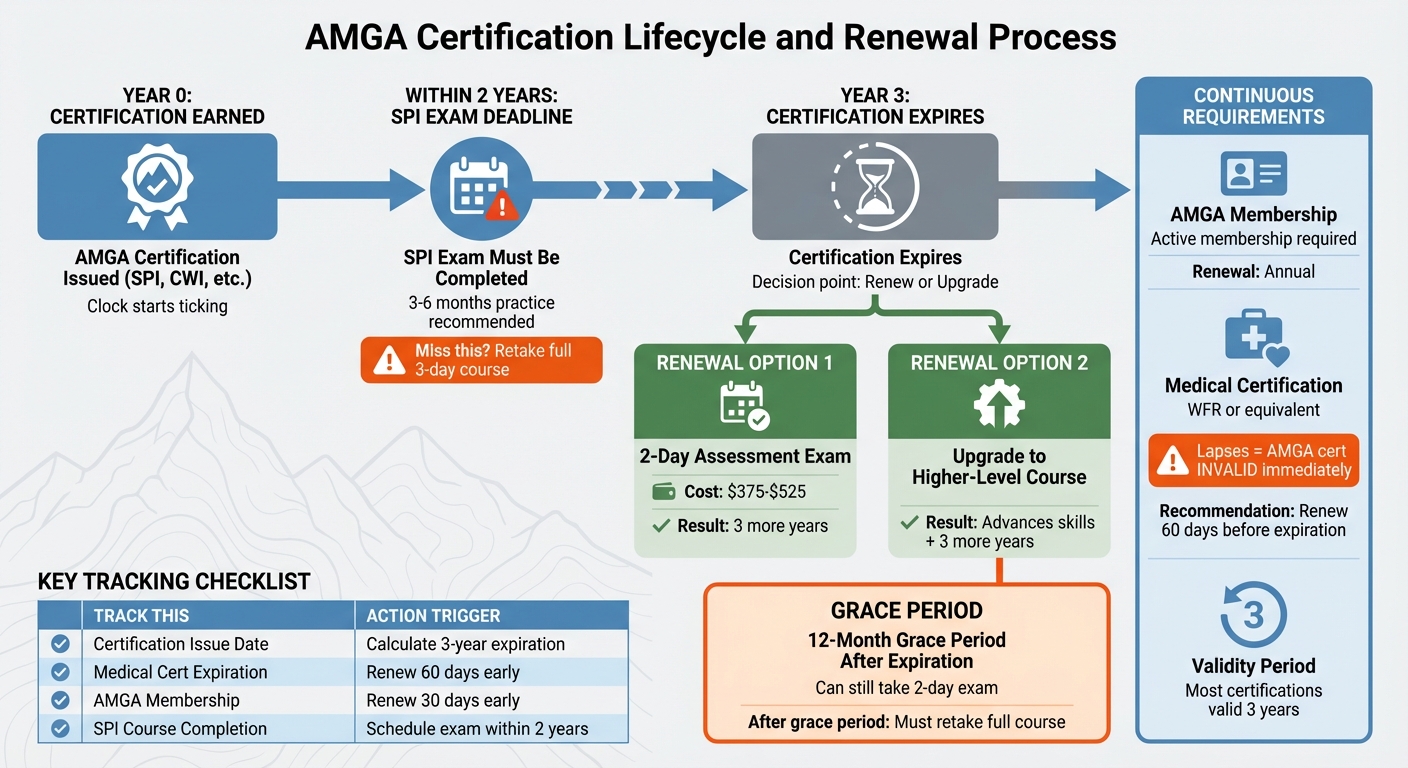
AMGA Certification Timeline and Renewal Requirements
Understanding your AMGA certification expiration and renewal process is key to staying on top of your professional qualifications. Most AMGA instructor certifications, like the Single Pitch Instructor (SPI) and Climbing Wall Instructor (CWI), are valid for three years. However, to keep your certification active, you must maintain an active AMGA membership and hold a valid first aid certification suitable for your work environment. These are the baseline requirements for managing your certification renewal and meeting critical deadlines.
The clock starts ticking on your certification’s validity as soon as it’s issued. For example, after earning your SPI certification, you must pass the SPI exam within two years. Failing to meet this deadline means you'll need to retake the entire three-day course.
Certification Validity Periods and Renewal Options
When your certification expires, you have two main options to renew it. You can either retake the two-day assessment exam, which costs between $375 and $525, or you can upgrade by completing a higher-level course. Upgrading not only advances your skills but also extends your lower-level certification for another three years.
If your certification has already expired, you have a 12-month grace period to pass the two-day exam. Once that window closes, you'll need to retake the full course to regain your certification.
It’s also crucial to keep your medical certification up to date. If your Wilderness First Responder (WFR) or an equivalent credential lapses, your AMGA certification becomes invalid immediately - no matter where you are in your three-year cycle.
Creating Your Recertification Checklist
To stay organized, create a detailed checklist to track your deadlines and avoid last-minute surprises. A simple tracking system can help you manage key dates like certification expiration, exam deadlines, medical certification renewals, and membership renewal dates. Here’s what to include:
| Item to Track | What to Record | Action Trigger |
|---|---|---|
| Certification Issue Date | Date you passed your exam | Calculate the 3-year expiration date |
| Medical Certification Expiration | WFR or equivalent expiration date | Renew at least 60 days before expiration |
| AMGA Membership | Annual membership renewal date | Renew about 30 days before expiration |
| SPI Course Completion | Date you completed the course (if pending certification) | Schedule your exam within the two-year window |
Once you complete an advanced AMGA course, it’s a good idea to contact the AMGA national office. This ensures your records are updated to reflect the new three-year validity period for your lower-level certifications. Keeping your records accurate prevents any administrative issues that could disrupt your professional status.
Building a Multi-Year Continuing Education Plan
Planning your continuing education (CE) over a three-year cycle can save you from last-minute stress. Instead of treating CE as a task you scramble to complete, map out your training in advance. This ensures you're always prepared, with no surprises from expiring credentials or unmet prerequisites for advanced courses.
Balance formal AMGA courses with external certifications. For instance, if you're working toward the IFMGA pathway, you'll need to schedule courses in Alpine, Rock, and Ski disciplines while keeping up with external certifications like Wilderness First Responder (WFR) and Professional Avalanche Training 2. Spread these commitments across your three-year cycle - focus on an AMGA-specific course in one discipline one year, refresh your medical or avalanche credentials the next. Let’s dive into how to plan your CE activities effectively within your recertification cycle.
Scheduling CE Within Your Recertification Cycle
Scheduling key training early in your cycle is a smart move. This gives you extra time in case courses fill up or unexpected issues like weather, injury, or work conflicts arise. For example, the SPI exam must be taken within two years, so aim to take it six months before the deadline. Most candidates spend three to six months practicing their skills between the initial course and the exam.
Timing your medical certifications is just as important. Your AMGA certification becomes invalid the moment your WFR or equivalent credential expires. To avoid disruptions, plan your WFR recertification at least six months before it lapses.
Combining AMGA and External Training
You can meet multiple requirements by blending AMGA and external courses. For example, if you're an AIARE instructor, AMGA courses in Ski, Alpine, or Ice disciplines can count toward the annual eight-hour AIARE CE requirement, as they’re pre-approved non-AIARE options. This dual-credit strategy helps maximize the value of your training.
Between formal courses, take advantage of low-cost resources like AMGA videos and bulletins to stay updated on technical systems and Scope of Practice changes. AIARE also offers free virtual workshops and webinars for instructors, which can partially fulfill annual CE requirements without adding travel expenses. Use these options to maintain your skills and stay current without breaking the bank.
Comparing CE Options with Simple Tables
When deciding between different CE pathways, comparison tables can help you weigh factors like cost, time commitment, and recertification credit. These visual tools make it easier to prioritize training that aligns with your career goals and budget.
| CE Category | Examples | Purpose | Requirement Level |
|---|---|---|---|
| AMGA-Specific | Rock Guide Course, Alpine Exam, Ice Instructor Program | Skill development and certification advancement | Mandatory for AMGA credentials |
| External Safety | Wilderness First Responder (WFR), CPR | Medical response and emergency management | Mandatory for IFMGA status |
| External Technical | Professional Avalanche Training 2 | Terrain-specific risk management | Mandatory for Ski and Alpine tracks |
| Professional Development | Leadership programs, Technical Videos, Guide Bulletins | Staying current with industry standards | Recommended for career growth |
sbb-itb-9d004f0
Selecting Continuing Education Courses That Matter
Picking the right continuing education (CE) courses can sharpen your skills, fulfill recertification requirements, and open doors in your career. The most effective courses not only enhance practical abilities that employers seek but also align with your long-term goals. Let’s break down the main CE categories and key factors to help you choose courses that fit seamlessly into your recertification plan.
Common CE Categories for AMGA Instructors
For AMGA instructors, CE courses typically fall into four main categories:
- Technical Skills: These include areas like movement systems, splitboarding, and winter weather forecasting.
- Socio-Emotional Training: Topics such as inclusive group management and psychological first aid fall under this category.
- Leadership Development: Courses focusing on field management and risk frameworks help instructors grow as leaders.
- New Instructor Development: Subjects like work season planning and wage negotiations support those just starting out.
Virtual CE options have also become a popular and effective way to build skills. For example, AIARE transitioned to offering virtual workshops exclusively for the 2025–26 season, making them free for instructors.
How to Assess Course Quality and Fit
When evaluating a course, start by checking the provider’s accreditation. Courses offered by AMGA-accredited businesses adhere to recognized industry standards for safety and ethics. Dig into the syllabus to confirm it covers essential topics like risk management, instructional techniques, and terrain assessment.
Also, make sure the prerequisites align with your experience. For instance, most SPI courses require participants to be at least 18 years old, have a minimum of 12 months of climbing experience, and have led at least 15 traditional rock routes. If you’re considering a virtual course, check that it qualifies for CE credit. The goal is to find courses that not only meet industry standards but also align with your recertification checklist.
Choosing CE That Improves Your Job Prospects
Once you’ve narrowed down your options, focus on CE courses that directly enhance your employability. As recertification requirements shift, so do employer expectations, making it crucial to stay ahead. Choose courses that address current industry needs. For instance, in 2026, Alpine Ascents International introduced a new hiring policy requiring guide applicants to complete - or plan to complete - specific AMGA courses such as the Alpine Guide Course, Alpine Snow & Glacier Module, or the Alpine Skills Course during their first summer on the job. This initiative, overseen by Guide Manager Mary Brown, ensures high technical standards for programs on Mt. Rainier and in the North Cascades.
"Guide applicants must have already completed, or have a plan to complete, the AMGA Alpine Guide Course, Alpine Snow & Glacier Module, or the Alpine Skills Course during their first summer of employment to be considered for guiding positions." – Alpine Ascents International
Additionally, professional-level avalanche training (Pro 1), Level 2 Leave No Trace certification, and advanced rope rescue skills are frequently listed in job descriptions and can make you stand out. Platforms like Get Outdoor Jobs can help you identify the most in-demand qualifications. If you notice skill gaps, prioritize CE courses that address them. Furthermore, training in adaptive instruction and inclusive teaching methods is becoming increasingly important as the industry places more emphasis on accessibility and diversity.
Tracking and Submitting Your Continuing Education Records
Keeping a detailed record of your continuing education (CE) is essential for hassle-free recertification and can give you an edge when applying for jobs. Beyond ensuring compliance, an organized CE record highlights your commitment to professional growth and sets you apart in a competitive job market.
Setting Up a CE Record-Keeping System
Start by creating a digital folder to store electronic copies of all your certificates, especially key ones like Wilderness First Responder (WFR), CPR, and Professional Avalanche Training credentials. Pair this with a tracking spreadsheet to log important details such as the provider, course title, completion date, credit hours, and associated costs. To ensure these critical documents are secure, use a cloud-based backup solution. This system not only helps you stay on top of your recertification cycle but also keeps track of expiration dates, so your certifications remain current without any interruptions.
Submitting CE Documentation to AMGA
When it's time to submit your CE records to the American Mountain Guides Association (AMGA), double-check that each certificate includes your full name, course title, completion date, credit hours, and the provider's name. For credits earned through AMGA events - like the 23 AMA PRA Category 1 Credits™ offered at the 2025 AMGA Annual Conference - make sure to update your professional profile with the necessary documentation during the annual dues cycle. Most instructors handle this by logging into their professional profile on amga.com to upload proof of completion. If you're considering enrolling in external training, review AMGA's policies beforehand to ensure the course qualifies for CE credit. Remember, documentation must confirm full completion within your current certification period.
Using CE Records to Strengthen Job Applications
A well-maintained CE record does more than just fulfill recertification requirements - it can significantly enhance your job applications, especially on platforms like Get Outdoor Jobs. By detailing the technical skills you've mastered (e.g., anchoring, rescue techniques, and site management) and your experience across various terrains (granite, sandstone, gneiss), you showcase your readiness for the challenges of professional guiding.
"The SPI program... is often seen as the gateway credential for climbers who want to work professionally in a single pitch environment".
Going beyond the minimum prerequisites by documenting your teaching experience - through lesson plans and detailed records of topics covered - further highlights the "structured, professional framework" that guide companies value when selecting candidates.
Conclusion
Keeping up with your AMGA continuing education is key to building a strong and lasting career. By managing your timeline, selecting the right CE courses, and maintaining detailed records, you position yourself as a dedicated professional who takes their craft seriously. AMGA certifications are among the most respected guide qualifications in the U.S., and they unlock opportunities in over 20 countries through IFMGA recognition.
Top instructors view continuing education as an investment in their future. Planning your training 3–6 months in advance and aligning courses with your career goals ensures you remain competitive in a field of more than 22,000 AMGA-trained professionals. Whether you're progressing from Single Pitch Instructor to Rock Guide, choosing the right courses gives you the tools to stay ahead.
Maintaining thorough CE records is equally important. When applying for positions on platforms like Get Outdoor Jobs, a well-documented training history demonstrates your commitment to growth and excellence. Employers across guide services, climbing gyms, and outdoor programs consistently prioritize candidates who keep their certifications current and actively pursue skill development.
"AMGA certifications in rock, alpine, and ski are the most respected guide qualifications in the United States and open doors for a lifetime of exciting and fulfilling work as a guide." - AMGA
FAQs
How can I renew my AMGA certification?
To keep your AMGA certification active, here’s what you need to do:
- Check your certification status: Confirm that your certification is either still valid or expired within the last 12 months. If it’s been more than a year, you’ll have to retake the program instead of renewing.
- Complete your Continuing Professional Development (CPD) hours: Accumulate the required CPD credits by participating in approved courses, workshops, or similar activities. These credits are tracked in your AMGA member portal, so make sure everything is up to date before the renewal deadline.
- Submit your renewal application: Log in to your AMGA account to upload proof of your completed CPD hours. Also, verify that your liability insurance and membership are current, then pay the renewal fee (in U.S. dollars). Once everything is processed, your updated certification will be issued.
Following these steps ensures your certification stays current, allowing you to continue working as a guide or instructor across the U.S. without interruptions.
What’s the best way to plan my continuing education for AMGA recertification?
To plan your AMGA continuing education effectively, start by checking your myAMGA dashboard for your recertification requirements and deadlines. Take note of the exact number of continuing education (CE) hours you need and mark your recertification deadline on your calendar. From there, work backward to create a timeline that includes courses, field practice, and assessments.
Browse the AMGA course catalog to find programs that satisfy your credit requirements. Whether your focus is rock, alpine, ski, or climbing instruction, pick courses that fit your schedule and learning style. Options include in-person, online, or hybrid formats. If your schedule is tight, online or self-paced courses can offer the flexibility you need to stay on track.
Keep all your records - completed courses, certificates, and any scholarships - in one organized location, like a spreadsheet or your myAMGA dashboard. Review your progress every few months to ensure you’re on target, and consider scheduling an extra course as a backup in case of cancellations or last-minute changes. Staying organized and proactive will make meeting your recertification goals much smoother.
What should I do if my Wilderness First Responder certification expires?
If your Wilderness First Responder (WFR) certification has expired, it’s no longer valid, and you’ll need to complete a recertification course to restore it. There are a couple of options available: an in-person course or a hybrid version that blends online learning with hands-on training.
To prevent any gaps in your certification, it’s smart to plan ahead and sign up for a recertification course before your current one runs out. Keeping your certification current not only meets AMGA requirements but also ensures your skills stay sharp and ready for action when needed.