
Impact of Climate Change on Outdoor Careers

Climate change is already changing outdoor jobs in the U.S. If you work outside, the main risks are clear: more heat, more smoke, shorter snow seasons, and less stable work calendars.
I’d sum it up like this: outdoor careers are splitting into two paths. Some jobs are getting harder to do, less steady, or shorter by season. Others are growing because employers need people to handle heat, fire risk, land repair, and year-round site management.
Here’s the short version:
- About 45 million U.S. workers spend time working outdoors.
- Heat cuts work time and safety, with some regions losing up to 2 hours from a workday.
- By mid-century, outdoor worker earnings at risk from heat could reach $39.3 billion per year.
- Snow-dependent jobs face shorter seasons, with some winter recreation seasons projected to shrink 20% to 60% by 2090.
- National park busy seasons are shifting, often moving earlier and stretching into spring and fall.
- Wildfire smoke can shut down field work fast, while also hurting worker health.
- Earlier shifts, clear stop rules, and mixed season work can cut a large share of job risk.
If you’re in guiding, parks, resorts, conservation, or field work, the message is simple: the work is still there, but the conditions are changing. The jobs with the most pressure are tied to fixed snow seasons or heavy summer exposure. The jobs with more staying power are tied to land care, climate planning, and year-round site work.
Not sure what outdoor role fits you?
Take our 2-minute career quiz to get matched with outdoor jobs that align with your goals, salary target, and lifestyle.
| Job area | What’s changing | What it can mean for workers |
|---|---|---|
| Winter recreation | Less snow, shorter seasons | Fewer winter-only work weeks |
| Parks and tourism | Visitor peaks shift earlier or into fall | Hiring dates may move |
| Field and conservation work | More heat and smoke days | More delays, shorter shifts, more safety rules |
| Climate-focused roles | More planning and land-repair work | More demand for year-round roles |
So if I were reading this for career planning, I’d take away one point first: outdoor work is not disappearing, but it is becoming less predictable unless employers change schedules, seasons, and job design.
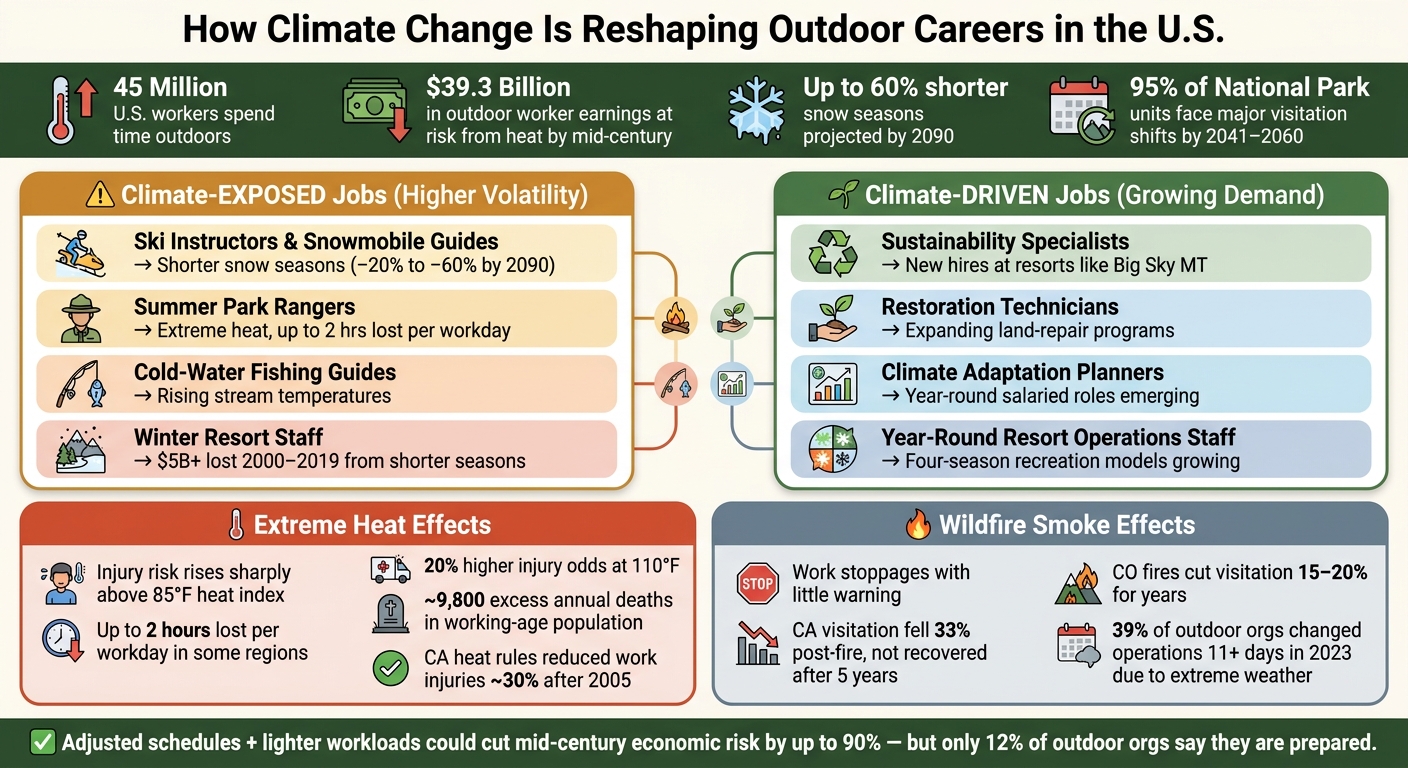
Climate Change Impact on Outdoor Jobs: At-Risk vs. Growing Careers
Scope and Methods of the Research
The studies in this summary use several methods to show how climate change is changing outdoor work. The summary pulls from climate models, visitation studies, economic analysis, occupational exposure research, and workforce reports.
Climate models rely on statistically downscaled data at 4-km resolution when scaled down from global models such as CMIP5. They compare a 1971–2000 historical baseline with mid-century (2036–2065) and late-century (2070–2099) results under RCP 4.5 and RCP 8.5 scenarios. Visitation studies take two main paths: revealed preference methods, which connect past visitation to weather patterns, and stated preference methods, which ask visitors how they expect to behave in the future. Economic analysis then turns those shifts into earnings-at-risk estimates using projected unsafe workdays and median annual earnings.
Study Types and U.S. Regions Covered
The research centers on a small set of high-risk regions where outdoor jobs are especially exposed to shifting seasons and weather. Heat-exposure studies focus on the South, with special attention to Texas, Florida, and Louisiana. Those three states account for 81.7% of estimated occupational heat exposure events while representing 36.5% of the workforce. Recreation and tourism studies focus on the Northeast and Intermountain West, especially Maine, Vermont, and Utah, where snow-based and warm-season economies are highly climate-sensitive. Most studies compare post-2000 conditions with near- and mid-century results for weather-sensitive outdoor jobs.
There are also limits in how these studies measure risk. Heat index values assume shade, yet OSHA notes they can run up to 15°F higher in direct sun. In plain terms, that means actual exposure may be higher than the models show. Standard datasets also tend to miss self-employed, contract, and informal outdoor workers. On top of that, workers facing economic strain are less likely to report heat-related illness at all. Those gaps matter most when the article moves into heat, smoke, and seasonal job disruption.
sbb-itb-9d004f0
How Changing Seasons Are Shifting Outdoor Employment
Climate change is changing the outdoor work calendar. Winter is getting squeezed, while spring and fall are stretching out. That affects when employers hire and how long seasonal jobs last.
Winter Sports Jobs and Shorter Snow Seasons
Snow-based jobs are taking some of the hardest hits. Ski area staff, snowmobile guides, and instructors all depend on a winter season that starts on time and lasts long enough to support steady work. That window is getting smaller. Between 2000 and 2019, U.S. ski areas lost more than $5 billion from shorter seasons, fewer visits, and higher snowmaking costs.
The long-range picture points the same way. In the mountains of western Wyoming and Montana, the share of precipitation that falls as snow is expected to drop by 25% by 2100. In those same areas, the cross-country skiing and snowmobiling season could shrink by 20% to 60% by 2090 under higher-emissions scenarios.
The U.S. Climate Resilience Toolkit puts it plainly: rising temperatures mean less snow and shorter seasons for skiing and snowmobiling. Snowmaking can help, but only up to a point. Resorts need cold nights to make snow, and as temperatures climb, those nights become less common. So even resorts that invest in snowmaking can’t fully make up for lost natural snow.
That’s why many mountain resorts are adding warm-weather activities like mountain biking, hiking, and zip-lining. The goal is simple: keep people employed beyond winter and turn ski resorts into year-round destinations. As snow seasons shrink, summer and shoulder-season business matters more.
National Parks and Shifts in Warm-Season Visitation
National parks are also seeing their busy seasons move on the calendar. From 1979 to 2008, peak visitation in many U.S. parks shifted an average of 4.6 days earlier, and that pattern is still speeding up. Looking ahead, 95% of U.S. National Park Service units are expected to see major visitation shifts by 2041–2060. Peak seasons are projected to grow by 13 to 31 days, mostly into spring and fall.
For hiring, that means parks may need staff earlier in the year and later into the fall. At the same time, some parks could see summer visitation fall by as much as 28% by 2050 under higher-emissions scenarios. So staffing plans may have to stretch in some months and pull back in others.
These shifts don’t look the same everywhere. A park with milder spring weather may gain visitors. A park facing punishing summer heat may lose them.
Regional Differences in Season Length and Job Stability
For outdoor workers, the big issue is stability. Some places may get longer working seasons. Others may lose the steady weather patterns that seasonal jobs depend on.
| Region | Projected Season Change | Job Effect |
|---|---|---|
| Northeast (Vermont) | Shorter, more variable winters; longer spring/fall | Shift toward year-round climate-ready roles; risk to snow-dependent jobs |
| Western U.S. (UT, CO, CA) | Severe snow drought; wildfire smoke closures | High instability for ski/snowboard instructors; reduced summer field work hours |
| Northern Great Plains (WY, MT) | 20%–60% shorter snow season by 2090 | Risk to winter-only roles; growth in year-round roles |
| Southern U.S. / Desert Parks | Longer, more extreme summers | Increased demand for winter/spring staffing; higher park operating costs |
In plain English, the calendar is moving under workers’ feet. In some regions, employers can stretch jobs across more of the year. In others, snow loss, heat, and smoke make work less predictable - even when demand is still there.
Heat, Wildfire Smoke, and Safety Risks for Outdoor Workers
For outdoor workers, climate change is now a safety and productivity problem, not just a weather problem. Heat and smoke do more than shift the seasons. They put direct strain on the body, slow work down, and make job sites more dangerous. As hotter days take up more of the calendar, crews lose usable work hours. That changes not just when people work, but how safely they can do the job once they arrive.
Extreme Heat and Reduced Physical Work Capacity
Extreme heat lowers physical capacity and weakens decision-making. It can lead to muscular fatigue, postural instability, slower reaction times, and poorer attention and judgment. Injury odds start to climb fast at a heat index of 85°F and rise even more above 90°F.
People often slow their pace to keep from overheating. That helps in the short term, but it also cuts output and can remove up to two hours from a workday in some regions. For crews paid by the day, by the project, or by the season, that lost time hits hard. By mid-century, total U.S. outdoor worker earnings at risk from extreme heat are projected to reach $39.3 billion per year during 2036–2065.
Official death counts miss much of the damage. The Bureau of Labor Statistics reports about 39 heat-related worker deaths per year, but research puts the true toll much higher: roughly 9,800 annual excess deaths in the U.S. working-age population. For people doing hard outdoor labor, this is not a distant risk. Agricultural workers face a 3% increase in recorded injury risk for every 1°C rise in Wet Bulb Globe Temperature above 30°C.
Heat is only part of the problem. Wildfire smoke adds a second hit.
Wildfire Smoke, Closures, and Disrupted Field Work
When smoke reaches unsafe levels, field work can slow down or stop altogether. In some cases, visibility drops enough to make normal tasks unsafe. For outdoor workers, that can mean a lost shift with almost no warning.
The health effects stack up fast. Smoke exposure increases the risk of respiratory distress, reduced lung function, and cardiovascular strain. When smoke and heat show up at the same time, the strain gets worse.
Overlapping Stressors and the Tasks Most Affected
The hardest situations are the ones where heat and smoke land together. That mix hits high-aerobic and precision work the most, because those tasks depend on both physical output and clear judgment.
Heat and smoke affect people in different ways, but the pattern is plain: both increase health risk and both reduce output.
| Impact Category | Extreme Heat | Wildfire Smoke |
|---|---|---|
| Health | Heat stroke, exhaustion, acute kidney injury, cardiovascular stress | Respiratory distress, reduced lung function, cardiovascular strain |
| Productivity | Slower work pace (self-pacing), increased rest breaks, up to 2 hours lost per workday | Work stoppages and reduced visibility for field tasks |
| Safety | Impaired coordination, dizziness, 20% higher injury odds at 110°F | Reduced vigilance and increased error rates |
| Most affected tasks | Strenuous physical labor such as digging and hauling, plus roofing and paving | Field monitoring, firefighting, park patrolling, agricultural harvesting |
One adaptation stands out for heat: moving work into the coolest 8-hour window, usually 5:00 AM to 1:00 PM, can cut economic risk by up to 90%. After California put its Outdoor Heat Illness Prevention standard in place in 2005, heat-related work injuries fell by about 30%. The lesson is pretty clear. Heat rules, earlier starts, and schedule changes help protect workers while keeping more labor hours in play.
Those safety and productivity losses feed straight into job and revenue risk.
Economic Effects and the Outdoor Jobs Most Affected
Safety issues and drops in output don't stop at the worksite. They now show up in revenue, hiring, and job stability across outdoor industries. And the hit isn't the same everywhere. Some jobs are under more pressure, while others are growing as employers put more effort into adaptation work.
Jobs at Risk in Recreation and Tourism
Cross-country skiing and snowmobiling seasons are projected to shrink by 20% to 60% by 2090 in places like western Wyoming and Montana. In those same areas, the share of precipitation falling as snow is expected to drop by 25% by 2100. For resort operators, that lands right on payroll. Shorter seasons mean smaller hiring windows and tighter margins.
Wildfire adds another layer of pressure. In Colorado, high-severity fires cut visitation to burned sites by 15% to 20% for years. In California, visitation fell 33% and still had not recovered five years later. The 2020 Cameron Peak Fire in Colorado's Arapaho and Roosevelt national forests cost an estimated 70,000 to 100,000 visitor trips annually in the following years.
That loss doesn't stay inside park boundaries. Gateway communities feel it too. Rocky Mountain National Park generated $862 million in economic output for local communities in 2024. When smoke or fire keeps people away, that money can stay off the table for years.
At the same time, some employers are adding roles tied to adaptation.
Growth in Conservation, Monitoring, and Resilience Roles
Demand is rising for jobs built around adaptation, including restoration technicians, sustainability specialists, and disaster resilience coordinators. Some organizations are also trying to turn short-term outdoor work into year-round salaried roles by combining recreation management with stewardship work.
Big Sky Resort in Montana shows what that shift can look like. In 2019, the resort hired a dedicated sustainability specialist and joined the National Ski Areas Association's Climate Challenge as part of its "Forever Project" to reach zero carbon emissions by 2030. That kind of hire points to a broader move toward climate-ready work.
Job seekers can track these openings on Get Outdoor Jobs.
Climate-Exposed vs. Climate-Driven Career Segments
The job shift gets easier to read when you separate roles into two groups: jobs exposed to climate risk and jobs created by that pressure.
| Career Segment | Role Examples | Climate Factors Shaping Demand |
|---|---|---|
| Climate-Exposed | Ski instructors, snowmobile guides, cold-water fishing guides, summer park rangers | Shorter snow seasons, rising stream temperatures, extreme heat, wildfire smoke |
| Climate-Driven | Sustainability specialists, restoration technicians, climate adaptation planners, year-round resort operations staff | Need for resource resilience, expanded shoulder seasons, disaster mitigation |
That's the main signal for career planning. Workers in exposed roles aren't automatically stuck, but the research points to more volatility in those jobs and steadier demand in climate-driven roles as outdoor employers adjust to longer seasons and more climate-ready operations.
Adaptation Strategies and Key Takeaways
Workforce and Work-Schedule Adaptations Supported by Research
Heat, smoke, and shorter seasons are changing how outdoor work gets planned. In response, employers are moving shifts earlier, setting stricter weather triggers, and building more flexible programs.
Research points to three main moves: earlier shifts, clear weather-based stop rules, and season diversification. For heat, that means using heat-index-based work/rest cycles, with moderate work stopped at 108°F and above.
Scheduling helps, but it’s only one piece of the picture. Many employers now rely on weather thresholds to decide when to delay, cancel, or shut down work. In plain terms, they’re setting firm stop rules, like Air Quality Index limits or temperature cutoffs, so staff aren’t left guessing. Handheld AQI monitors and real-time weather apps are now part of that day-to-day setup. In 2023, 39% of surveyed outdoor organizations changed operations on 11 or more days because of extreme weather.
Season diversification is gaining ground too. Operators that long depended on snow-based programming are now testing four-season recreation models to deal with shorter winters. At the same time, organizations are putting money into making facilities better able to handle storms, fire, and floods. So far, 34% have already taken action on that front.
What the Evidence Points to for Outdoor Careers Ahead
Those operating shifts point to a bigger divide in outdoor work: roles with direct climate exposure may get less predictable, while jobs tied to adaptation may see more demand.
Career stability will depend a lot on how fast employers adjust. Jobs tied to fixed seasonal conditions, especially snow-dependent careers, face clear instability. Northern U.S. regions may see the biggest increases in workable winter and spring seasons.
The upside is that schedule and workload changes can make a huge difference. Universal adoption of adjusted work schedules and lighter workloads could cut mid-century economic risk to outdoor sectors by about 90%, and end-of-century risk by 93%. But there’s a gap between what works and what’s in place now: only 12% of outdoor organizations said they were prepared to manage climate risk.
That leaves outdoor careers in a tight spot. The pressure is growing, and the jobs most likely to hold steady may be the ones backed by employers willing to change how work gets done.
FAQs
Which outdoor careers are most at risk?
People who work outdoors in hard physical jobs face the most danger. Agricultural and construction workers are hit especially hard by extreme heat. That can lead to heat-related illness, chronic dehydration, and heat stroke.
Jobs that depend on steady seasonal weather are under pressure too. That includes snow-based recreation, water-based industries, fishing, field harvesting, and seasonal labor. As climate patterns shift, work windows become less predictable, which makes planning and day-to-day operations much harder.
What outdoor jobs may grow because of climate change?
Climate change is pushing up demand for outdoor jobs in renewable energy, ecosystem restoration, and emergency response. That includes roles like wind turbine technicians and solar installers.
It’s also likely to drive growth in agriculture, land management, and forestry. Think agronomists, irrigation engineers, conservation scientists, wildfire prevention crews, specialized arborists, data analysts, and environmental technicians.
How can outdoor workers adapt to heat and smoke?
Outdoor workers can stay safer by putting heat and smoke safety first. That means drinking water before you feel thirsty, taking breaks in the shade, and knowing the early warning signs of heat exhaustion and heat stroke.
If you're looking at a job, don't just ask about pay and hours. Ask how the employer handles dangerous heat. Find out whether they have a heat illness prevention plan, clear work-stop rules when temperatures get too high, and flexible scheduling for the hottest parts of the day. If wildfire smoke is a risk, ask about protections too, like moving workers to indoor tasks or providing proper respiratory protection.
It also helps to build your resume in this area. Certifications in heat illness prevention and safety related to outdoor conditions can make you a stronger candidate.