
Remote Outdoor Jobs for Beginners

Yes - you can break into outdoor work without moving or starting in the field. Many beginner-friendly remote roles now sit in writing, social media, customer support, data, teaching, memberships, gear help, reservations, and marketing. In this guide, I’d sum it up like this: if I can show outdoor interest, solid work-from-home habits, and basic digital skills, I already have a path in.
Here’s the short version:
- I don’t need a field-heavy background for every role
- Past work in retail, hospitality, admin, teaching, or support can transfer well
- Entry pay often ranges from about $20/hour to $65,000/year, with some roles above that
- The easiest first proof usually comes from:
- volunteer work
- small portfolios
- freelance samples
- seasonal jobs
- citizen science records
- Fast entry points often include:
- content writing
- social media
- customer support
- reservations
- membership coordination
A few skill areas show up again and again:
- Outdoor basics: Leave No Trace, gear knowledge, map use, weather and safety awareness
- Remote habits: clear emails, meeting deadlines, staying organized, working across time zones
- Tools: Google Workspace, Excel, Canva, CMS tools, CRM systems, Zendesk, and sometimes GIS
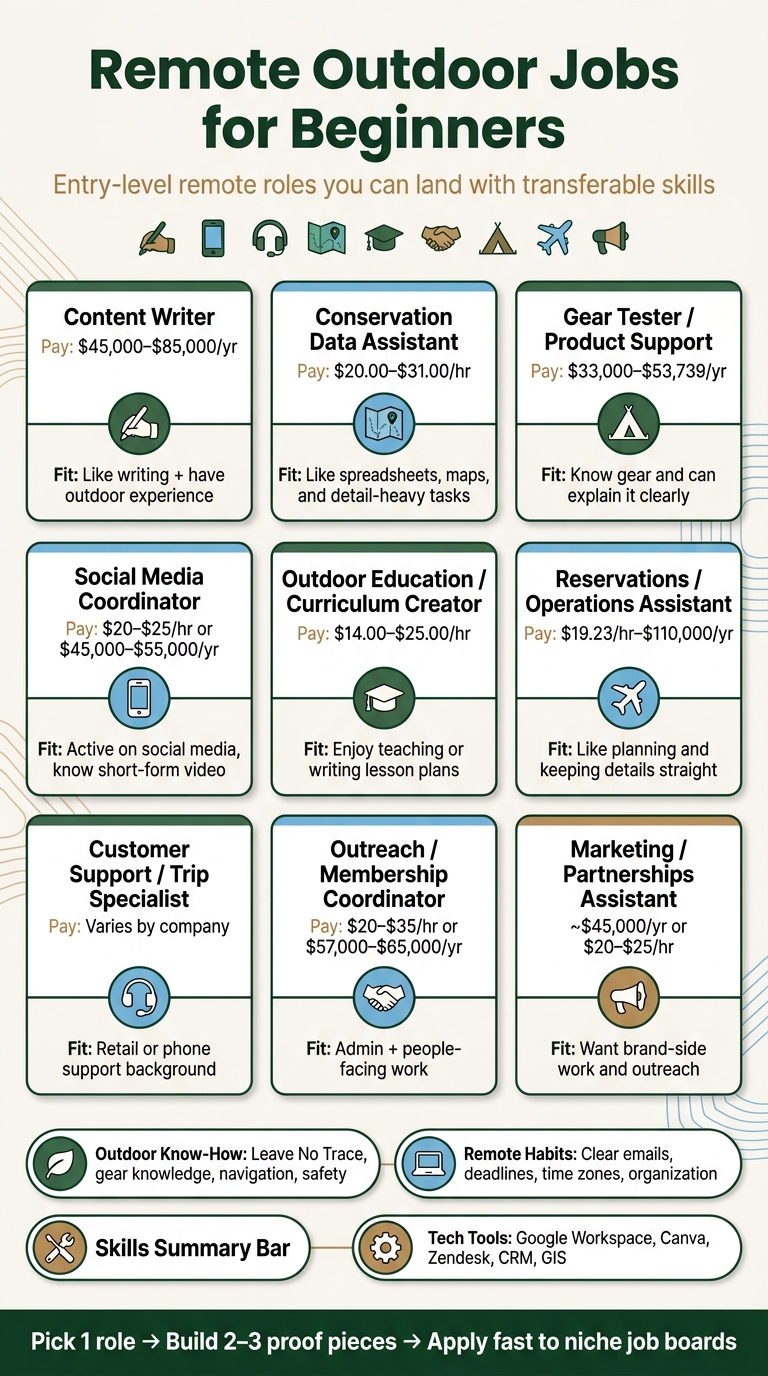
Remote Outdoor Jobs for Beginners: Roles, Pay & Entry Requirements
Quick Comparison
Not sure what outdoor role fits you?
Take our 2-minute career quiz to get matched with outdoor jobs that align with your goals, salary target, and lifestyle.
| Role | Good fit if I… | Usual work focus | Typical pay shown in the article |
|---|---|---|---|
| Content writer | like writing and have outdoor experience | articles, guides, reviews | $45,000–$85,000/year |
| Social media coordinator | already post content and know short-form video | posts, comments, tracking | $20–$25/hour or $45,000–$55,000/year |
| Customer support / trip specialist | have support or retail experience | orders, gear questions, trip help | varies by company |
| Conservation data assistant | like spreadsheets, maps, and detail-heavy tasks | records, mapping, data cleanup | $20.00–$31.00/hour |
| Outdoor education / curriculum | enjoy teaching or writing lessons | virtual classes, lesson plans | $14.00–$25.00/hour, some weekly pay |
| Outreach / membership coordinator | like admin plus people-facing work | renewals, CRM updates, event help | $20–$35/hour or $57,000–$65,000/year |
| Gear tester / product support | know gear and can explain it clearly | reviews, warranty help, product questions | $33,000–$53,739/year |
| Reservations / operations assistant | like planning and keeping details straight | bookings, changes, traveler questions | $19.23/hour to $110,000/year |
| Marketing / partnerships assistant | want brand-side work | outreach, assets, campaign support | around $45,000/year or $20–$25/hour |
If I were starting from scratch, I’d pick one target role, build 2–3 proof pieces, and apply fast to new listings on niche boards and company career pages. That’s the simplest way to turn interest into interviews.
sbb-itb-9d004f0
Skills Beginners Need for Remote Outdoor Jobs
Most entry-level remote outdoor jobs come down to three things: outdoor know-how, solid remote-work habits, and basic tech skills. The good news? You can build all three without spending much money.
Basic Outdoor Knowledge for Entry-Level Roles
A smart place to start is Leave No Trace (LNT) principles. They show that you understand how to reduce your impact and work with care in outdoor spaces. That matters in jobs tied to conservation, education, and field support.
It also helps to know the basics of navigation and safety. That includes reading maps, using a compass or GPS, and spotting trail or weather hazards. These are simple skills, but they matter a lot in many entry-level outdoor roles.
You can also strengthen your application with a CPR/AED or Wilderness First Aid (WFA) credential. It shows employers that you take safety seriously and can stay calm if something goes wrong.
Remote-Work Skills Employers Expect
Remote outdoor employers usually look for the same core habits as other remote teams: clear communication, good organization, and follow-through.
In practice, that means:
- Joining video meetings on time
- Writing short, clear emails
- Managing your own schedule without constant check-ins
- Working across U.S. time zones
- Keeping a stable internet connection
This stuff may sound basic, but it can make or break your chances. If an employer thinks they'll need to chase you for updates, that's a problem.
Simple Tech Skills That Help Beginners Qualify
Many entry-level remote outdoor jobs use tools that are already familiar. If you can handle spreadsheets, do online research, and enter data cleanly, you're in decent shape for many data-related roles.
For outreach or marketing work, even basic social media posting may be enough to get your foot in the door.
If you want an extra edge, free lessons on Alison or YouTube can help you learn GIS (Geographic Information Systems), which is used for mapping in conservation and nature-related work.
Low-Cost Ways to Build Skills Fast
One of the fastest ways to fill out a beginner resume is to volunteer. A local watershed group, land trust, or nature center can give you hands-on practice with GPS tools, field notes, and survey work on weekends. That kind of experience lines up well with conservation, outreach, and operations jobs.
You can also build proof of interest on your own. Apps like iNaturalist and eBird let you log species observations into scientific databases. Free course audits on edX, Coursera, and FutureLearn can help you learn more about ecology, conservation, or sustainability. And a small self-led project, like doing weekly bird counts at a local pond, can show initiative and basic analysis skills.
With those basics in place, the next move is picking a role that's a good fit for beginners.
1. Remote Outdoor Content Writer or Blogger
For beginners, content writing is often one of the easiest remote outdoor jobs to get into. It rewards two things: clear writing and first-hand outdoor experience. If you already spend time hiking, camping, fishing, or backpacking - and you can put that into plain, useful words - this can be a smart first move.
What the Role Involves
Remote outdoor content writers research, write, and edit articles, guides, and reviews for brands, publications, and agencies. Some jobs also include social media posts or short-form video work.
Typical U.S. Employers
Outdoor brands like REI, Patagonia, and Yeti hire for this type of work. So do publishers like Outside Magazine and Backpacker, along with agencies like Backbone Media and Origin Outside.
Pay for remote content and marketing jobs in the outdoor space usually falls between $45,000 and $85,000 per year. For example, a remote Associate Editor role at Backpacker magazine listed a salary of $55,000 to $65,000.
Entry-Level Requirements
Most employers want writers who can do solid research, write clean copy, and hit deadlines without hand-holding. Outdoor experience helps a lot. If you've spent time backpacking, camping, or fishing, your writing tends to sound more grounded.
A few extra skills can help, too:
- Basic use of a CMS like WordPress
- SEO formatting
- Simple photo or video editing
For beginner roles, though, published clips matter most.
Best First Steps to Gain Experience
A good way to start is by publishing a few free clips or writing for smaller outlets. Build a simple portfolio site on WordPress or Wix and use it to show your work. Then pitch local campgrounds, outfitters, or tour companies that need new website copy. That's often the easiest way to land a first published piece.
Once you have three to five published articles, start pitching paid assignments. After that, it gets a lot easier to branch into paid work and larger outdoor media outlets.
2. Remote Social Media Coordinator for Outdoor Brands
If you’re already at ease making content for Instagram or TikTok, this role can be a solid fit. Outdoor brands want people who get the lifestyle and can make posts that feel natural, not forced. For beginners, this path is often easier to enter than paid writing because strong personal content can matter more than a thin resume.
What the Role Involves
You’ll handle posts, captions, short-form video, UGC, comments, and performance tracking. Employers tend to want people who work fast, catch small details, and understand the outdoor crowd.
Typical Pay
Pay depends on the company and the level of the role. OARS listed a part-time remote Social Media Assistant job in early 2026 at $20–$25 per hour for about 10–12 hours per week. Outside Magazine listed a remote Social Media Strategist role at $45,000–$55,000 per year. For most people starting out, part-time jobs and internships are the simplest way in.
Entry-Level Requirements
Internships and freelance projects often count as experience. Brands also want people with real outdoor experience, so it helps to say what you actually do, whether that’s hiking, climbing, or something else. On the tools side, you should expect to use Canva, Slack, and basic scheduling or analytics tools.
Best First Steps to Gain Experience
Start with your own accounts. Post outdoor-themed content, document a trip, review a piece of gear, or film short videos you can later use in a portfolio. That way, you’re not just saying you can do the job - you’re showing it.
Some brands want direct proof. Field & Stream, for example, asks applicants to share at least five examples of brand posts or relevant social media links to be considered.
If you’d rather do less content production and spend more time helping people solve problems, the next role moves into customer support.
3. Remote Customer Support or Trip Specialist for Outdoor Companies
If you already have experience in retail, phone support, or customer service, this is one of the easier remote outdoor jobs to get into.
What the Role Involves
You’ll answer questions by phone, email, live chat, and sometimes social media. That can include order changes, cancellations, returns, warranty claims, and product advice.
At outdoor companies, the job usually goes a bit further. You may help customers pick gear, explain sizing, and troubleshoot equipment. You might also flag repeat problems to product, engineering, or marketing teams.
Typical U.S. Employers
Remote outdoor companies hire for these roles at a wide range of pay levels. Some are hourly support jobs. Others are higher-paying specialist roles.
One thing to watch: some jobs are tied to certain states or regions, so read the posting closely.
Entry-Level Requirements
Most roles ask for:
- A high school diploma
- Strong communication skills
- Basic Microsoft Office skills
- A quiet workspace with wired internet
Outdoor knowledge matters too. Employers like AllTrails and Zamberlan want people who know activities like backpacking, hiking, and mountaineering from direct experience.
How to Start
Experience at an outdoor retail store carries over well. Volunteer work and part-time outdoor jobs can help too, especially if they gave you hands-on time with gear or customer questions.
It also helps to learn tools like Zendesk or HubSpot before you apply.
If customer calls aren’t your thing, the next role moves more toward conservation support and less toward front-line service.
4. Remote Conservation Data Assistant
This role is all about cleaning, organizing, and mapping conservation data. If you like maps, spreadsheets, and detail-heavy work, it’s a solid way to get into conservation. You don’t need a deep field background to start. What matters more is accuracy and the ability to stay organized.
What the Role Involves
Day to day, you’ll work with data collected in the field: wildlife tracking records, species observations, and water quality measurements. A lot of the job comes down to spotting errors, keeping records clean, and making sure data ends up in the right place.
Common tasks include checking datasets for mistakes, uploading records into ArcGIS Online, updating procedures, and creating simple PDF maps. Some roles also ask you to help train field staff on data collection apps like ESRI Survey123 or Field Maps.
Typical U.S. Employers
Most hiring comes from federal agencies and conservation nonprofits. That includes NPS, USFWS, CPW, ACE, GBI, and NPCA.
Pay depends on the role. GBI pays $30.00/hour in year one and $31.00/hour in year two, while CPW’s Terrestrial Data Assistant starts at $20.00/hour.
Entry-Level Requirements
Many employers want a bachelor’s degree in ecology, geography, natural resource management, environmental data science, or a related STEM field. For remote work, you also need to be comfortable working on your own and paying close attention to small details.
In many cases, employers ask for working knowledge of ArcGIS Pro or ArcGIS Online. R, Python, or SQL often show up as preferred skills rather than strict must-haves.
Best First Steps to Gain Experience
The easiest way to get noticed is to prove you can handle small data tasks with care. For this role, citizen science work helps most when it creates clean, location-tagged records you can put on a resume. Platforms like eBird, iNaturalist, and iMapInvasives produce verifiable records used by working researchers.
Small volunteer projects can be enough to land an interview, especially if your work is well documented. If you want hands-on remote practice, the Felidae Conservation Fund offers fully remote volunteer roles cataloging wildlife camera trap images, often with just 1–2 hours per week required.
On your resume, be specific. Numbers help. Use lines like:
- “logged 200+ observations”
- “processed 450 samples”
5. Remote Outdoor Education Instructor or Curriculum Creator
If you want a remote job that uses your outdoor know-how without sending you into the field, education is a smart place to start. These jobs usually split into two paths: live instructors who teach virtual classes, and curriculum creators who build lesson plans, activity guides, and supply lists. If you enjoy being in front of students, go with instruction. If you’d rather map things out and write, curriculum work may be a better fit.
What the Role Involves
At NatureBridge, Distance Learning Educators spend most of their time leading programs live, while curriculum writers put together lesson arcs, facilitation guides, and clear activity directions.
Typical U.S. Employers
Nonprofits like NatureBridge hire remote educators to run virtual park-based programs. Adventure camp groups like DEAN Adventure Camps bring on contract curriculum writers in the off-season to build online programs in subjects like STEM and environmental science.
| Employer | Role Type | Pay Rate |
|---|---|---|
| NatureBridge | Distance Learning Educator | $14.00/hr |
| DEAN Adventure Camps | Curriculum Writer (contract) | $25.00/hr |
| Palomar Christian Conference Center | Remote Outdoor Education Instructor | $660/week |
Entry-Level Requirements
A lot of these roles ask for a bachelor’s degree plus about one year of paid or volunteer teaching experience, although some entry-level naturalist programs will consider first-time applicants. Curriculum jobs often want basic familiarity with NGSS. You also need strong virtual communication skills and the ability to hold students’ attention online.
Best First Steps to Gain Experience
One good way in is to volunteer at a local nature center. That can help you build informal teaching hours, which often count toward a one-year experience requirement. If you want curriculum work, practice writing lesson plans that are clear enough for another staff member to run on their own.
It also helps to show your work, not just talk about it. A small portfolio can go a long way, such as:
- Sample lesson plans
- A short demo video of your teaching
- Activity guides or student handouts
Those materials make it easier for employers to see how you teach and how you organize content.
If you want less teaching and more operations work, the next role shifts toward nonprofit coordination.
6. Remote Outreach or Membership Coordinator for Outdoor Nonprofits
This role blends member communication with admin support. You help with sign-ups, renewals, and everyday member questions. If you like working with people and keeping systems organized, this can be a smart path into broader operations work.
What the Role Involves
On a normal day, you might process applications and renewals, update CRM records, schedule occasional social posts, and take care of simple admin tasks. Entry-level work often includes reviewing applications against set criteria, basic data entry, keeping email lists up to date, and helping with event registration or calendar invites.
Typical U.S. Employers
Here are a few U.S. employers with similar roles:
| Organization | Role | Pay | Remote Status |
|---|---|---|---|
| Outdoor Prolink | Membership Coordinator | $20–$22/hr | Remote (Boulder) |
| Center for Biological Diversity | Online Membership Associate | $57,000–$65,000/yr | Fully Remote |
| CARCD | Membership & Admin Coordinator | $32–$35/hr | Fully Remote (CA) |
| Trout Unlimited | Membership and Operations Coordinator | $20–$25/hr | Hybrid (VA) |
Trout Unlimited, for example, supports more than 300,000 members and supporters across 400 chapters. That gives you a sense of the scale these teams can work at.
Entry-Level Requirements
A lot of these jobs ask for 1–3 years of customer service, membership services, or admin experience. That said, some part-time roles are open to students or people making a career switch. Most employers want strong written communication, comfort with spreadsheets or Microsoft Excel, and a willingness to learn CRM tools and other team software.
Your cover letter matters here. Make the link to the mission clear, especially if you're applying to groups focused on conservation, access, or public lands.
Best First Steps to Gain Experience
One of the best ways in is simple: volunteer with a local conservation chapter. Helping with recruitment, event sign-ups, or social scheduling builds the same skills these jobs use.
It also helps to get comfortable with:
- Google Workspace
- A CRM platform such as Salesforce or MemberClicks
If you want something that leans more toward travel and field logistics, this role can also set you up well for the next step.
7. Remote Gear Tester Coordinator or Product Support Specialist
If you want a role that leans more toward products than general customer support, this is a solid next move. It’s also a good starting point if you already use outdoor gear and can explain how it works in plain English.
What the Role Involves
On a typical day, you might test products, log issues, answer technical questions, and keep track of warranty or repair details. At some companies, the job also includes hands-on gear testing and written feedback on how products perform.
Some employers run product support as a fully remote function, so most of the work happens through online tools and team communication.
Typical U.S. Employers
| Employer | Focus |
|---|---|
| Zenbivy | Gear testing, product support |
| Fortune Brands Innovations | Warranty support, technical support |
| KJUS (Acushnet Holdings Corp) | Sales support |
| Switchback Travel | Gear testing, review work |
Remote product support roles usually pay about $33,000 to $51,000 per year, and remote sales support specialists at KJUS can earn $44,643 to $53,739 per year.
Entry-Level Requirements
Most product support jobs want some customer service experience. That said, internships, part-time retail work, or volunteer roles can also help you get in the door.
Clear technical communication matters a lot here. You need to explain product details in a way customers can follow without getting lost. Many employers also ask for experience with tools like Zendesk, Shopify, Jira, or Microsoft Office.
For gear testing roles, firsthand outdoor experience carries a lot of weight. Think backpacking, skiing, or camping. Strong writing and photography skills also matter, since you may need to document what you tested and how it performed.
Best First Steps to Gain Experience
Start with the gear you already own. That’s often the easiest way to show product knowledge without overthinking it.
A few good ways to build experience:
- Write honest, detailed reviews of gear you’ve used
- Take high-quality photos in actual outdoor conditions
- Practice using Zendesk if you want to move into product support
- Show any customer service work from retail, internships, or volunteer roles on your resume
Done well, this gives you proof that you understand both the product side and the customer side.
8. Remote Reservation or Operations Assistant for Adventure Travel
If you like trip planning and keeping lots of moving parts straight, this role deserves a close look. It can work well for beginners who are organized, friendly with customers, and comfortable using booking tools. Adventure travel companies hire remote staff to handle reservations, reply to traveler questions, and keep booking details in order.
What the Role Involves
You’ll help coordinate bookings for tours, lodging, and transportation. That usually means confirming reservation details, updating records, and using booking software to keep everything accurate. In entry-level roles, the day-to-day work often includes confirming bookings, making changes to reservation files, and following up when plans shift or problems come up.
Typical U.S. Employers
| Employer | Typical Role | Salary Range |
|---|---|---|
| Destination Knot | Travel Reservations Coordinator | $30,000–$65,000/year |
| Aisles & Abroad | Travel Reservations Specialist | $45,000–$75,000/year |
| Lindblad Expeditions | Reservations Agent | $19.23/hour + uncapped sales bonus |
| An Epic Adventure | Reservation Booking Manager/Coordinator | $85,000–$110,000/year |
Entry-Level Requirements
You’ll still need basic computer skills, steady internet, and close attention to detail. Some employers offer full onboarding and certification, especially for junior or assistant roles. A few set stricter training rules. For example, Lindblad Expeditions requires a 6- to 8-week training period, and no vacation is allowed during that time.
Best First Steps to Gain Experience
Start with the skills you may already have. Customer service, admin work, and strong organization all transfer well to adventure travel jobs. On your resume, make those skills easy to spot.
It also helps to learn the basics before interviews, such as common destinations, busy seasons, and how booking demand shifts through the year. And before you apply, check that your computer and internet setup meet remote-work needs. Once your resume points clearly to those transfer-ready skills, use focused search terms to find beginner-friendly remote openings.
9. Remote Marketing or Partnerships Assistant in the Outdoor Industry
If you want to move from operations into more brand-facing work, marketing and partnerships roles are a smart next step. This kind of beginner role blends social media, outreach, and brand coordination. It fits well if you like keeping moving parts organized and want to work closer to the public side of an outdoor brand.
Outdoor industry employers hire remote assistants to support campaigns, manage partner relationships, and keep brand communication moving across adventure travel companies, outdoor retailers, agencies, and nonprofits.
What the Role Involves
These roles often cover social posts, partner outreach, asset tracking, and campaign support. You might help coordinate with brand ambassadors, affiliate partners, sponsors, or local tour partners so seasonal promotions and trip launches stay on track.
At its core, the job is about keeping people, files, and deadlines lined up. If you've done that in another role, you're already closer than you might think.
Typical U.S. Employers
Employers range from adventure travel companies like OARS and The Explorer's Passage to outdoor retailers like Backcountry and agencies like Obviouslee.
Pay can be a solid starting point. Entry-level marketing assistant roles may start around $45,000 per year, while part-time seasonal roles often pay $20 to $25 per hour. These jobs are often easier to break into than full marketing roles because many employers hire for support work first and higher-level planning later.
Entry-Level Requirements
Most employers want a degree or internship background in marketing, communications, tourism, or a related field. They also tend to look for strong writing, comfort with social media, and basic Canva or HubSpot skills.
Google Workspace or Microsoft Office is usually standard. For brand-focused roles, active participation in outdoor activities may also be required. That makes sense: if you're helping represent an outdoor brand, it helps to know the space from the inside.
Best First Steps to Gain Experience
A small portfolio can go a long way here. Show sample posts, captions, outreach examples, or campaign support work so employers can picture how you'd help on day one.
If you've worked as a guide or in another field-based outdoor role, make that stand out on your resume. That background shows you understand the audience, the pace of seasonal work, and the kinds of trips or products these brands sell. Pair that with a few real tools and work samples to show you can step in and support campaigns from day one.
10. Finding Remote Outdoor Jobs Using Get Outdoor Jobs
Once you know the kind of role you want, head to Get Outdoor Jobs to narrow things down. It’s a niche job board for the outdoor industry, with listings in conservation, education, adventure tourism, retail, and admin work.
The site has a dedicated "Remote Outdoor Jobs" filter, which makes it easier to zero in on work-from-home roles. If you’re just starting out, try search terms like "Assistant", "Coordinator", "Content," or "Customer Support" inside that filter. That can help surface entry-level openings.
You’ll also find remote jobs in areas like:
- marketing
- content
- customer support
- sales
- design
- operations
There’s also an "Outdoor Career Insights & Advice" blog with beginner tips and industry trend coverage.
The free plan shows the 10 most recent listings. Premium gives you full listings, advanced filters, daily updates, and email alerts. After you review the newest remote openings, it makes sense to branch out to employer career pages and broader remote job filters.
Where to Find Remote Outdoor Job Listings
Use Outdoor Job Boards With Remote Filters
After you’ve narrowed down the kind of role you want, the next step is finding openings without wasting hours scrolling. Specialized outdoor job boards are a solid place to start, especially if you’re new to the field. Most let you filter for remote, hybrid, and entry-level roles right away, which makes the search a lot less messy.
Search Get Outdoor Jobs for Beginner-Friendly Roles
Get Outdoor Jobs pulls together thousands of outdoor listings from multiple sources and updates them daily. If you’re just testing the waters, the Free Plan shows the 10 most recent listings. Premium gives you full access, advanced filters, daily updates, and email alerts.
That setup can save time, especially when you’re trying to spot beginner-friendly jobs before they get buried under a pile of newer posts.
Check Employer Career Pages and Nonprofit Sites
Job boards help, but don’t stop there. Employer career pages matter too. Outdoor brands, conservation nonprofits, and adventure travel companies often post remote roles on their own sites.
Sometimes those pages include roles that never make it to big job boards, so it’s worth checking them directly.
Use Search Terms That Match Entry-Level Jobs
Your search terms can make a big difference. Instead of typing something broad, use phrases like "remote conservation assistant", "remote outdoor customer support," or "remote education coordinator".
Then pair those terms with an entry-level filter to narrow the results. It’s a simple move, but it helps you get from browsing to applying with less time lost.
How to Gain Experience and Build a Beginner Outdoor Resume
Once you know which role you want, the next step is simple: build the closest proof you can.
Use Local Volunteer Work to Build Relevant Experience
Volunteer work is one of the easiest ways to show outdoor experience, even if you're just getting started. Programs like the Volunteers-In-Parks (VIP) program and Student Conservation Association (SCA) internships can give you hands-on time with trail maintenance, visitor services, and resource protection.
And it doesn't have to be a huge time commitment. Even one trail work day or a park cleanup event can show that you care, that you show up, and that you've spent time in outdoor spaces doing useful work. It also helps you meet people nearby, which can open doors later.
If volunteer work alone doesn't get you far enough, paid seasonal work can help.
Consider Seasonal Onsite Jobs as a First Step
A seasonal job is a fast way to add paid outdoor experience. A 3–6 month role can give you direct experience, a line on your resume, and a better feel for how park and tourism jobs work day to day.
Companies like Xanterra and Aramark often hire for front desk, reservations, and retail roles in national parks. These jobs often pay $12–$18 per hour and may come with low-cost housing. For someone trying to get a foot in the door, that's a solid first move.
Translate Past Work Into Outdoor-Industry Language
You may already have more related experience than you think. The trick is to describe it in terms that fit the outdoor job you want.
For example:
- Restaurant or hotel reservations can map to trip support
- Teaching can map to education roles
- Retail can map to gear support
Use that language on your resume and cover letter. Same work, different framing. That shift can make hiring managers see the fit much faster.
Build a Simple Portfolio With Beginner Projects
A small portfolio can help a lot, especially if you're applying for entry-level work. You don't need a giant body of work. Two or three simple samples are enough to show role fit.
Match each sample to the kind of role you want:
| Role Type | Portfolio Item to Create |
|---|---|
| Content writer or blogger | 2–3 gear reviews or trail write-ups |
| Social media coordinator | Sample posts or a mock campaign for an outdoor brand |
| Outdoor education | A short lesson plan or curriculum outline |
| Conservation/operations | A basic data spreadsheet or a short field report |
Think of it this way: if your resume says, "I can do this", your portfolio shows, "I've already started."
Comparison Tables for Quick Reference
Now that you've looked at the roles above, these tables make the tradeoffs easier to see at a glance. They compare the skills you’ll need, where each role usually happens, and how much effort each path tends to take.
Skills beginners need - by category:
| Skill Category | Key Skills for Beginners | Why It Matters |
|---|---|---|
| Outdoor Knowledge | Gear specs, Leave No Trace principles, conservation basics, trip planning | Helps you sound informed in niche roles |
| Remote-Work Skills | Clear communication, time management, follow-through | Remote teams depend on trust and clear writing |
| Basic Tech Skills | Zoom, Slack, Google Workspace, Trello or Asana, Canva | Common tools for onboarding and day-to-day work |
If you want the fastest way in, look at fit, not just pay. A role that matches what you already know can be a much easier starting point.
Beginner roles compared by fit, setting, and pay:
| Role | Main Tasks | Main Work Setting | Best For Beginners Who… | Typical Starting Pay (USD) |
|---|---|---|---|---|
| Content Writer | Writing blogs, gear reviews | Mostly indoor | Like writing and have outdoor experience | $35,000 – $50,000 |
| Social Media Assistant | Scheduling posts, engagement | Mostly indoor | Are active on social media and know Canva | $27,000 – $40,000 |
| Customer Support | Handling inquiries, bookings | Fully indoor | Have customer service experience | $28,000 – $42,000 |
| Conservation Data Assistant | Organizing conservation data, research | Fully indoor | Prefer admin and detail-heavy work | $24,000 – $38,000 |
| Outdoor Education Creator | Developing curriculum | Mostly indoor | Have teaching or subject matter experience | $30,000 – $50,000 |
If you need experience first, the next table helps you compare the main paths by time, cost, and how closely they connect to remote work.
Experience paths compared by time, cost, and how directly they lead to remote work:
| Path | Time Commitment | Cost (USD) | How Directly It Leads to Remote Work |
|---|---|---|---|
| Volunteering | Flexible (5–10 hrs/week) | $0 | Moderate - builds network and resume |
| Seasonal Onsite Work | High (3–6 months) | Paid (earn income, often includes housing) | Moderate - builds industry credibility |
| Online Courses | Low (2–6 weeks) | $0 – $500 | High - teaches specific digital tools |
| Freelance Projects | Variable | $0 | High - builds portfolio proof directly |
Free and low-cost online courses can help you build remote-ready skills fast.
Pros and Cons of Common Starting Paths
Pick the path that lines up with your time, budget, and current skills. If you're ready to apply, this table can help you choose the fastest route into a remote outdoor role.
| Starting Path | Main Benefits | Main Drawbacks | Cost | Time to Build Experience | Best Fit For |
|---|---|---|---|---|---|
| Volunteering | High networking potential; low barrier to entry; resume-building with real organizations | Unpaid; requires significant free time | Very low / Free | Weeks to months | Beginners needing industry connections and skill-building |
| Seasonal Onsite Jobs | Paid work; often includes housing or meals; builds field credibility fast | Temporary; no benefits; may require travel or a vehicle | Low to moderate | 3–9 months | Beginners with high flexibility and low financial obligations who want hands-on experience |
| Freelancing | Remote-first from day one; maximum flexibility; portfolio building | Unstable income; requires self-marketing and your own equipment | Low to moderate | Ongoing | Writers, photographers, and social media creatives with existing digital skills |
| Direct Entry-Level Applications | Stable income; potential benefits; clear career path | High competition; requires strong transferable skills | Low | Immediate (if hired) | Career changers with office, tech, or admin skills |
The biggest tradeoff comes down to what you can afford to give up right now: pay, time, stability, or flexibility.
Volunteering works well for beginners starting from zero. You get hands-on exposure, meet people in the field, and add work with actual organizations to your resume. The catch is simple: it's unpaid, so you need enough free time and some financial breathing room.
Seasonal onsite work can build field credibility fast. That's a big plus if you want outdoor experience that employers can spot right away. But these roles are temporary, and many don't come with benefits. Some also require travel or access to a vehicle.
Freelancing makes sense if you already have writing, photography, or social media skills. It lets you start remote from day one and build a portfolio as you go. On the flip side, income can be uneven, and you'll need to market yourself and use your own gear.
Direct entry-level applications are often the best match for career changers with office, tech, or admin experience. If you get hired, you may get steady pay and a more defined path forward. The hard part is competition. You'll need to show how your past work carries over to the role you're targeting.
Conclusion
After the role-by-role breakdown, the main point is simple: beginners can get in by matching the skills they already have to remote jobs in the outdoor space. Entry-level work in support, operations, travel, and education is within reach.
Start with what you know. Then put that experience into outdoor-industry language. Retail, hospitality, and admin work can transfer straight into jobs like customer support specialist, operations assistant, or social media coordinator.
A perfect resume isn't the thing that tips the scale. Consistency does. Set up job alerts, apply within 48 hours of a listing going live, and mirror the wording in the job post. Clear communication, fast follow-through, and tailored applications show that you're ready for remote work. That's what helps move people ahead.
Remote outdoor work is a path, not an endpoint. From there, the next move is simple: focus on one role, one search filter, and one application at a time.
FAQs
Which remote outdoor job is easiest to start with?
For beginners, customer support and data entry roles are usually the easiest remote outdoor jobs to get into. They often come with training and lean more on transferable soft skills than on specialized know-how.
Common entry-level options include seasonal customer care representatives and data entry clerks for outdoor retail brands. These jobs mostly call for organization, clear communication, and dependable computer skills.
Do I need certifications to get hired?
It depends on the job. Some roles call for special credentials, while others don’t need any formal training at all.
For many outdoor jobs, certifications like Wilderness First Responder, CPR, or Leave No Trace can matter a lot. In some cases, they help you look more qualified. In others, they’re required from day one.
Technical or field-based roles may also ask for job-specific training, especially when safety, gear, or hands-on work is part of the role.
How can I prove experience if I’m a beginner?
Build experience by showing the skills you already use in school, group projects, and everyday life. Things like teamwork, communication, problem-solving, and organization all count. If you’ve worked with classmates, handled deadlines, sorted out issues, or kept a project on track, that matters.
You can also get hands-on practice by volunteering with local parks or nature centers. Another good path is joining citizen-science platforms like eBird or iNaturalist. And if you want something you can show right away, make a few simple work samples, like social media calendars or customer service responses. That gives employers clear proof of what you can do.