
Ultimate Guide to Seasonal Guiding Careers
Seasonal guiding can give you outdoor work fast, but the tradeoff is short contracts, uneven pay, physical strain, and few benefits. In most cases, jobs run for 90 to 120 days, pay often mixes a day rate or trip rate with tips, and housing can make or break what you take home. If I were looking at this path, I’d focus on three things first: the job type, the certs needed, and the full pay setup.
Here’s the short version:
- Main job paths: hiking/backpacking, river/paddling, ski/snowboard, climbing/mountaineering, and park/camp/youth programs
- Peak seasons: summer for most trail, river, park, and camp jobs; winter for ski and snowboard roles; fall for many hunting and fishing jobs
- Common pay setups: daily rates, per-trip pay, or hourly pay; tips can add 20% to 40%
- Entry certs: CPR and First Aid
- Higher-skill roles: often ask for WFA, WFR, SRT, SPI, or avalanche training
- Hiring windows: summer hiring often starts January to April; winter hiring often starts August to October
- Big lifestyle issues: shared housing, tax planning, injury risk, and time between seasons
If you want a simple way to think about it, this work usually falls into two groups:
| Type of role | What matters most |
|---|---|
| Entry-level guest roles | Group management, service skills, CPR/First Aid, stamina |
| Technical field roles | Rescue training, field time, judgment, route safety, higher medical certs |
I’d also keep this in mind: a lower-paying job with staff housing can leave you with more money than a higher-paying job in a resort town with full rent. And if you stack seasons - like rafting in summer and ski work in winter - you can keep income coming through more of the year.
Not sure what outdoor role fits you?
Take our 2-minute career quiz to get matched with outdoor jobs that align with your goals, salary target, and lifestyle.
So before I apply anywhere, I’d check: pay, tips, housing cost, gear needs, start and end dates, and whether the role is W-2 or 1099.
What nobody told me about working in the outdoor industry - real advice for guides and instructors
sbb-itb-9d004f0
Main Types of Seasonal Guiding Jobs
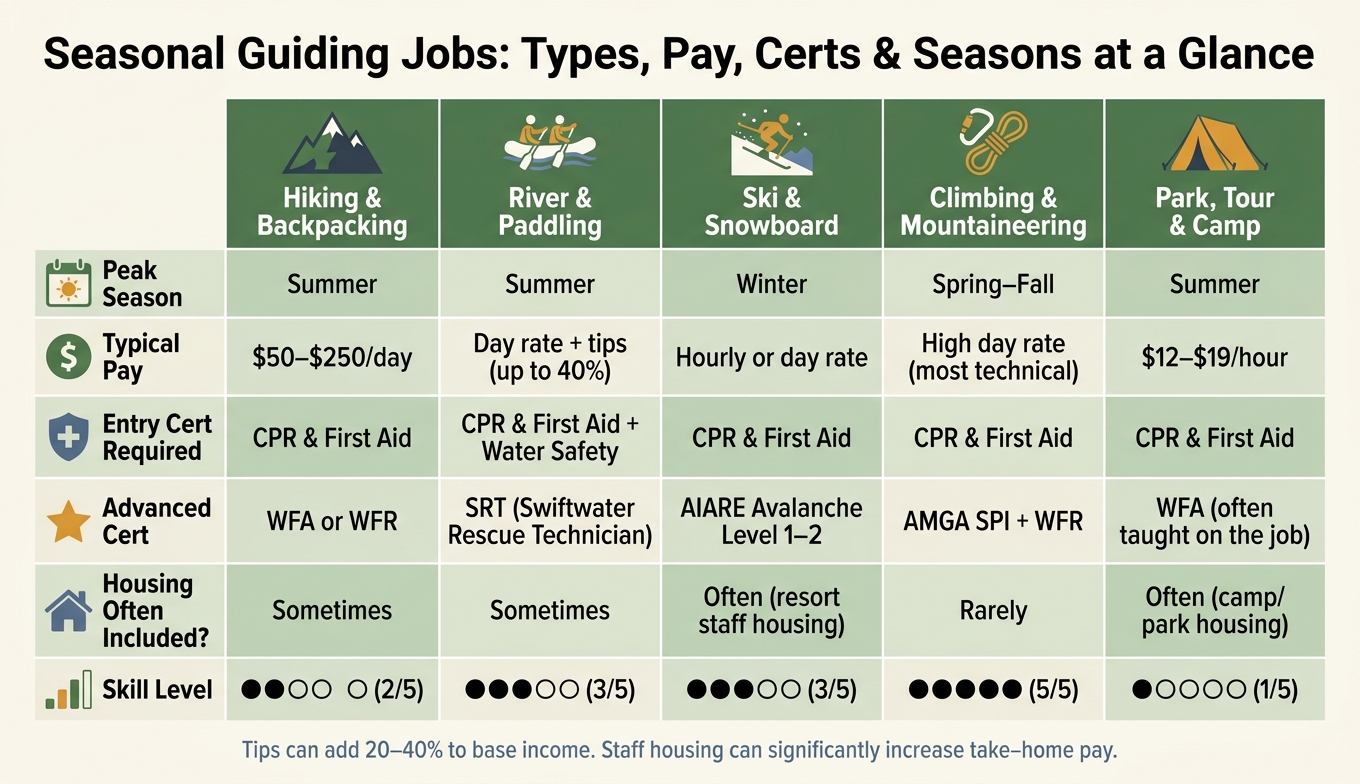
Seasonal Guiding Jobs: Types, Pay, Certs & Seasons at a Glance
These are the main seasonal guiding paths, from entry-level guest-facing roles to more technical backcountry work. Hiking and park jobs tend to lean on interpretation, communication, and group leadership. River, climbing, and winter jobs usually ask for more safety training, rescue skills, and route management.
| Job Type | Peak Season | Common Employer | Work Environment |
|---|---|---|---|
| Hiking & Backpacking | Summer | Private outfitters, NPS concessionaires | Backcountry trails, mountain terrain |
| River & Paddling | Summer | River outfitters | Whitewater rivers, coastal waters |
| Ski & Snowboard | Winter | Ski resorts | Alpine slopes, backcountry |
| Climbing & Mountaineering | Spring–Fall | Climbing schools, guide services | Rock faces, high-altitude peaks |
| Park, Tour & Camp | Summer | NPS, Xanterra, Aramark, summer camps | National parks, visitor centers, campgrounds |
Hiking, trekking, and backpacking guides
Hiking and backpacking guides lead day hikes and multi-day trips on trails, in mountain terrain, and across backcountry routes. The job usually includes navigation, group management, Leave No Trace, and natural-history interpretation. Most of these roles are with private outfitters or NPS concessionaires, and pay usually falls between $50 and $250 per day.
River, paddling, snow, and climbing guides
Rafting, kayaking, and canoeing guides work in fast-moving settings where safety mistakes can turn serious fast. Because of that, water safety and rescue skills matter a lot. Many outfitters run pre-season guide schools, and some offer them at no cost for multi-season hires. After hiring, raft guides may run as many as three 3-hour trips per day. Tips can also have a big effect on total seasonal pay.
Snow and climbing jobs sit on the more technical end of the spectrum. Ski and snowboard instruction follows a different hiring cycle, with many resorts recruiting in August and September. Backcountry winter roles usually add avalanche training, often with AIARE-level certifications. Climbing and mountaineering jobs are the most technical of the group. They usually call for years of personal experience, strong risk management, and advanced certifications.
Park, tour, camp, and youth program guides
These jobs mix outdoor education, guest service, and supervision. Park guides lead interpretive walks and visitor talks in national parks. In many cases, they work for private concessionaires such as Xanterra or Aramark instead of the NPS itself, which makes them a common starting point for new guides.
Summer camp counselors and multi-activity program leaders take on youth supervision, group facilitation, and broad risk management across several activities. Pay is usually $12 to $19 per hour, and many jobs include shared housing. That can matter a lot in expensive mountain and resort towns. These roles are often a solid first step because employers will often teach technical skills on the job.
These job types lead to different hiring standards, which the next section covers.
Qualifications, Training, and Certifications Employers Look For
Hiring standards change a lot by role. An entry-level day program may ask for little more than CPR and First Aid. A backcountry, river, or climbing job is a different story. Those roles usually call for rescue training and time in the field.
So the issue isn't only whether you can guide. It's whether you can handle the level of responsibility that comes with that job.
Entry-level roles usually screen for the basics. More technical jobs look much harder at rescue skills, judgment, and how you handle pressure.
| Qualification | Park/Tour/Camp Roles | River, Climbing, and Winter Roles |
|---|---|---|
| Medical Certs | CPR & Basic First Aid | Wilderness First Responder (WFR) or WEMT |
| Technical Certs | Often taught in guide school | Single Pitch Instructor (SPI), Swiftwater Rescue Technician (SRT), and AIARE avalanche training |
| Experience | Personal experience; hospitality or youth-work background | 2+ seasons of professional guiding |
| Typical Trips | Day hikes, Class I–II rapids, ziplines | Multi-day backcountry, Class IV+ rapids, alpine peaks |
Outdoor experience and people skills
Guest-facing roles depend on calm leadership, clear communication, and solid service habits. Employers want proof that you can do the activity and manage a group of strangers doing it in bad weather. That's the part many people miss.
Personal skill matters, of course. But calm decisions, stamina for long days, and a real instinct for customer service often make the difference between getting a callback and getting passed over. Experience in retail, camps, or guest services can help a lot here. Employers know activity skills can often be taught on the job. Attitude and people skills usually take longer.
Those traits help you get hired. Certifications help you qualify for better roles.
First aid, rescue, and activity-specific certifications
CPR and Basic First Aid are the baseline for almost every guiding job. After that, the bar goes up fast.
A Wilderness First Aid (WFA) certification is enough for many entry-level day-trip jobs. It's a 2-day course that usually costs $150–$300. If you're guiding solo or leading multi-day backcountry trips, employers will often want a Wilderness First Responder (WFR). That's an 80-hour course, usually $300–$800, with renewal every three years.
For more technical jobs, the list gets longer:
- Whitewater guides often need a Swiftwater Rescue Technician (SRT) certification, which usually costs $300–$800.
- Rock climbing roles often require at least an AMGA Single Pitch Instructor (SPI) credential, usually $1,500–$2,500.
- Backcountry ski guides are often expected to have AIARE Level 1 or 2 avalanche training.
In many cases, medical certs need to be done before you're hired. Activity-specific training is sometimes added after you start.
Education and training paths for career growth
Most working guides don't have a specialized degree, and that's completely normal. What tends to build trust faster is a mix of certifications, field time, and a track record of staying calm when things get messy. In this line of work, people notice that stuff fast.
That said, a Bachelor's or Master's through outdoor education degree programs can help if you want to move into management, program leadership, or guide training roles.
If you don't have a degree, employer-run guide schools are still a solid way in. Many rafting and paddling outfitters run spring guide schools that last 1–2 weeks. These programs often cover river reading, risk management, and other job basics. Some outfitters waive the $300–$1,000 fee if you commit to multiple seasons.
As guides add more certifications and stack more seasons, they can move into roles with more responsibility and better pay.
Next comes the practical part: where to find these jobs and how to apply.
How to Find and Apply for Seasonal Guiding Jobs
Once you’ve got the right certifications, the next part is pretty simple: timing and outreach can make or break your season.
Where seasonal guiding jobs are posted
Guide jobs are spread across a few different places. General outdoor job boards like Get Outdoor Jobs pull together adventure guiding listings and let you sort by location and job type. If you’re aiming for federal roles with the National Park Service or Forest Service, USAJOBS is the main place to look.
Use the table below to line up your search method with the type of role you want:
| Search Method | Best For | Strengths | Limitations |
|---|---|---|---|
| General Boards (e.g., Get Outdoor Jobs) | Entry-level and general adventure roles | High volume, easy filters, includes housing info | High competition for popular locations |
| Niche Boards | Specialized and technical roles | Targeted listings, industry-specific requirements | Fewer total listings |
| USAJOBS | Federal and government roles | Stability, clear pay scales, career track | Strict early deadlines (Jan–Mar); slow process |
| Direct Outreach | Local outfitters, fly shops, lodges | Finds unposted openings, builds personal rapport | Time-intensive, requires persistence |
| Regional Boards | Location-specific seekers | Concentrated opportunities in specific regions | Limited to one geographic area |
After you spot an opening, don’t sit on it. In this line of work, speed and a clean application usually matter more than a long cover letter.
Application timelines, outreach, and networking
Apply about two to three months before the season starts. For summer jobs, hiring usually starts in January and hits its busiest stretch between February and April for a May or June start. Major outfitters like OARS take applications from October through April.
Winter jobs at ski resorts usually start showing up in August, with the main hiring window running through October for a November start. Federal jobs run on their own schedule. The National Park Service and Forest Service post most summer roles on USAJOBS between January and March, and if you miss that window, you’ll usually have to wait until next year.
That said, posted jobs aren’t the whole picture. Direct outreach can work better than waiting around. Sending a resume and cover letter straight to outfitters, fly shops, or lodges can help you find openings that never get posted. Reaching back out to old supervisors or staying active in guide circles can also lead to referrals.
This is one of those fields where trust goes a long way. A recommendation from someone who has worked with you often carries more weight than a cold application.
Resumes, cover letters, and interviews for guide roles
Employers move fast, and certifications are often the first thing they check. Put your Wilderness First Responder (WFR), CPR, and any activity-specific credentials like Swiftwater Rescue or AMGA certifications near the top of your resume.
Then show your time in the field. List field days, routes, and leadership roles. It also helps to lead with guest-facing experience. Work in hospitality, retail, or teaching shows that you can handle clients well, and outfitters care about that just as much as technical ability.
For cover letters, keep things short and direct. Focus on your ability to work with beginners and families, not just your own athletic background. If you mention local knowledge, make sure it’s tied to the outfitter’s actual terrain.
Before you accept an offer, ask clear questions about the job details, including:
- Daily rate in USD
- Average tips
- Whether housing is included or taken out of pay
- Meal arrangements
- Exact start and end dates
- What personal gear you need to bring
Sometimes a lower daily rate with free housing leaves you with more money in your pocket than a higher rate that comes with full market rent. In guide work, patience, clear communication, and guest service matter just as much as technical skill.
Building a Long-Term Seasonal Guiding Career
Seasonal guiding can turn into a long career. Getting hired for one season is the first step. The harder part is turning that first role into steady repeat work.
Stacking seasons to create year-round income
The most practical way to work all year is to pair summer and winter jobs. A common setup is guiding rivers or leading hikes in the summer, then teaching skiing, snowboarding, or working ski patrol in the winter.
When the calendar flips between seasons, many guides fill the gap by teaching wilderness medicine, working retail, or taking remote gear and sales roles. There’s another piece people sometimes miss: many seasonal guides are paid as 1099 independent contractors. That means taxes and benefits are often on you, not the company.
Over time, career growth often follows a clear path. You start in the field, move into lead guide roles, then into operations or program management. Later on, some guides move into private outfitting or start their own business. But that path doesn’t happen by accident. You need to think ahead about pay gaps, housing, and taxes before those issues hit you midyear.
Pay, housing, and lifestyle planning
Pay can swing a lot from one outfitter or season to the next, so it helps to plan for uneven income and tip-heavy work. In many cases, tips make up 20% to 40% of total seasonal income, which means guest service doesn’t just matter for reviews - it affects your paycheck in a direct way.
Housing is one of the biggest money variables in this line of work. Staff housing is often free or costs about $300 per month for shared accommodations. That can make a huge difference in what you keep. Still, don’t assume anything. Check the housing setup and contract terms before you sign.
The table below shows the plain trade-offs of this lifestyle:
| Category | Benefits | Risks |
|---|---|---|
| Financial | Tips can add 20% to 40% to base income; low cost of living with staff housing | Inconsistent income; often no employer 401(k) or health insurance |
| Lifestyle | Access to wild places; active work; tight-knit community | Physical exhaustion; isolation; rustic living conditions |
| Career | Builds leadership and risk management skills quickly | Burnout, injury, and seasonal insecurity |
Conclusion: What to focus on before your next season
Before your next season, match your certifications to the jobs you want, confirm pay and housing terms, and budget for taxes and the gaps between contracts.
FAQs
Which guiding job is best for beginners?
Many entry-level guiding jobs don't ask for past paid experience. A lot of outfitters train new hires on the job, which makes it easier to get your foot in the door.
Some of the most beginner-friendly roles include:
- Bus guiding
- Zipline attending
- Stand-up paddleboarding (SUP) instruction
Rafting companies often run guide schools too, where beginners can learn from scratch. For most of these jobs, you'll usually need basic CPR and First Aid certifications.
How much money can seasonal guides actually keep?
Seasonal guiding pay usually isn't high, and the income pattern can feel pretty uneven. Some weeks are busy and pay well. Other stretches can be slow, which makes the season feel a bit feast-or-famine.
Entry-level guides often earn $150–$250 per day or about $15–$19 per hour. More experienced guides with top certifications can make $350+ per day. Over the course of a season, skilled pros often land somewhere between $25,000 and $45,000.
Tips can boost income by 20%–40%, but that extra money isn't guaranteed. It depends on the trip, the clients, and the season. Housing also matters a lot. If an employer provides it, that can take real pressure off. If not, rent and day-to-day living costs can eat up a big chunk of those wages.
Should I choose a W-2 or 1099 guiding job?
It comes down to what matters more to you: job security or autonomy.
A W-2 role with an established outfitter gives you more structure. You’ll often get mentorship, gear support, and a clearer path for building core skills. That setup can be a big help when you’re still learning the ropes.
A 1099 role puts you in the driver’s seat. You have more control over the trips you run, the rates you charge, and the clients you take on. The trade-off is that you’re also on the hook for your own marketing, insurance, permits, gear upkeep, and income that can swing from month to month.