
Search And Rescue Career Paths: Certified Climbers' Guide
If I’m a certified climber and want SAR work, climbing skill alone usually won’t get me there. In most U.S. teams, I need medical training, rescue training, field time, and a clear path from trainee to team member. Paid jobs exist, but most SAR work is still volunteer-based, and many listings prefer or require EMT or EMR.
Here’s the short version:
- I usually start with a volunteer county SAR team
- I’m more likely to stand out with CPR/BLS, WFA or WFR, and EMT or EMR
- For rope-focused roles, I need high-angle rescue training beyond climbing
- Most new members go through a 3–4 month candidate phase, though some teams take much longer before full trust in the field
- Volunteer teams may ask for 100–300 hours per year
- Starting gear can cost about $1,000
- Paid SAR roles often land around $40,000 to $100,000+ depending on role and agency
- About 70% of SAR specialist openings require or prefer medical credentials
If I had to boil it down to one idea, it’s this: the best route is climbing + medical + rescue systems + time on a team.
A fast side-by-side view:
Not sure what outdoor role fits you?
Take our 2-minute career quiz to get matched with outdoor jobs that align with your goals, salary target, and lifestyle.
| Path | What I’m Doing | What Usually Helps Most | Pay |
|---|---|---|---|
| Volunteer SAR member | Ground search, carries, field support | WFR, EMT/EMR, navigation | Unpaid |
| Rope rescue tech | High-angle rescue, anchors, steep terrain evacuation | Rope rescue tech training, climbing background, medical certs | Varies; often paid in public safety roles |
| SAR leader/coordinator | Team direction, mission planning, ICS work | Field experience, ICS training, leadership | Often $70,000–$100,000+ |
If I want to turn climbing into SAR work, the path is simple to understand: join a team, add medical training, build rescue hours, and document everything.
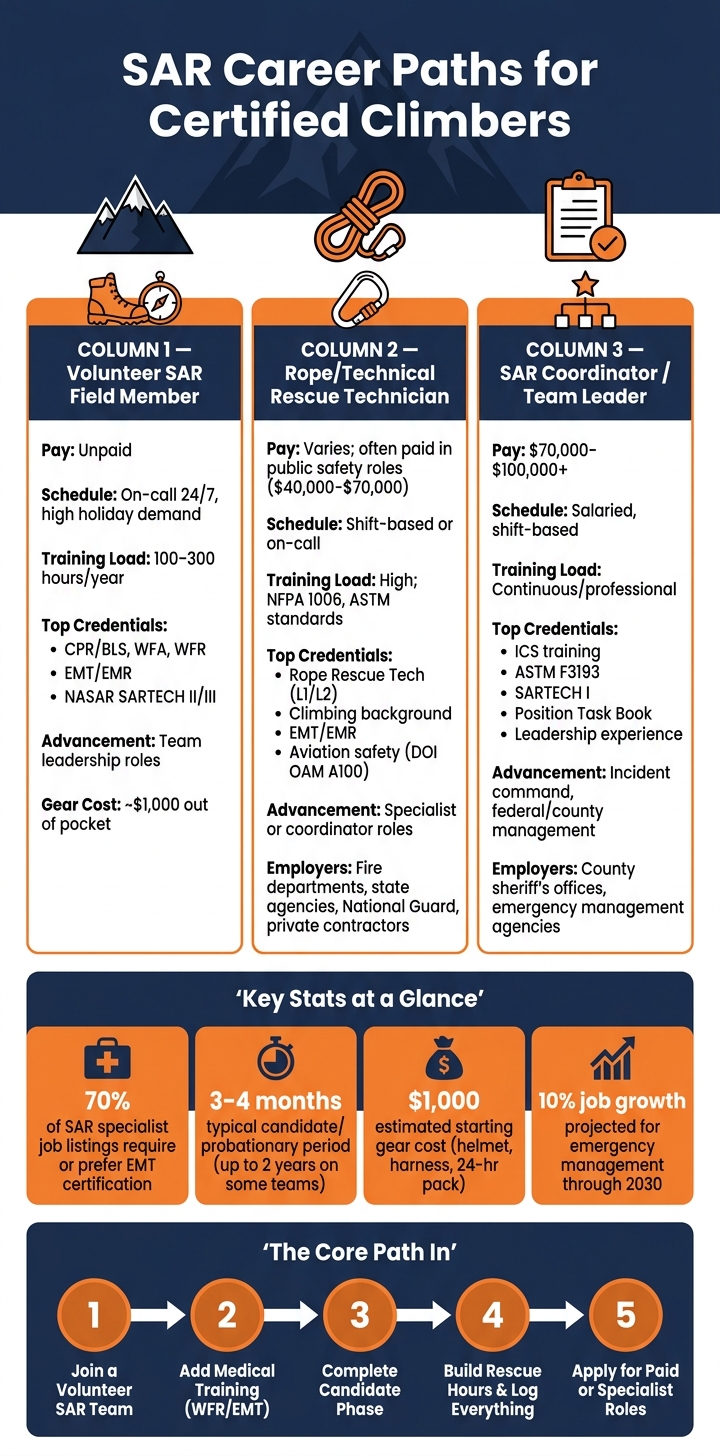
SAR Career Paths for Certified Climbers: Pay, Training & Requirements
How to Prepare to Join a Search and Rescue Team | SAR Training for finding Missing Persons
sbb-itb-9d004f0
Core search and rescue roles for certified climbers
Certified climbers usually get into SAR through field work first. From there, many move into rope rescue or leadership.
Mountain and wilderness SAR team member
This is the main field role. Field team members do the direct, boots-on-the-ground work: hasty searches, grid searches for clues, patient carries in a Stokes litter, and emergency medical care within the limits of their certifications.
What sets stronger applicants apart is usually medical training and navigation. Teams expect solid topo map reading, GPS use, and calm judgment when things get messy. WFR or EMT can make an application stronger. Just as important, teams want people who work well with others and take coaching without friction.
Technical rope rescue technician and helicopter-supported rescue roles
This is where climbing ability lines up most clearly with SAR work. Rope rescue technicians handle complex anchor systems and high-angle evacuations on cliffs, canyon walls, and steep rock faces. These jobs are often based in fire departments, public safety agencies, or private technical rescue contractors.
NASAR uses Awareness, Operational, Technician, and Supervision levels. High-angle rescue calls for Technician-level training. When rope rescue shifts into aerial evacuation, aviation safety training comes next. For helicopter-supported roles, extra aviation safety credentials may apply, such as DOI OAM A100, which covers hoist safety and short-haul awareness. These jobs are usually found with state agencies, the National Guard, or private aviation rescue contractors.
SAR specialist, team leader, and coordinator
Leadership roles in SAR, whether as a specialist, team leader, or coordinator, come from field time more than a stack of credentials. Team leaders direct squads during live missions. Coordinators, often based in a county sheriff's office or emergency management agency, handle the big-picture work: mission planning, resource allocation, risk management, and multi-agency logistics under the Incident Command System (ICS). At this stage, humility, coaching, and sound judgment matter more than ego.
The main difference between these paths is the size of the job they carry.
| Role | Primary Focus | Key Skills | Common Employers |
|---|---|---|---|
| Field Team Member | Ground search and patient care | WFR/EMT, navigation, fitness | County volunteer teams, National Park Service |
| Rope/Helicopter Technician | High-angle and aerial rescue | Technical rope systems, aviation safety certs | Fire departments, state agencies, National Guard, private contractors |
| SAR Coordinator | Mission management and logistics | ICS training, risk management, leadership | County sheriff's offices, emergency management |
Training and certifications that move climbers into SAR work
If you want to move from climbing into SAR, field roles usually come down to two things: medical training and technical rescue skill. That matters most for field members, rope technicians, and alpine rescue roles. The strongest applicants don’t just climb well. They pair climbing credentials with rescue and medical qualifications.
Climbing and guiding credentials that strengthen SAR applications
AMGA’s SPI, Rock Guide, and Alpine Guide tracks carry a lot of weight for rope and alpine SAR work. Rock Guide candidates need solid multipitch and trad-leading experience. For alpine and expedition work, IFMGA recognition is the top international standard and carries strong weight for SAR employers.
Climbing credentials help you get noticed. Medical certification is what usually gets you into field work.
Medical and rescue certifications employers look for
Typical starting credentials include CPR/First Aid and Basic Life Support (BLS). Many teams also look favorably on Wilderness First Aid (WFA) or Wilderness First Responder (WFR). Busier or paid teams often require Emergency Medical Technician (EMT), Wilderness EMT (WEMT), or Emergency Medical Responder (EMR) certification. In day-to-day hiring, many teams want EMR or EMT plus continuing education.
Medical training is only part of the picture. NASAR’s SARTECH I, II, and III certifications are widely recognized and show core field skills like navigation, tracking, and survival. For technical rope rescue roles, teams often refer to NFPA 1006 and ASTM mountain and rope rescue standards. Avalanche Level 1 or 2 is also useful if the work involves snow terrain.
Once recruits have those credentials, most teams put them through a formal candidate period.
How climbers move from trainee to field-ready SAR member
Most new SAR members go through a probationary or candidate period that lasts 3 to 4 months, though some teams use a full two-year cycle before someone is seen as a trusted field member. During that stretch, recruits work through classroom instruction, scenario-based field exercises, and winter-condition training before becoming full field members.
| Stage | Key Credentials | Focus Area |
|---|---|---|
| Trainee / Candidate | CPR, BLS, WFA, NASAR SARTECH III | Navigation, survival, team basics |
| Field Member | WFR, WEMT, EMT, SARTECH II, Avalanche Level 1 | Patient care, technical rescue |
| Advanced Member | Rope Rescue Tech (L1/L2), Swiftwater Rescue, Avalanche Level 1/2 | Advanced technical systems |
| Team Leader | ASTM F3193, SARTECH I, Position Task Book | Incident command, field supervision |
| Instructor | AMGA RGE / IFMGA, Train-the-Trainer | Mentorship, technical evaluation |
Instructor-level roles usually call for train-the-trainer coursework and, for climbing-specific jobs, full AMGA guide credentials.
Career progression, pay, and job search strategy
Entry points, advancement steps, and lifestyle trade-offs
Once you’ve got the rescue and medical credentials in place, moving up usually comes down to three things: time in the field, reliability, and availability.
For climbers, the most common way in is a volunteer SAR team. That’s where rope work and alpine skills tend to transfer the fastest into technical rescue jobs. In most cases, you start as a field member, build experience on missions and training days, then move into rope technician work. From there, people often step into team lead or coordinator roles, and later into incident command or SAR coordinator positions.
That path sounds straightforward on paper. In practice, it can be tough to break in. In some highly competitive regions, teams may get as many as 100 applications for just 12 open volunteer spots.
The bigger issue for many people isn’t skill. It’s the lifestyle. Volunteer SAR can demand near-constant readiness, including holidays, family events, and overnight callouts. Paid roles bring more structure, but they still come with shift work, required training, and the steady work of keeping certifications current.
There’s also some out-of-pocket cost at the start. Plan to spend about $1,000 on personal gear, including a helmet, harness, and 24-hour personal pack.
| Path | Pay | Schedule | Training Load | Advancement Potential |
|---|---|---|---|---|
| Volunteer | Unpaid | On-call (24/7), high holiday demand | High; 100–300 hrs/year | Limited to team leadership |
| Seasonal | Hourly or contract-based | Fixed seasonal terms, often 40+ hrs/week | Moderate to high; intensive pre-season training | Stepping stone to full-time roles |
| Full-Time | $40,000–$100,000+ | Salaried, shift-based or on-call | Continuous/professional | High; coordinator or specialist roles |
What pay and schedules look like in the United States
The main trade-off in U.S. SAR is pretty simple: you give a lot of time, and the pay is often modest.
Most SAR work in the United States is volunteer-driven. A lot of team members have full-time jobs in other fields - teaching, nursing, engineering - and fit SAR around the rest of life. Paid roles exist, but they’re far less common. You’ll mostly find them with the National Park Service, county sheriff’s offices, emergency management agencies, and other government rescue programs.
When one of those paid jobs opens up, medical credentials often help tip the scale. About 70% of SAR specialist job listings require or prefer EMT certification. That means EMT or EMR training doesn’t just help in the field. It can also help volunteers move into paid roles that draw a lot of applicants.
| Job Title | Salary Range | Typical Employer |
|---|---|---|
| Entry-Level SAR Technician | $30,000–$50,000 | County agencies, state parks |
| SAR Specialist / Team Member | $40,000–$70,000 | NPS, sheriff's offices |
| SAR Team Leader | $70,000–$90,000 | Municipal/state agencies |
| SAR Coordinator / Manager | $80,000–$100,000 | County/federal agencies |
NPS ranger positions at the GS-7 to GS-11 levels usually pay between $46,000 and $70,000+, depending on locality. Emergency management specialists earn a median of about $70,000 per year, and that field is projected to grow 10% through 2030.
Finding SAR and technical rescue openings with Get Outdoor Jobs

When you’re ready to apply, timing matters more than many people expect. A lot of openings don’t stay live for long, so it helps to check often and start early. Seasonal hiring windows often open in late fall or early spring, which gives regular job checkers a clear edge.
Get Outdoor Jobs pulls outdoor industry roles from multiple sources into one searchable database with daily updates. For SAR candidates, the smartest move is to search with narrow terms such as "search and rescue", "technical rescue", "rope rescue", "EMT," or "WEMT." Then filter by location, job type, and specialty so you’re not digging through jobs that don’t fit. Daily alerts can also help you spot new postings right away.
Conclusion: Turning climbing credentials into a long-term SAR career
For certified climbers, the route into SAR is clear, but it takes work. You need more than climbing ability. You also need medical training, rescue systems knowledge, and time in the field.
Most people move from candidate to field member, then into specialist, leadership, or coordinator roles. That progress tends to stall if you can’t show proof that you’re ready. That’s where structured tracking comes in. Use a Position Task Book to log training and field experience so your readiness is on paper, not just assumed. And in SAR, teamwork counts just as much as technical skill.
Use Get Outdoor Jobs to track current SAR openings and be ready when the right role shows up.
FAQs
Do I need EMT or EMR to get started in SAR?
It depends on the team or agency. Many SAR roles require or strongly prefer EMT or EMR credentials. Others treat them as a plus, or ask you to earn them soon after you join.
A lot of entry-level roles start with CPR and First Aid. From there, the training often moves into wilderness-focused medical care, since that’s the kind of setting many SAR teams work in.
How is rope rescue different from climbing experience?
Climbing and rope rescue both use vertical systems, but they’re not the same thing.
Climbing is mostly about personal movement and sport. Rope rescue, on the other hand, is an emergency service that calls for careful planning, route finding, and managing complex systems when the pressure is on.
Rope rescue also puts a lot of weight on team-based safety and strict procedures. Rescuers have to manage litter raises, patient packaging, and terrain-specific operations in high-stakes, unpredictable conditions.
Can I build a paid SAR career after volunteering?
Yes. Volunteer experience often lays the groundwork for paid search and rescue jobs, especially with municipal fire departments, federal agencies, state task forces, and private rescue groups.
If you want to make that move, start by documenting your deployments and certifications. Many applicants also improve their odds with advanced medical credentials and technical certifications like NFPA 1006. Requirements vary by agency and region.