
Top Climate-Specific Hazards for Outdoor Workers

Outdoor workers in the U.S. face increasing risks from climate-related hazards, including extreme heat, wildfire smoke, severe storms, cold stress, and vector-borne diseases. These challenges vary by region, occupation, and season, significantly impacting worker health and income. Key findings include:
- Extreme Heat: The Southern U.S. experiences 81.7% of all heat-related workplace incidents. Construction workers face the highest risk, with July being the peak danger month. Heat exposure could quadruple by 2065, threatening $55.4 billion in annual earnings.
- Wildfire Smoke: Workers in the West, especially in California, face prolonged exposure to hazardous air quality during wildfire seasons. Emergency responders and agricultural workers are most affected.
- Severe Storms and Flooding: Coastal and inland regions face rising risks from hurricanes, floods, and heavy rains, endangering first responders and outdoor laborers.
- Cold Stress: Winter conditions pose risks nationwide, with wind chill and wet environments increasing dangers like frostbite and hypothermia.
- Vector-Borne Diseases: Warmer climates expand the range of ticks and mosquitoes, exposing workers to diseases like Lyme and West Nile Virus.
Employers and workers must prioritize safety measures, including proper training, protective gear, and monitoring tools like WBGT meters. Mitigating these risks is critical to safeguarding health and preventing economic losses.
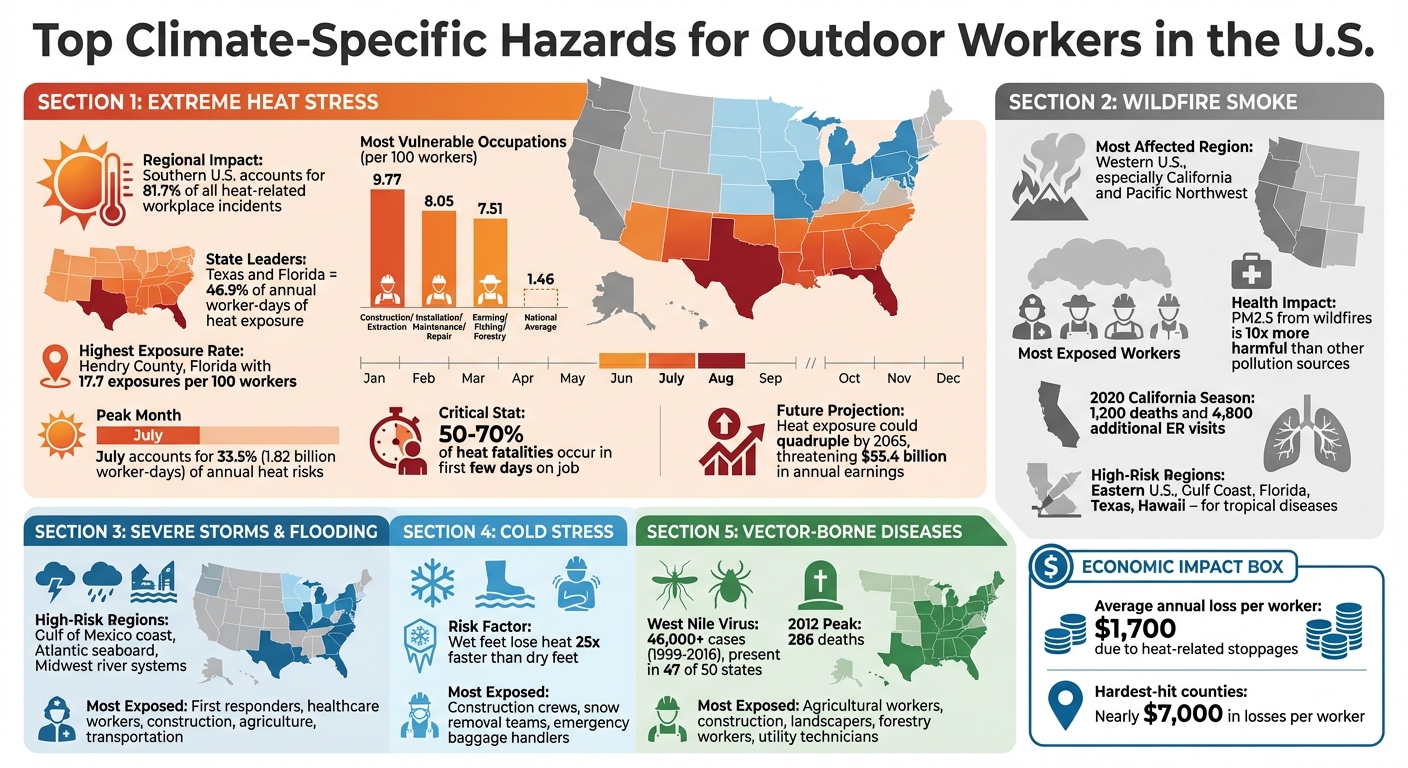
Climate Hazards Impact on U.S. Outdoor Workers by Region and Occupation
1. Extreme Heat Stress
Regions Most Affected
Not sure what outdoor role fits you?
Take our 2-minute career quiz to get matched with outdoor jobs that align with your goals, salary target, and lifestyle.
The Southern United States bears the brunt of occupational heat stress, accounting for a staggering 81.7% of all heat-related workplace incidents in the contiguous U.S.. Workers in this region face 4.44 billion heat-exposure days annually. Florida and Texas are particularly hard hit, together making up 46.9% of the nation’s annual worker-days of heat exposure.
Among all states, Louisiana and Florida see the highest exposure rates. In fact, Hendry County, Florida, stands out with the highest daily rate, recording 17.7 exposures per 100 workers. The combination of scorching temperatures, intense sunlight, and high humidity creates a hazardous environment where the body struggles to cool itself through sweat evaporation. Florida has seen a sharp rise in exposure, with an additional 34.7 million worker-days added annually during the 2010s.
This uneven distribution of heat stress highlights the varying risks faced by outdoor workers across different regions.
Outdoor Occupations Most Exposed
Certain industries face heightened risks due to the nature of their work and environmental conditions.
Construction and extraction workers are the most vulnerable, with an exposure rate of 9.77 per 100 workers, far exceeding the national average of 1.46. Other high-risk sectors include installation, maintenance, and repair at 8.05 per 100, and farming, fishing, and forestry at 7.51 per 100. These jobs often involve prolonged outdoor activity combined with strenuous physical labor, which generates additional body heat. For instance, a 70-kg worker engaged in very heavy tasks, like intense shoveling, can produce up to 520 Watts of metabolic heat.
Seasonality of Risk
The danger peaks in July, the deadliest month for heat exposure, which accounts for 33.5% (1.82 billion worker-days) of annual heat-related risks. Surprisingly, heavy workloads can lead to heat-related illnesses even at temperatures as low as 65°F. Direct sunlight can further intensify the heat, adding up to 13.5°F to the Heat Index. Tragically, fatalities have occurred at Heat Index levels as low as 86°F.
Key Safety Challenges
The most perilous time for workers is during their first few days on the job, when their bodies haven’t yet adapted to the heat. Alarmingly, 50%–70% of heat-related fatalities occur during this critical adjustment period. Compounding the issue, standard thermometers and Heat Index readings often underestimate actual risk, as they fail to account for direct sunlight, wind, and physical workload. To get accurate onsite data, experts recommend using WBGT (Wet Bulb Globe Temperature) meters. Additionally, wearing vapor-barrier coveralls can significantly worsen conditions, raising the effective temperature by 19.8°F.
sbb-itb-9d004f0
2. Wildfire Smoke and Poor Air Quality
Regions Most Affected
The Western United States is no stranger to wildfire smoke, with regions like California and the Pacific Northwest enduring extended fire seasons that often peak from late summer into autumn. In August 2021, the Dixie Fire became California's largest single wildfire on record, shrouding Northern California in hazardous smoke. Around the same time, the Caldor Fire triggered mass evacuations near Lake Tahoe as air quality reached dangerous levels.
But wildfire smoke isn't confined to these hotspots. In March 2021, two human-caused fires near South Dakota's second-largest city and Utah's recurring basin inversions showed how smoke can impact areas far from traditional fire zones. These widespread challenges significantly affect outdoor workers in these regions.
Outdoor Occupations Most Exposed
Certain outdoor jobs bear the brunt of wildfire smoke exposure. Emergency responders - such as firefighters, paramedics, and police officers - are directly exposed to hazardous smoke and combustion byproducts during active operations. Agricultural and migrant workers face prolonged exposure to particulate matter, often compounded by language barriers and limited access to safety resources. Similarly, construction crews and utility workers remain outdoors even when smoke travels far from the fire's origin.
These roles often involve physically demanding tasks, which increase the inhalation of toxic particles. Migrant workers, in particular, are at heightened risk due to factors like poverty, lack of safety training, and employment by smaller businesses that may lack protective resources.
Key Safety Challenges
The fine particulate matter known as PM2.5 is a major health hazard, as it can penetrate deep into the lungs and bloodstream. Particles from wildfire smoke are up to 10 times more harmful than those from other pollution sources. When wildfire smoke causes PM2.5 levels to spike, asthma-related hospital visits can increase tenfold compared to moderate rises linked to urban pollution. For example, during California's 2020 wildfire season, an estimated 1,200 deaths and 4,800 additional emergency room visits were attributed to respiratory issues.
Standard safety protocols often fall short during wildfire events, leaving high-risk groups - including emergency responders - vulnerable. Mental health struggles among these workers add another layer of concern. To address these risks, employers should provide N95 respirators, create filtered break areas with air conditioners set to "recirculate", and use the AirNow website for real-time air quality updates. Additionally, offering multilingual safety training materials can help protect immigrant workers.
3. Severe Storms and Flooding
Regions Most Affected
Extreme weather events are becoming more frequent and severe across the United States, with climate change amplifying their intensity. Coastal regions along the Gulf of Mexico and the Atlantic seaboard frequently endure hurricane-related flooding, while the Midwest grapples with river floods triggered by heavy spring rains. Mountain areas often face flash floods caused by rapid snowmelt, and shifting weather patterns are bringing more severe storms to inland regions.
These regional differences highlight the importance of creating safety measures tailored to the specific risks each area faces, much like the strategies needed for other climate-related challenges.
Outdoor Occupations Most Exposed
Certain jobs place workers directly in harm's way during severe storms and floods. First responders - such as paramedics, firefighters, and police officers - are often on the front lines, braving the most dangerous conditions during and after these events. Similarly, workers in healthcare, construction, agriculture, and transportation face significant risks due to limited access to shelter during extreme weather.
"Floods, storms, droughts, and wildfires often require complex emergency response, recovery, and rescue operations. These operations put many types of workers at risk, including first responders, health care workers, and those involved in pre- and post-disaster support." – EPA
The overlapping risks faced by these workers emphasize the need for thorough and effective safety protocols across all outdoor industries.
Key Safety Challenges
Severe storms, much like extreme heat or wildfire smoke, demand vigilant safety precautions. Flooding poses immediate physical dangers but also leads to secondary hazards, such as mold, bacteria, and waterborne illnesses, which can worsen respiratory conditions. For those involved in disaster response, the mental toll is significant, with anxiety, depression, and PTSD often accompanying the physical risks. Severe storms present a unique challenge by combining immediate physical threats with long-term environmental and psychological impacts.
To address these challenges, employers should focus on providing hazard-specific training, ensuring access to mental health resources, and implementing measures like proper ventilation and drying systems in areas affected by flooding. These steps can help protect both the physical and mental well-being of workers exposed to severe storms.
Too Hot to Work: the effects of extreme heat on outdoor workers
4. Cold Stress and Winter Conditions
Cold stress brings its own set of challenges for those working outdoors, adding to the hazards posed by heat and smoke.
Regions Most Affected
Cold stress isn't limited to the northern states that experience severe winters. The danger level depends on regional thresholds - what feels dangerously cold in one area might not be the same in another. For instance, in milder climates, temperatures as high as 32°F can still pose serious risks. Wind chill makes matters worse, turning a 40°F day into what feels like 28°F on exposed skin.
Outdoor Occupations Most Exposed
Certain outdoor jobs put workers at a higher risk of cold stress. Construction crews, snow removal teams, and emergency responders like police officers, firefighters, and EMTs regularly face freezing conditions. Other roles, such as baggage handlers, landscapers, and oil and gas workers, often require long hours outside in low temperatures.
Seasonality of Risk
While winter is the primary season for cold-related dangers, these risks aren’t confined to just a few months. Wet conditions can trigger cold-related issues like trench foot, chilblains, or even hypothermia at almost any time of year. This means workers in consistently damp environments may face cold stress risks throughout the year, making year-round safety precautions essential.
Key Safety Challenges
Cold weather risks become even more dangerous when wet conditions are involved. For example, wet feet lose heat 25 times faster than dry feet, making waterproof footwear a necessity. Beyond the immediate threats of frostbite and hypothermia, winter also introduces hidden dangers. Snow can obscure hazards like skylights or weakened roof areas, increasing the risk of falls. Moisture from snow can also reduce the insulating properties of protective gear, heightening the chance of electrocution. Additionally, heavy physical work in cold conditions can lead to rapid fatigue or even cardiac stress.
To address these challenges, employers should take proactive steps. Scheduling the heaviest tasks during the warmest part of the day, using a buddy system to monitor for symptoms, and ensuring access to warm, dry break areas can make a significant difference in keeping workers safe.
5. Vector-Borne Diseases and Biological Hazards
The changing climate is giving disease-carrying insects and ticks a broader range, creating new health risks for outdoor workers across the U.S. Managing these vector-borne hazards requires specialized safety measures tailored to the evolving challenges.
Regions Most Affected
Climate change isn't just about rising temperatures - it also intensifies the spread of vector-borne diseases. West Nile Virus, for instance, is the most common mosquito-borne disease in the U.S., with infections reported in 47 out of 50 states in 2017. Between 1999 and 2016, over 46,000 cases were documented, with 2012 standing out as the deadliest year, accounting for 286 deaths. In the eastern U.S. and Gulf Coast regions, the presence of malaria-carrying mosquitoes has increased, though actual malaria cases remain low - around 2,000 annually, mostly tied to international travel. Meanwhile, tropical diseases like Dengue, Chikungunya, and Zika are more prevalent in Florida, Texas, Hawaii, Puerto Rico, and the U.S. Virgin Islands. On the other hand, Lyme disease and other tick-borne illnesses are creeping into new areas as warmer temperatures allow ticks to thrive in places they previously couldn’t.
Outdoor Occupations Most Exposed
Certain jobs come with higher risks due to the nature of the work environment. Agricultural workers, construction crews, landscapers, forestry workers, utility technicians, and mail carriers often find themselves in settings like wooded areas, tall grass, or leaf litter - ideal habitats for ticks and insects. Emergency responders, including firefighters and paramedics, face unique challenges during disaster recovery efforts, especially after floods or hurricanes, when mosquito populations can spike. Migrant and immigrant workers face additional risks, as language barriers may limit their access to critical safety training.
Seasonality of Risk
The danger from ticks and mosquitoes isn’t constant - it changes with the seasons. Tick activity tends to peak during warmer months, while mosquito-borne diseases become more of a threat as rising temperatures and increased rainfall extend their breeding seasons. Climate change has stretched these periods, starting earlier in spring and lasting longer into fall. Higher temperatures also speed up mosquito development and increase their biting frequency, leaving outdoor workers exposed for longer periods than in previous decades.
Key Safety Challenges
"Outdoor workers, such as agricultural workers, could be at higher risk of exposure to tick and insect bites that cause Lyme disease, West Nile virus, and other diseases." - EPA
The risks don’t stop at insect bites. Shifting pest populations have led to increased pesticide use in agriculture, exposing workers to additional chemical hazards. These pesticides can linger on clothing or skin, potentially bringing the danger home. Small businesses, in particular, often struggle to implement robust safety programs to address these biological risks. To reduce exposure, workers should use insect repellents, wear long-sleeved clothing, and conduct thorough tick checks after working in grassy or wooded areas. Employers also play a crucial role by providing protective gear and training tailored to local and seasonal risks, including awareness of venomous wildlife and poisonous plants.
Pros and Cons
This section examines the tangible benefits of a thriving outdoor job market while highlighting the growing risks posed by climate challenges.
Working outdoors in areas prone to extreme weather presents a difficult trade-off: access to abundant job opportunities versus exposure to serious health risks. For example, the U.S. South offers a wealth of jobs in construction, agriculture, and energy. However, it also accounts for a staggering 81.7% of all heat-related workplace incidents in the country. Texas and Florida alone contribute 46.9% of annual heat exposure cases. For many workers, particularly those in seasonal roles, this means choosing between earning a paycheck and safeguarding their health during the most hazardous times of the year.
New workers face an especially steep learning curve. Early exposure to extreme heat is particularly dangerous, especially if employers fail to gradually increase workloads to allow for acclimatization. Seasonal workers are particularly vulnerable, and the economic toll can be severe. On average, outdoor workers lose over $1,700 annually due to heat-related stoppages, with losses climbing to nearly $7,000 in the hardest-hit counties.
"No one should be put in a position where they have to choose between their income and their health."
The regional concentration of outdoor jobs further complicates the situation. Jobs in construction and extraction industries have the highest heat exposure rates, with 9.77 incidents per 100 workers - more than six times the national average of 1.46. While this steady demand bolsters job growth in Sun Belt cities, it also exposes workers to additional risks such as poor air quality, limited access to air-conditioned housing, and socioeconomic challenges like language barriers. Areas where the majority of residents lack a high school diploma experience a 3.5-fold increase in heat-related workplace incidents compared to more educated communities.
The risks tied to extreme heat and poor air quality highlight how environmental factors directly affect worker safety and economic stability. High temperatures can impair decision-making and fine motor skills, increasing the likelihood of falls, equipment-related accidents, and reduced productivity. For employers, this creates a balancing act: they benefit from a large, available workforce but must contend with higher injury rates, rising workers' compensation claims, and potential penalties as states like California, Oregon, and Washington enforce stricter heat safety regulations.
| Factor | Advantages | Disadvantages |
|---|---|---|
| Job Availability | High demand in construction, agriculture, and energy sectors in the South | 81.7% of heat-related exposures occur in the region |
| Seasonal Work | Hiring peaks during summer months | 33.5% of annual heat-related incidents occur in July |
| Worker Adaptation | Acclimatized workers face lower risks (0.11 vs. 1.46 incidents per 100 workers) | 50–70% of fatalities occur within the first few days of exposure |
| Economic Impact | Steady income during high-demand periods | Workers risk losing $1,700–$7,000 annually due to heat-related work stoppages |
| Regional Growth | Expanding job markets in Sun Belt areas | Climate change could quadruple extreme heat exposure by 2065 |
These challenges and opportunities underscore the importance of developing thoughtful strategies to protect outdoor workers while supporting economic growth in these regions.
Conclusion
Outdoor workers in the U.S. are facing growing threats from extreme heat, wildfire smoke, severe storms, cold stress, and vector-borne diseases. These risks are intensifying, and both workers and employers need to act swiftly to mitigate the dangers.
For workers, understanding and addressing vulnerabilities is key, especially for those new to outdoor jobs. Starting with shorter shifts, staying hydrated, and checking local air quality conditions are essential first steps to reduce risks.
Employers, on the other hand, have a responsibility to create safer work environments. This can include implementing heat illness prevention plans that use WBGT (Wet Bulb Globe Temperature) monitoring, enforcing "Water, Rest, and Shade" protocols, and providing multilingual training to ensure all employees understand safety measures. Several states, including Washington, Minnesota, California, Oregon, and Colorado, have already introduced laws targeting occupational heat exposure. As climate challenges grow, more regulations are likely to follow.
The economic stakes are just as serious. Without action, climate change could quadruple outdoor workers' exposure to extreme heat by 2065, potentially putting $55.4 billion in annual earnings at risk. Workers need to factor in regional climate hazards when planning their careers. Evaluating job options should include considerations like acclimatization support, employer safety policies, and access to protective gear.
For those navigating these challenges, platforms like Get Outdoor Jobs can be a valuable resource. By offering tools to filter job opportunities based on geographic risks and highlighting employers in states with stronger safety laws, it helps workers make informed decisions. Whether you're pursuing roles in agriculture, construction, emergency services, or conservation, aligning your career with safety standards and regional climate realities can protect both your health and your income.
FAQs
What steps can outdoor workers take to stay safe in extreme heat?
Extreme heat can be a serious hazard for outdoor workers, but there are ways to reduce the risks and stay safe. First and foremost, stay hydrated. Make it a habit to drink cool water regularly - about 1 quart every 15–20 minutes is a good rule of thumb. For longer shifts, you might also want to include electrolyte drinks to replenish lost minerals. Dressing wisely matters too: opt for lightweight, light-colored clothing and a wide-brimmed hat to help keep your body cool. And don’t forget to take breaks in shaded or air-conditioned areas, especially when temperatures climb above 80°F. If possible, plan the toughest tasks for cooler times of the day, like early morning or late afternoon.
Another important step is acclimatization. Workers who are new to the heat - or returning after some time away - should gradually increase their exposure over 7–14 days to give their bodies time to adjust. Be on the lookout for early warning signs of heat-related illness, such as dizziness, headaches, or excessive sweating. If these symptoms show up, stop working immediately, move to a cooler spot, drink water, and seek medical help if necessary. Employers also play a critical role here - they should provide proper training on heat safety and have clear plans in place for prevention and emergencies.
By prioritizing hydration, wearing the right clothing, taking frequent breaks, and staying alert to warning signs, outdoor workers can stay safer and more productive, even in extreme heat.
What steps can employers take to protect outdoor workers during wildfire smoke events?
Employers need to keep a close eye on the air quality index (AQI) and PM2.5 levels by relying on updates from reliable sources like the EPA or local health departments. Adjusting work schedules is key - try to avoid outdoor tasks when air quality dips into unhealthy ranges and postpone non-essential activities if possible. For outdoor work that can’t be delayed, aim to schedule tasks during cooler parts of the day when smoke levels are typically lower.
Providing workers with N95 respirators or higher-efficiency masks is essential. Make sure they’re properly fitted and that employees are trained on how to use them effectively. To further reduce exposure, encourage frequent breaks in shaded areas, ensure workers stay hydrated with water or electrolyte drinks, and limit physical exertion. It’s also important to educate employees about the signs of smoke-related illnesses, like headaches, coughing, or shortness of breath, and encourage them to report any symptoms right away.
Lastly, having a solid emergency response plan is crucial. This plan should include clear evacuation routes, designated safety zones, and easy access to protective equipment to keep everyone safe if conditions take a turn for the worse.
What outdoor jobs face the greatest risks from climate-related hazards?
Outdoor workers who spend long hours exposed to the elements are among the most at risk from climate-related dangers. Jobs in agriculture, forestry, fishing, construction, and waste management make up the majority of heat-related occupational deaths in the U.S., with extreme heat posing a major threat. Emergency responders, including firefighters, paramedics, and police officers, also face serious risks from wildfire smoke, flooding, and other climate-driven events.
Workers in industries like transportation, landscaping, and farming often deal with heightened challenges such as extreme temperatures, prolonged sun exposure, and increased noise levels - all of which are exacerbated by climate change. These roles are a key focus of safety training and climate-adaptation initiatives designed to minimize risks and improve working conditions.
If you're considering a career in one of these fields, platforms like Get Outdoor Jobs offer thousands of listings tailored to your skills and location, making it easier to find the right opportunity.