
Collaborating With Outdoor Groups: Tips for Success
If I want to work well with outdoor groups, I keep it simple: pick the right group, offer one clear skill, put roles in writing, and follow through.
In the U.S., many trail clubs, land trusts, and volunteer crews work with public land agencies like the USFS and BLM. Some projects run on 45- to 90-day public comment windows, and many groups are short on staff, so they often need steady help more than big promises. That means I stand out by being clear, reliable, and easy to work with.
Here’s the short version:
- Research first. I look at the group’s mission, current projects, and where they are short on time or help.
- Match one skill to one need. A specific offer gets more replies than a vague “happy to help.”
- Use clear communication. A short email, one direct ask, and written roles save time for everyone.
- Handle safety early. Waivers, insurance questions, site rules, and risk plans should not wait.
- Help in more than one way. Field work matters, but admin support, data work, and event setup matter too.
- Track my work. Hours, events, and project numbers turn volunteer work into resume proof.
A simple example: instead of saying I’d love to get involved, I’d say I saw your trail count project and I can help collect and organize field data for the next two workdays. That is easier to act on.
Not sure what outdoor role fits you?
Take our 2-minute career quiz to get matched with outdoor jobs that align with your goals, salary target, and lifestyle.
Bottom line: the people who get asked back are usually the ones who show up, do the work, and make things easier for the group.
This article breaks down how I would do that step by step.
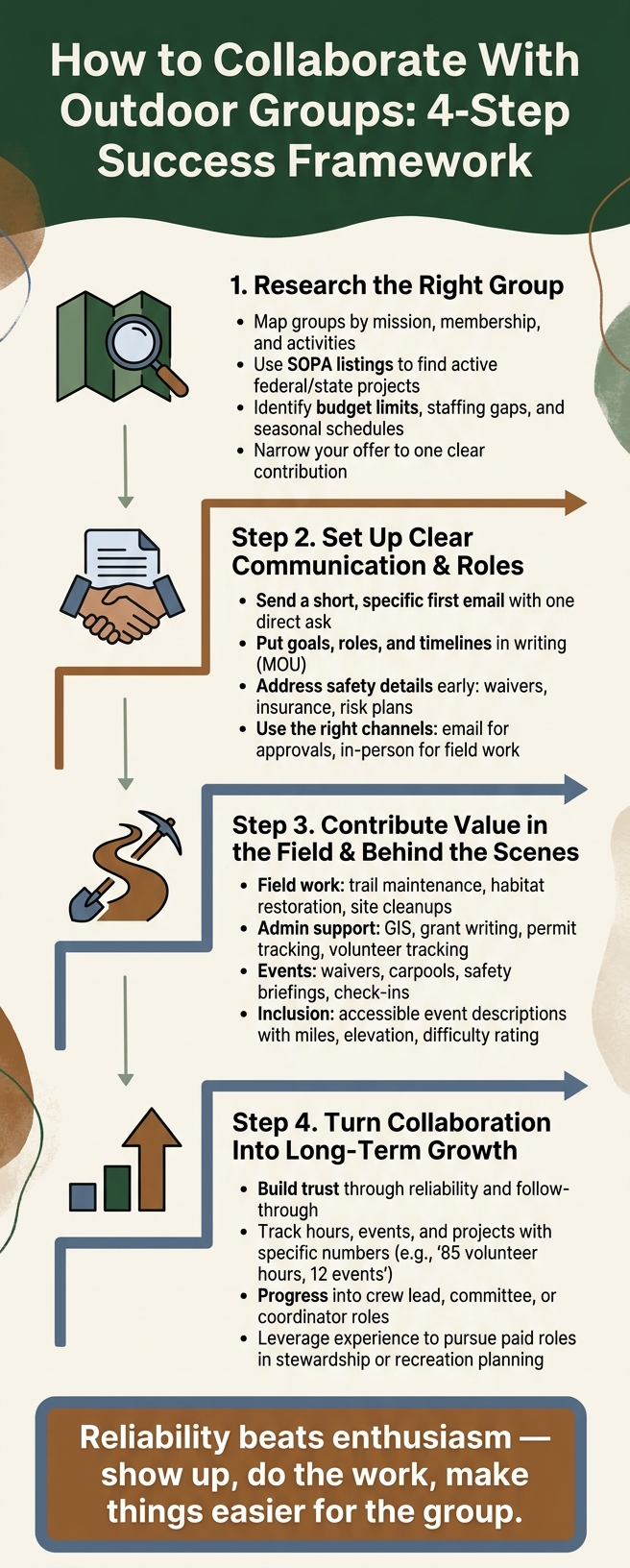
How to Collaborate With Outdoor Groups: 4-Step Success Framework
1. Research the right groups before reaching out
Research each group before you reach out. Generic outreach tells people you haven’t done your homework. Before you contact anyone, put together a short profile for each group: their mission, who they serve, what they’re working on now, and where they’re stretched thin. That homework turns a broad intro into a relevant proposal. Once you know who the group is, the next step is figuring out what they need and what they can realistically take on.
Map local groups by mission, membership, and activities
U.S. outdoor groups include trail clubs, conservation nonprofits, land trusts, and affinity groups such as BIPOC run clubs or women's mountain biking groups. The point isn’t just to find a group. It’s to find one where your skills fix a real problem.
A few places to look:
- Group websites and social media
- Outdoor shop calendars
- Local USFS or BLM partner lists
- The Schedule of Proposed Actions (SOPA) from the Forest Service or BLM for federal and state projects
SOPA can be especially helpful because it shows planning work already in motion. If a project is active, there may be a place where outside help fits.
Identify each group's priorities and limits
Most groups focus on conservation, safety, trail maintenance, and reducing user conflict. But that’s only half the story. You also need to know what’s slowing them down.
Many groups run on small budgets, volunteers, and seasonal schedules. Some also deal with legal and permitting limits, including NEPA compliance requirements, that shape what they can and can’t do. If you understand those limits before reaching out, your proposal is more likely to land well. It also shows respect for how the group works.
Use what you learn to narrow your offer to one clear contribution.
Match your skills to a specific need
Pick one skill that supports the group’s current work. Then explain your value in one sentence that ties what you offer to the group’s mission. Say a local trail group needs help collecting trail counts or user survey data, and you have GIS or data collection experience. That’s a direct match.
Here’s the basic idea:
- Ask what the group needs
- Match one skill to that need
- Make your offer specific
Vague offers tend to get ignored. Specific offers get replies.
After you identify the right group and the right need, set clear expectations before you offer help.
sbb-itb-9d004f0
2. Set up clear communication and roles from the start
Once you’ve matched your skills to a need, reach out with a clear purpose. Start by asking about priorities, deadlines, and what kind of help they need most. That first email should be short and direct: a clear subject line, one sentence on who you are, one sentence on something specific you noticed in their work, and one specific ask, such as a 20-minute call the week of 10/12/2026.
Keep it simple. One concise message. One clear ask.
Make a professional first contact
Reach out to the person who actually handles the work. In most cases, that means the local coordinator or recreation technician first. If you’re emailing, mention something specific so your note doesn’t feel generic - a trail project they’re running, a public comment period that’s open, or a planning deadline they’re working against.
That small bit of context goes a long way. It shows you’ve done your homework and that you’re not just sending the same email to ten different groups.
Write down goals, responsibilities, and safety details
After the first conversation, put the agreement in writing right away. As the work grows, move to a simple written outline or a Memorandum of Understanding (MOU) that spells out shared goals, roles, timelines, safety expectations, and how decisions will be made.
"If it isn't in writing, it didn't happen." - Trails Preservation Alliance
| Collaboration Element | Group/Land Manager Responsibilities | Your Responsibilities |
|---|---|---|
| Oversight | Legal/planning requirements, safety standards, land-use permits | Project coordination, technical labor, volunteer recruitment |
| Resources | Land access, existing data, maintenance capacity | Specialized skills (e.g., GIS, trail building), gear, grants |
| Deliverables | Final approvals, official signage, public safety oversight | Progress reports, field observations, volunteer hours |
| Risk Management | Insurance requirements and liability frameworks | Adherence to safety protocols and risk management plans |
Safety details matter early, not later. Waiver requirements, risk management plans, preparedness information, and any insurance questions should be handled during the first planning stages.
Use the right channels for updates and feedback
Use email when you need approvals and a written record. Use in-person check-ins for field work and group meetings. Newsletters and social posts work well for surveys and public comment deadlines.
After each project or event, do a short debrief. Keep it tight: what worked, what didn’t, and what should change next time. Then carry those lessons into the next round of work.
That’s how you become useful not just in the field, but behind the scenes too.
3. Contribute useful value in the field and behind the scenes
Once roles are clear, move from planning to direct help. Let the group's top priorities guide where you step in.
Support stewardship projects and event logistics
Field work is one of the clearest ways to pitch in. Trail maintenance, invasive species removal, habitat restoration, and site cleanups are common needs. If you're volunteering on site, show up on time, bring the right gear, and follow the leader's instructions and site rules.
There’s also a lot that happens around the work itself. Groups often need help with volunteer check-ins, signed waivers, carpools, and safety briefings. For small nonprofit teams, help that saves staff time goes a long way. In many cases, small, steady tasks are what lead to bigger responsibilities later.
Share professional skills in focused ways
Professional skills can matter just as much as field labor. If you can help with GIS, data analysis, grant writing, HR, IT, first aid, or budget support, that can make a clear difference.
Before you offer to teach a class or lead a session, check with group leaders first. It needs to fit their risk and insurance rules. And it’s best to lead only in areas where the group’s policies and priorities make room for it.
Improve access, inclusion, and administrative support
Clear event descriptions make it easier for people to decide if they can take part. A good post should include distance in miles, elevation gain in feet, and a plain difficulty rating.
Behind the scenes, groups also get a lot from help with volunteer tracking, documentation templates, event calendars, permit tracking, and coordination with land-use agencies. This work may not get much attention, but it keeps everything else moving.
| Contribution Type | Field-Based | Administrative |
|---|---|---|
| Stewardship | Trail maintenance, invasive species removal, habitat restoration, site cleanups | Grant writing, permit tracking, drafting maintenance specifications |
| Events | Leading hikes, tool safety briefings, site cleanup | Carpool coordination, waiver management, volunteer tracking |
| Education | Map reading, first aid, natural history walks | Event descriptions with mileage, elevation, and difficulty |
| Inclusion | Beginner-friendly guided trips, accessible site selection | Identifying accessible meeting spots, integrating DEI principles in newsletters |
That kind of support builds trust and often puts you in line for larger roles later.
4. Turn collaboration into long-term career growth
Once a collaboration starts working, it can open the door to stronger references and paid work.
Build trust through reliability and follow-through
Trust is built through consistency, not just past experience. Leaders pay attention to the people who do what they said they’d do, even on small tasks. In plain terms: reliability beats enthusiasm. Show up on time, do the work, and finish what you start.
If your schedule changes, let the group know early. If a task is taking longer than planned, say that too. That kind of follow-through matters. People often get references, introductions, and bigger responsibilities because they handled routine jobs well. In many cases, references go to the people who take care of cleanup, repairs, and last-minute logistics without making it a big production.
As people start to trust you, your role can grow.
Take on larger roles as your experience grows
Volunteers often move into crew lead, sawyer, tool wrangler, or committee roles over time. Each step gives you more hands-on experience and something concrete to add to your resume. People who keep showing up are more likely to move into crew-leading and committee roles.
Track your hours, miles, events, or projects so you can turn your work into resume-ready results. Specific numbers show impact better than vague descriptions. A line like “Supported 12 trail work events and logged 85 volunteer hours” says a lot more than “Helped with outdoor projects.”
Documenting your work also makes it much easier to prove that growth later.
Use collaboration experience to find paid outdoor roles
Hands-on work with trail groups or conservation nonprofits can help you figure out which kind of paid work fits you best. Then you can use that experience to go after roles in stewardship, volunteer coordination, or recreation planning.
Get Outdoor Jobs is a practical next step when you're ready, with daily-updated listings across conservation, guiding, environmental services, and administrative roles.
Conclusion: Keep collaborations practical, respectful, and mission-focused
Once the planning, communication, and field work are done, the same basics still apply: consistency, clarity, and follow-through. Good collaboration with outdoor groups usually comes down to four habits: research first, match your skills to a real need, communicate clearly, and do what you said you'd do.
The groups that welcome long-term partners want people who listen before jumping in, learn the group's priorities, and show up when it counts. Lasting partnerships aren't one-off deals. They take steady involvement. That can mean showing up at workdays and public meetings, keeping a record of what you've contributed, and staying involved after the first round of work is finished.
Treat collaboration like a long-term commitment, and it can help both the community and your career.
FAQs
How do I choose the right outdoor group?
Start by finding local organizations, businesses, and community leaders that care about the same kinds of outdoor spaces you do. Look for groups that line up with your goals, whether that means trail stewardship, conservation, hiking, or mountain biking.
Then take a closer look at how they operate. Put the most weight on groups that communicate clearly, show up on a regular basis, finish the projects they start, and know how to work with land management agencies.
What should I say in my first outreach email?
Focus on building a partnership instead of jumping straight into asks. Start with a brief intro to yourself and your organization, then explain why your mission matters and how it connects to the work they care about.
From there, shift the conversation to them. Ask open-ended questions about their priorities, concerns, and day-to-day challenges. That simple move changes the tone from “here’s what we need” to “here’s how we can work together.”
Make it clear that you want to help them meet their goals. Offer your group’s time, labor, or other resources where they can be useful. Keep the message professional, short, and focused on building a long-term working relationship.
How can I turn volunteer work into paid outdoor roles?
Focus on building professional trust, showing technical know-how, and forming strong agency relationships. The key is simple: be the volunteer people can count on. Show up, follow safety rules, and learn how the work is done, including processes like environmental reviews and trail management goals.
That matters more than many people think. Land managers and partner groups don't just need extra hands. They need people who understand the bigger picture and can work within it without adding friction.
Physical trail work is one path, but it’s not the only one. You can also help with specialized support like:
- Data analysis
- Grant writing
- Project organization
Those skills can make a big difference behind the scenes, especially for groups juggling tight budgets, reporting needs, and day-to-day fieldwork.
If you want to turn that experience into paid work, look into roles in conservation, guiding, and administrative support through Get Outdoor Jobs.