
Top 7 Conservation Success Stories
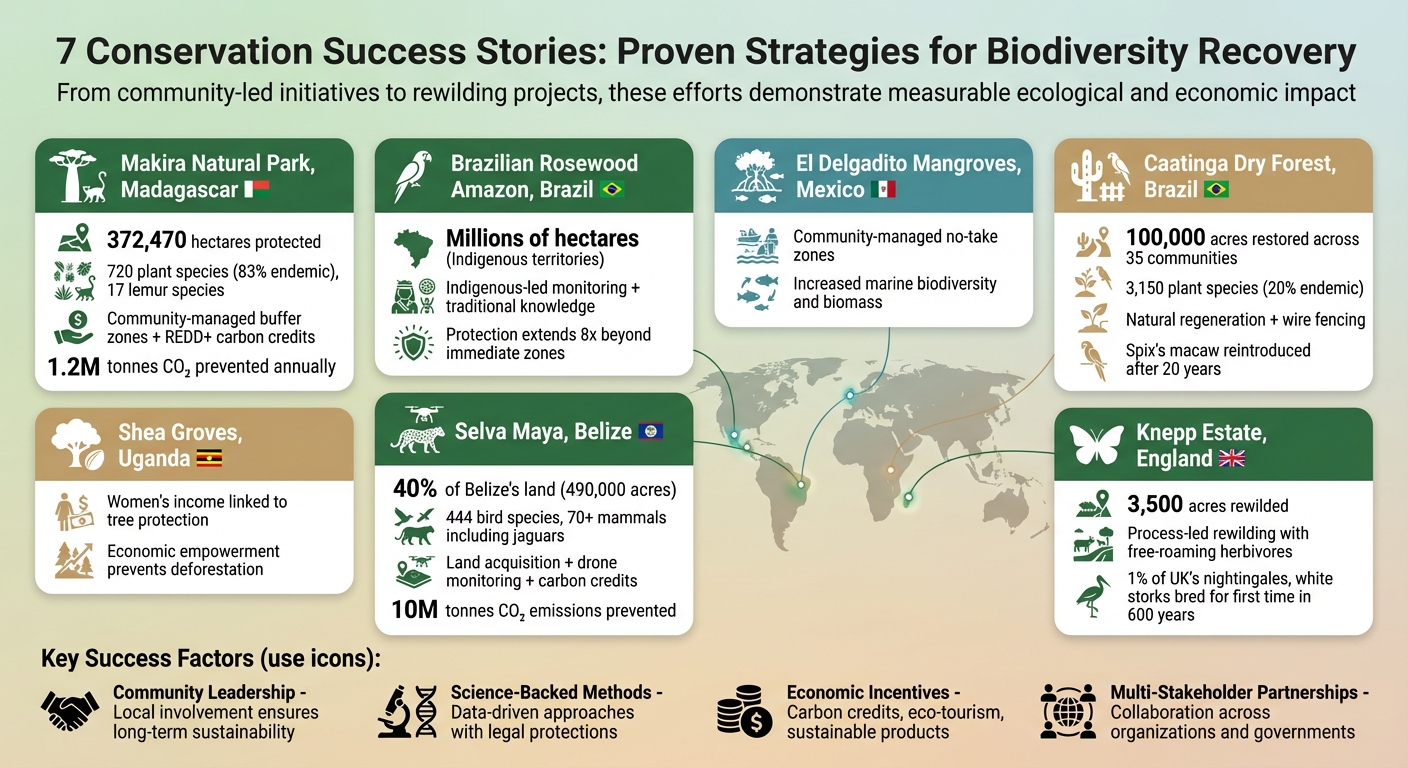
Conservation efforts are reversing biodiversity loss and restoring ecosystems worldwide. From protecting endangered species to rewilding degraded lands, these initiatives show how focused actions can lead to measurable results. Here are seven inspiring examples:
- Makira Natural Park, Madagascar: Protects 372,470 hectares of forest, home to 720 plant species and 17 lemur species. Combines community management with carbon credit revenue to reduce deforestation and improve livelihoods.
- Brazilian Rosewood Amazon Project, Brazil: Indigenous-led efforts safeguard millions of hectares of rainforest, blending traditional knowledge with modern conservation tools.
- El Delgadito Mangrove Restoration, Mexico: Community-driven restoration of mangroves improves marine biodiversity and supports sustainable coastal practices.
- Caatinga Dry Forest Recovery, Brazil: Restores degraded lands using natural regeneration, protecting unique plant species and reintroducing the Spix's macaw.
- Shea Groves, Uganda: Preserves shea trees by linking women's income to their protection, creating a sustainable balance between economic needs and conservation.
- Selva Maya Rainforest, Belize: Protects 40% of Belize’s land, supporting jaguars, 444 bird species, and critical watersheds through community partnerships and advanced monitoring.
- Knepp Estate Rewilding, England: Transforms 3,500 acres of farmland into a thriving habitat for species like nightingales and white storks, while supporting eco-tourism and organic farming.
These projects highlight the power of combining local involvement, science-backed strategies, and sustainable funding to protect biodiversity and improve ecosystems. Each success story provides a model for addressing global conservation challenges.
7 Global Conservation Success Stories: Key Strategies and Measurable Results
Inspiring wildlife comebacks: snow leopards, mountain gorillas & black rhinos
1. Makira Natural Park Forest Protection in Madagascar
Not sure what outdoor role fits you?
Take our 2-minute career quiz to get matched with outdoor jobs that align with your goals, salary target, and lifestyle.
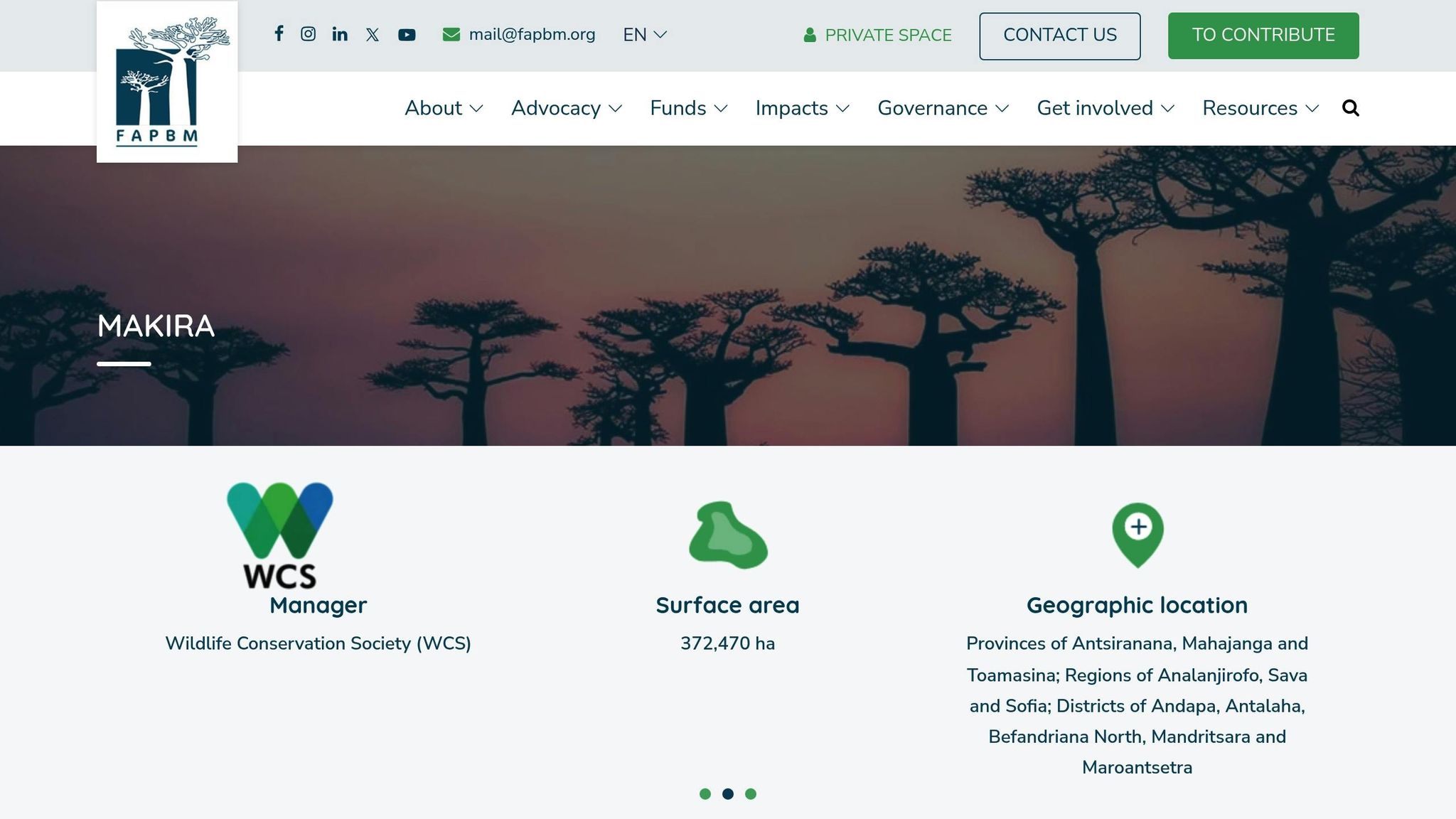
Makira Natural Park in Madagascar stands as a shining example of effective conservation. Spanning 372,470 hectares (around 920,000 acres), it preserves the island's largest remaining block of unbroken lowland and medium-altitude moist evergreen forests. This effort has led to remarkable achievements in biodiversity preservation, community engagement, and forward-thinking conservation strategies.
Impact on Biodiversity
Makira plays a vital role in safeguarding Madagascar's extraordinary biodiversity. The park is home to 720 plant species, 83% of which are found nowhere else on Earth. It also provides sanctuary for 17 lemur species, including the critically endangered Silky Sifaka (Propithecus candidus) and Red Ruffed Lemur (Varecia rubra). Beyond lemurs, the park supports 112 bird species, 68 amphibian species, and 60 reptile species. Many of these animals are unique to the Marojejy–Makira–Masoala region, underscoring the park's ecological importance.
Area Protected and Community Involvement
Makira's success stems from its innovative strategy: a strictly protected central zone surrounded by over 350,000 hectares (about 865,000 acres) of community-managed buffer forests. This approach directly involves the nearly 200,000 people living nearby. Since 2011, the Fondation pour les Aires Protégées et la Biodiversité de Madagascar has awarded grants totaling MGA 1,987,655,606 (around $450,000) to support conservation and community-driven initiatives. These efforts not only protect the environment but also provide tangible benefits like watershed conservation, reduced flooding, and sustainable access to natural resources.
Practices and Methods Used
Makira employs a mix of community-focused and technical methods to achieve measurable conservation results. Through the REDD+ framework, the project prevents about 1.2 million tonnes of carbon emissions annually. Revenue from carbon credits is reinvested into community projects and land management. As Beliazava, President of the Makira Community Association Federation, explains:
"The less the community clears the forest, the more carbon credits there are to sell, and so the chance to address problems in their villages, like the lack of roads and infrastructure".
The park also trains local communities in sustainable agriculture, promoting cash crops like vanilla, cloves, raffia, and cacao, while encouraging intensive rice farming to replace slash-and-burn practices. Fish farming offers an alternative to bushmeat hunting, reducing pressure on wildlife. By 2014, over 6,000 people had accessed mobile health clinics, and initiatives like environmental youth clubs, radio programs, and multimedia campaigns have raised awareness about conservation. These combined efforts have led to a noticeable decline in unsustainable hunting across the region.
2. Brazilian Rosewood Amazon Conservation Project in Brazil
Brazil's conservation efforts in the Amazon stand out as a powerful example of how community-driven initiatives can protect both species and ecosystems. The Brazilian Amazon, home to the endangered Brazilian rosewood, showcases how Indigenous leadership and modern science can work hand in hand. This project focuses on three main pillars: safeguarding land, empowering communities, and promoting sustainable practices.
Area Protected or Restored
Indigenous territories, especially those managed by the Kayapo people, play a crucial role in preserving millions of hectares of pristine rainforest. These communities have established organizations like the Protected Forest Association and the Raoni Institute to oversee land management and uphold their territorial rights. Additionally, the Amazon Region Protected Areas (ARPA) program has significantly expanded conservation efforts in the region. Using an approach called Project Finance for Permanence (PFP), ARPA secures long-term funding to ensure sustainable management of these critical ecosystems.
Community Involvement and Benefits
Local communities are at the heart of these conservation efforts, blending their traditional ecological knowledge with scientific tools to monitor and protect the environment. For instance, residents work to safeguard aquatic wildlife and floodplains through collaborative conservation efforts. Some have taken on roles as "beach guardians", protecting sensitive nesting sites. This hands-on involvement has a ripple effect, benefiting areas up to eight times larger than the immediate conservation zones.
By placing Indigenous and local leadership at the forefront, these initiatives not only protect biodiversity but also strengthen community resilience.
Practices and Methods Used
The project’s success relies on smart zoning strategies that strike a balance between conservation and sustainable resource use. Indigenous territorial monitoring plays a central role in maintaining forest health. By empowering local communities, these methods ensure that conservation efforts remain effective and enduring.
3. El Delgadito Mangrove Restoration in Mexico
El Delgadito leads the charge in restoring Mexico's mangroves, reversing damage caused by past development and resource extraction. This initiative highlights how local involvement can create measurable ecological improvements.
Area Protected or Restored
This project has successfully reclaimed a significant amount of habitat, thanks to efforts rooted in local initiatives. Across Mexico, many restoration projects rely on community-driven models, enabling residents to take an active role in protecting their environment. This hands-on involvement helps ensure the long-term care and preservation of restored mangrove areas.
Community Involvement and Benefits
Local communities are the backbone of Mexico's mangrove restoration efforts. In Baja California Sur, for instance, community-managed "no-take" zones have led to increased marine biodiversity and greater marine biomass. By actively participating in these projects, locals play a vital role in safeguarding these coastal ecosystems while reaping the benefits of healthier environments.
Practices and Methods Used
The restoration approach focuses on engaging local stakeholders rather than relying on top-down management strategies. This collaborative method ensures that the people most connected to the land are empowered to protect and restore it.
4. Caatinga Dry Forest Recovery in Northeastern Brazil
The Caatinga dry forest in Brazil has long faced challenges like desertification and overgrazing, leaving 13% of its soil barren. But there’s hope - new restoration techniques are helping to heal this ecosystem, which is home to 3,150 plant species, 20% of which are found nowhere else. Here’s a closer look at how focused efforts, creative solutions, and community action are driving this recovery.
Area Protected or Restored
The Recaatingamento project has made impressive strides, restoring nearly 100,000 acres (40,000 hectares) across 35 communities. In Lages das Aroeiras alone, 52 acres (21 hectares) have been set aside for recovery, with an additional 467 acres (189 hectares) under active management. Meanwhile, a protected area spanning 120,000 hectares now serves as a safe haven for the reintroduction of Spix's macaw.
Impact on Biodiversity
In June 2022, ICMBio brought back eight Spix's macaws using a "soft release" method, marking the species' return after two decades. Beyond this, the restoration has allowed native trees like imburana, baraúna, and aroeira to thrive again, providing much-needed canopy cover for the ecosystem.
Practices and Methods Used
Instead of relying on traditional reforestation, which often fails in arid regions, the Recaatingamento approach focuses on natural regeneration. Communities use wire fencing to keep goats - whose grazing habits worsen land degradation - out of recovering areas, giving vegetation a chance to grow back. As José Moacir dos Santos, President of IRPAA, explains:
"The recovery of the Caatinga is very slow; it takes 20, 30 years. It's different from the Amazon: Rain hits again, and in five years the forest is back".
These methods reflect a shift toward restoration techniques tailored to the unique challenges of arid environments.
Community Involvement and Benefits
Since 2009, the Lages das Aroeiras community has introduced "Feed Houses", which produce drought-resistant fodder for 1,800 animals. They’ve also diversified income sources by harvesting wild fruits, producing native bee honey, making goat cheese, and even creating fruit popsicles. These efforts have transformed the community - housing has tripled, and fewer young people are leaving the area.
sbb-itb-9d004f0
5. Shea Groves Restoration in Northern Uganda
In Northern Uganda, the shea groves - often referred to as "Women's Gold" - play a dual role in supporting the environment and empowering local communities. These groves are not just vital ecosystems; they are also a source of sustainable income for many women in the region. This financial connection has created a strong motivation to protect the trees, reducing the likelihood of clearing land for farming or other subsistence needs.
Area Protected or Restored
The focus here is on preserving the shea groves that already exist, rather than launching large-scale replanting initiatives. By preventing the cutting of shea trees, the strategy ensures the conservation of their natural habitat. This approach aligns with other community-driven conservation efforts highlighted earlier.
Community Involvement and Benefits
The involvement of local communities, especially women, is central to this initiative. Women harvest shea nuts to produce shea butter, which directly ties their income to the health of the groves. This connection between economic opportunity and environmental care creates a cycle where protecting the groves benefits both the people and the ecosystem. It’s a model that addresses poverty while encouraging sustainable practices.
Practices and Methods Used
The restoration effort relies on on-site conservation, ensuring that the trees are protected within their natural environment. This method preserves the surrounding ecosystem and avoids the need for external enforcement. Local communities take the lead in managing and protecting the groves, making the initiative both practical and deeply rooted in local stewardship.
6. Selva Maya Rainforest Protection in Belize
The Selva Maya is a sprawling 30-million-acre tropical forest that stretches across Belize, Guatemala, and Mexico. Within Belize, key areas like the 236,000-acre Belize Maya Forest and the 254,000-acre Rio Bravo Conservation Management Area play a crucial role in this conservation effort. Combined, these initiatives have placed nearly 40% of Belize's total land under protection, creating a vital foundation for preserving biodiversity.
Impact on Biodiversity
This conservation initiative has had a profound effect on wildlife. The Rio Bravo area alone is home to an impressive 444 bird species, earning it the designation of an Important Bird Area by BirdLife International in 2008. Across the Selva Maya region in Belize, the forest supports over 70 mammal species, including jaguars that rely on these corridors for migration. Additionally, this ecosystem boasts more than 5,000 plant species and diverse landscapes, ranging from lowland broadleaf forests to pine savannas and freshwater wetlands. Belize stands out globally by connecting its northern and southern forests - particularly notable since only 10% of protected areas worldwide achieve such connectivity.
Area Protected or Restored
In 2021, a coalition led by The Nature Conservancy and the Belize Maya Forest Trust secured the 236,000-acre Belize Maya Forest, which accounts for 9% of Belize’s landmass. To ensure long-term protection, Managing Director Elma Kay initiated a carbon project that sells international credits, aiming to prevent 10 million tons of CO₂ emissions. Meanwhile, the Rio Bravo Conservation Management Area, established in 1989 by the Programme for Belize with backing from the World Land Trust, spans 254,000 acres - covering 4.4% of the country’s land area. Phil Riebel, Director of Carbon Balanced Paper North America, highlighted its significance, describing the Rio Bravo as "part of the greater Selva Maya Region, the largest continuous protected area in Central America and one of the most remarkable conservation success stories in the world".
Community Involvement and Benefits
Local communities play a central role in these conservation efforts. In 2021, the Belize Maya Forest Trust partnered with nine neighboring communities, including Mennonite farmers who help monitor access points and prevent poaching or illegal logging. David Requena, Chairperson of Yalbac Village, underscored this collaboration:
"There must be a balance between farming and conservation. I have my own little plot I'm conserving. That is something I want to see not only for us, but for Belize as a whole".
Beyond its ecological benefits, the forest protects three critical watersheds that provide about one-third of Belize’s drinking water and one-quarter of its irrigation water. These community partnerships are integral to implementing effective management strategies.
Practices and Methods Used
The conservation strategy blends land acquisition with cutting-edge technology. For instance, in 2021, a consortium acquired the Belize Maya Forest to prevent industrial-scale agriculture. The initiative enforces a "No Cut, No Kill" policy, using drones, GPS tracking, and specially trained rangers to enhance patrols. To address fire risks, soil moisture sensors are deployed for early detection, in collaboration with the National Wildland Fire Working Group. In May 2024, the organization Rare hosted a workshop with the Belize Maya Forest Trust and local farmers from Spanish Lookout and Valley of Peace. Together, they co-designed strategies to minimize wildfires while respecting traditional farming practices. The project also relies on sustainable financing, such as ecotourism and carbon credits, with Rio Bravo already certifying 1.6 million tons of carbon offsets.
7. Knepp Estate Rewilding in England
In 2000, Knepp Estate in West Sussex embarked on a bold journey to restore 3,500 acres of struggling farmland near Gatwick Airport. Burdened by £1.5 million in debt, the estate shifted its focus entirely, setting the stage for one of England's most celebrated conservation stories.
Practices and Methods Used
Knepp adopted a "process-led" philosophy, stepping back to let nature take the reins. They introduced free-roaming herbivores - Longhorn cattle, Exmoor ponies, Tamworth pigs, and deer - to mimic the role of extinct megafauna. Fences were removed, allowing the land to regenerate naturally. What were once crop fields evolved into a patchwork of scrub, wildflower meadows, and wood pastures.
The River Adur also underwent a transformation. The Environment Agency dismantled artificial banks and disabled weirs, restoring natural flood cycles. This intervention enabled sea trout to migrate upstream within just a year. Additionally, reintroductions of native species like beavers (in February 2020) and white storks (between 2018 and 2020) brought back key wildlife that had been absent for centuries. These hands-off methods quickly yielded impressive ecological results.
Impact on Biodiversity
By 2010, Knepp had become home to nearly 1% of the UK’s nesting nightingales. In June 2017, the estate recorded a stunning 148 purple emperor butterflies in a single day, establishing the largest breeding colony for this species in the country. Turtle dove numbers grew from just 3 pairs in 1999 to 16 pairs by 2017. Bat species also flourished, with 13 of the UK's 18 species documented on the estate by 2009. In 2020, white storks successfully raised chicks in the wild for the first time in England in 600 years. Reflecting on this transformation, Professor Sir John Lawton, author of the Making Space for Nature report, remarked:
"If we can bring back nature at this scale and pace just 16 miles from Gatwick airport we can do it anywhere. I've seen it. It's truly wonderful, and it fills me with hope."
Community Involvement and Benefits
Initially met with skepticism, the rewilded landscape has since become a source of local pride. The estate now boasts 16 miles of public trails, wildlife viewing platforms, and a growing wildlife tourism industry that includes guided safaris, glamping, and locally-sourced dining. Beyond tourism, Knepp produces 75 tonnes of organic, pasture-fed meat each year.
The White Stork Project has also engaged the local community by inviting residents to volunteer their roofs as potential nesting sites. Meanwhile, the restored River Adur provides natural benefits like flood mitigation, healthier soil, and improved water quality for nearby areas.
Area Protected or Restored
Spanning 3,500 acres, Knepp has transformed from failing farmland into a conservation triumph. The estate has earned multiple awards and is recognized as a Verified Conservation Area. Summing up the philosophy behind Knepp’s transformation, Isabella Tree reflected:
"We looked at how we could use the estate radically differently, working with the land rather than pushing against it."
What We Can Learn from These Conservation Successes
Looking at these projects, a few key elements stand out as crucial for success: community-driven efforts, science-backed plans with legal support, partnerships involving multiple stakeholders, and economic incentives. In places like Cabo Pulmo and Millbank, local communities played a pivotal role, leading to a 460% increase in fish biomass and transforming local practices through paid involvement. Former Secretary of the Interior Bruce Babbitt summed it up perfectly:
"Change typically comes up from the grass roots, growing slowly from the sustained efforts of determined citizens."
But it’s not just about community action. The combination of solid scientific research and enforceable legal measures is equally important. Take the Santa Cruz Island fox project, for instance. By swiftly removing feral pigs and implementing captive breeding, the fox population skyrocketed from fewer than 100 to 2,150 by 2015. Similarly, Cabo Pulmo benefited from UNESCO and Ramsar protections, shielding it from large-scale development. Scott Morrison, Conservation Director at The Nature Conservancy, highlighted this approach:
"The approach developed with our partners shows that science, collaboration and focus are a potent combination for bringing once vulnerable species back to health."
Partnerships involving multiple stakeholders also play a major role. For example, the Great Lakes Restoration Initiative poured over $575 million into restoring 4,000 acres in 2023, which in turn supported an $18 billion recreational economy.
Economic shifts from resource extraction to conservation often bring lasting benefits. Cabo Pulmo is a great example, where the transition from overfished waters to eco-tourism doubled per capita income - from $8,240 to $18,000 - and brought in $538,000 for local businesses. Similarly, research in the Gulf of California showed that community-managed areas saw species richness grow from 15 to 25 species, while open-access zones saw a decline from 20 to 17 species. The table below highlights these strategies and their outcomes.
| Project | Key Strategy | Primary Result | Economic Impact |
|---|---|---|---|
| Cabo Pulmo | Community-enforced no-take zones | 460% fish biomass increase | Per capita income: $18,000 |
| Island Fox | Invasive species removal & breeding | Population rebound from <100 to 2,150 | Fastest ESA mammal recovery |
| Great Lakes | Multi-agency tribal partnerships | Over 4,000 acres restored (2023) | $18 billion annual revenue |
| Mexican Wolf | Genetic diversity & reintroduction | Growth from 0 to 241 wild wolves | 60 documented packs |
Conclusion
The seven stories highlighted here prove that focused conservation efforts can repair ecological damage and make a real difference. Cabo Pulmo saw a staggering 460% rise in fish biomass, the Santa Cruz Island fox population rebounded from fewer than 100 to 2,150 in just ten years, and the Endangered Species Act has preserved 99% of the species it protected, saving an estimated 227 species from extinction between 1973 and 2004.
Not only do these initiatives restore ecosystems, but they also bring economic benefits. Cabo Pulmo transitioned from struggling fisheries to thriving eco-tourism, boosting per capita income to $18,000. This shows that conservation and economic growth can coexist. As Joel Sartore, National Geographic Explorer and Photographer, aptly puts it:
"I believe that people want to help protect this world, and the species in it, but they first have to see these animals and learn what the issues are... There is no better time to act than now".
These outcomes provide a roadmap for replicating success in other vulnerable ecosystems. The key ingredients - effective legal protections, local community leadership, science-driven strategies, and collaboration across multiple stakeholders - can be applied to conservation efforts worldwide. Whether you're interested in supporting grassroots movements, advocating for stronger environmental policies, or pursuing a career in this field, these examples show that transformative change is possible.
If you're inspired to take action, there are plenty of ways to get involved. For those looking to turn their passion into a career, platforms like Get Outdoor Jobs offer thousands of opportunities in conservation and environmental services. From fieldwork to community engagement, the conservation field welcomes dedicated individuals ready to protect biodiversity and build on these successes.
FAQs
How do community-based conservation efforts benefit both people and the environment?
Community-based conservation puts local residents at the heart of protecting their natural surroundings, striking a balance between maintaining healthy ecosystems and supporting human livelihoods. By directly involving communities, these initiatives ensure that conservation efforts respect local traditions and meet the needs of the people, fostering long-term engagement and success.
The impact of these efforts is undeniable. Take Cabo Pulmo, Mexico, for example - a community-led marine reserve that saw fish populations bounce back in a big way, coral reefs regain their vitality, and entire ecosystems flourish. Similar stories can be found in the restoration of the Escalante River in Utah or the recovery of the island fox on Santa Cruz Island in California. These local actions have not only reversed environmental damage but have also created sustainable habitats. On top of that, they’ve opened doors to economic opportunities like ecotourism, sustainable fishing, and other jobs tied to nature.
But the benefits go beyond just the environment and economy. These projects bring people together, preserving cultural knowledge and creating a shared sense of responsibility for protecting the planet. If you’re someone who’s eager to make a difference, platforms like Get Outdoor Jobs can help you find outdoor careers dedicated to conservation and environmental stewardship.
What makes rewilding projects like Knepp Estate so successful?
The transformation of Knepp Estate showcases how stepping back and letting nature take the lead can yield incredible ecological and economic rewards. By introducing free-roaming herbivores - such as longhorn cattle, Exmoor ponies, Tamworth pigs, and deer - the estate revived natural grazing behaviors. These animals reshaped the landscape into a thriving mix of grasslands, scrub, and woodlands. The shift away from intensive farming and the removal of internal fences allowed these animals to wander freely across the 3,500-acre property, sparking natural regeneration.
Efforts like restoring rivers and creating wetlands further boosted biodiversity. Satellite monitoring has even shown noticeable increases in tree cover and ecosystem health. Beyond the environmental benefits, Knepp has become a model for blending conservation with sustainable business. With wildlife tourism offerings like safaris, camping, and glamping, the estate generates around $1 million annually. Educational programs and active community engagement have also been key to its ongoing success.
If projects like Knepp inspire you to pursue a career in conservation, rewilding, or ecological monitoring, check out Get Outdoor Jobs, a platform connecting people with outdoor-industry opportunities.
How do carbon credits help fund conservation efforts at Makira Natural Park?
The income from selling Makira Natural Park’s certified carbon credits plays a vital role in funding conservation efforts. Each year, about $350,000 is directed toward managing the park, while roughly $800,000 goes toward projects that enhance community livelihoods. This financial support helps safeguard forests, boost local development, and maintain ongoing environmental initiatives.