
Effective Communication In Outdoor Leadership Roles

Effective communication is the backbone of successful outdoor leadership. It ensures safety, builds trust, and improves teamwork, especially in unpredictable backcountry environments. Here’s what you need to know:
- Set Clear Goals: Pre-trip meetings, daily briefings, and transparent decision-making keep everyone aligned. Use techniques like the "repeat back" method to confirm understanding.
- Encourage Open Dialogue: Active listening, paraphrasing, and asking open-ended questions help address challenges and include all voices. Debriefs after tasks refine strategies and promote inclusivity.
- Build Trust Individually: One-on-one check-ins strengthen relationships and resolve issues early. Focus on understanding and support rather than immediate correction.
- Handle Conflict Effectively: Address disagreements promptly and fairly. Assigning rotating roles can prevent power struggles and ensure balanced workloads.
- Adapt Leadership Styles: Use transformational leadership for high-pressure moments and servant leadership for day-to-day interactions to balance motivation and care.
Applying Situational Leadership to Outdoor Recreation
sbb-itb-9d004f0
Core Communication Methods for Outdoor Leaders
Outdoor leaders rely on three key communication strategies to keep their teams safe and effective in remote settings: setting clear goals, encouraging open dialogue, and fostering individual connections.
Not sure what outdoor role fits you?
Take our 2-minute career quiz to get matched with outdoor jobs that align with your goals, salary target, and lifestyle.
Using Clear Goals to Motivate Teams
Before heading out, pre-trip meetings help establish clear goals, define roles, and set team norms. Early guidelines are crucial for ensuring that everyone knows their responsibilities. The Utah State University Field Safety Handbook emphasizes that "Excellent leaders articulate and explain goals as often as necessary". In other words, repeating key points isn’t overkill - it’s absolutely necessary.
Daily briefings structured around the basics - Where, What, How, When, and Who - keep everyone on the same page. To confirm understanding, leaders often use the "repeat back" method, asking team members to restate the plan in their own words. Additionally, leaders clarify how decisions will be made, whether through direct instructions, group discussions, or team votes. This transparency helps manage expectations and lays the groundwork for open communication and trust.
Creating Open Dialogue for Problem-Solving
After setting clear goals, fostering open dialogue becomes essential for addressing challenges as they arise. Active listening plays a huge role here, and two techniques stand out: paraphrasing (rephrasing what someone said to confirm understanding) and asking open-ended questions to invite input. These methods ensure that every team member’s perspective is heard and valued, which the Field Safety Handbook highlights as critical for improving "group intelligence" and minimizing risks.
Interestingly, research from the University of Utah shows that people are 50% more creative when they’re outdoors. Leaders who treat time outside as an opportunity for discussion - not just physical activity - can tap into this creativity to solve problems more effectively.
It’s also important to involve quieter team members. After completing tough tasks, leaders should hold debriefs to discuss what went well and what could improve. These feedback sessions not only refine strategies for future situations but also show that everyone’s voice matters.
Building Trust Through Individual Communication
One-on-one check-ins are a powerful way to build trust and address potential issues before they escalate. During these conversations, leaders should ask team members how they’re feeling, seek feedback on their leadership, and listen attentively without interrupting. This personalized attention - referred to as "individualized consideration" in leadership studies - helps establish trust.
When addressing problems, the "connection before correction" approach works best. This means focusing on structural adjustments, like scheduling more rest breaks, rather than jumping straight to criticism.
A study published in The Leadership Quarterly found that the quality of communication matters more than its frequency when it comes to team performance. According to the research, "effective leadership stimulates communication among team members, and that, through increased communication, team members are able to acquire important information about their teammates... This, in turn, leads members to form judgments about teammates' trustworthiness". In short, meaningful conversations are the foundation of trust, which is essential for teams to operate safely and effectively in demanding outdoor environments.
Group Dynamics and Expedition Behavior
In expeditions, teamwork often outweighs technical skills when it comes to success. Clear communication is the glue that holds teams together, and Expedition Behavior (EB) provides a framework to align personal and group goals, ensuring everyone works toward collective success.
Building Team Unity
At its core, Expedition Behavior is about caring as much for the well-being of others as you do for yourself. NOLS defines it as:
Expedition Behavior (EB) encompasses actions that serve the health and function of a group or community when working together toward common goals.
This approach emphasizes treating every team member with respect and dignity, even in challenging situations.
One of the first steps to fostering unity is clarifying roles and expectations early on. These initial discussions create a shared understanding of not just what needs to be done, but why each task matters to the group as a whole.
Reliability also plays a big role in building trust. Following through on commitments and setting clear boundaries helps prevent misunderstandings that could undermine team cohesion. Molly Hagbrand of NOLS explains:
EB means that group and personal goals are aligned and in support of each other. When we collaboratively work together, everyone succeeds.
Research backs this up. A study of outdoor education participants showed a 23% to 40% improvement in key leadership skills after a six-month course. The largest gain - a 40% increase - was in decision-making, a skill essential for maintaining unity in uncertain situations.
When teams establish trust through clear roles and consistent actions, they’re better equipped to handle disagreements.
Resolving Conflict in Outdoor Teams
Conflict is unavoidable during long expeditions, but addressing it head-on is key to preserving team cohesion. As John Kanengieter and Aparna Rajagopal-Durbin, both NOLS Directors, explain:
Leadership means getting along in a diverse group, cooperating with teammates, effectively resolving conflict, and keeping yourself and others motivated.
NOLS advocates for "Constructive Resolution", which involves tackling disagreements immediately and fairly to prevent resentment from festering. Leaders play a crucial role in this process by staying calm under pressure and creating an environment where team members feel comfortable expressing concerns. Honesty and accountability from leaders build the trust needed to navigate conflicts effectively.
To maintain balance within the group, leaders should encourage team members to take on different roles, such as designated leader, active follower, peer leader, or self-leader. This helps prevent power struggles and ensures everyone shares the workload. Additionally, offering support without overstepping - helping when necessary but not taking over someone’s responsibilities - avoids fostering dependency or resentment.
Comparing Leadership Communication Styles
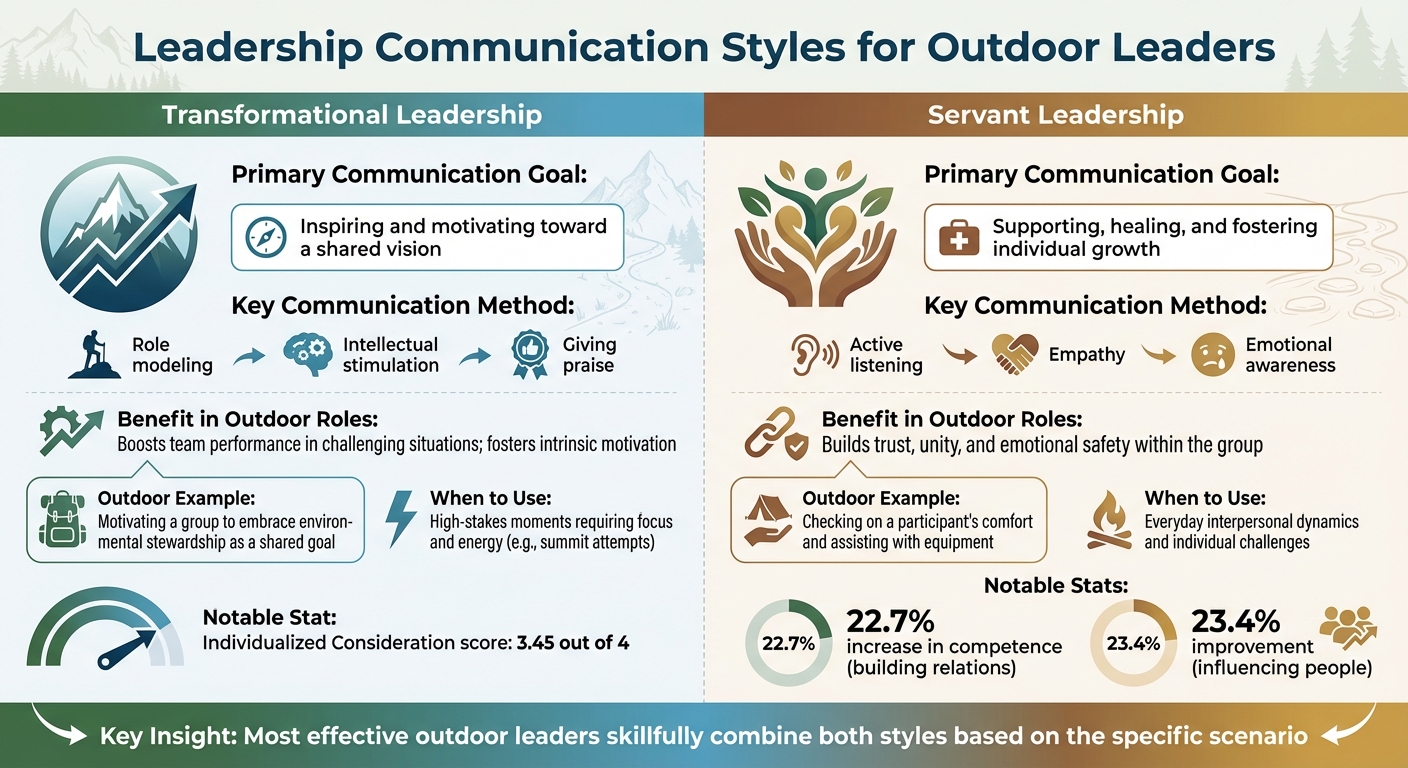
Transformational vs Servant Leadership Communication Styles in Outdoor Settings
Outdoor leadership demands flexibility in communication, as different situations call for distinct approaches. Some leaders lean on transformational leadership, which focuses on inspiring teams with a shared vision, while others adopt servant leadership, prioritizing individual care and personal growth. Research suggests that the most effective outdoor leaders skillfully combine these styles based on the specific scenario at hand.
Transformational leaders excel at using charismatic communication and intellectual stimulation to motivate their teams. They inspire individuals to look beyond their own interests and rally around a collective mission, such as promoting environmental stewardship. In one study of 104 international outdoor leaders, the concept of "Individualized Consideration" received an impressive score of 3.45 out of 4, highlighting their ability to support individuals while keeping the broader team goal in focus.
On the other hand, servant leadership places a stronger emphasis on relationship-building and emotional awareness. These leaders rely on active listening and empathy to create a sense of emotional safety within their teams. A study involving outdoor education students revealed that focusing on "building relations" led to a 22.7% increase in perceived competence over six months. Similarly, prioritizing "influencing people" resulted in a 23.4% improvement.
The best outdoor leaders don’t stick rigidly to one style. Instead, they adapt their approach to suit the moment. For example, transformational communication might be critical during high-stakes situations like a summit attempt, providing the momentum and focus needed to succeed. Meanwhile, servant communication is invaluable in day-to-day scenarios, such as debriefing sessions or helping team members overcome challenges with equipment.
Comparison Table: Transformational vs. Servant Leadership
| Feature | Transformational Leadership | Servant Leadership |
|---|---|---|
| Primary Communication Goal | Inspiring and motivating toward a shared vision | Supporting, healing, and fostering individual growth |
| Key Communication Method | Role modeling, intellectual stimulation, giving praise | Active listening, empathy, and emotional awareness |
| Benefit in Outdoor Roles | Boosts team performance in challenging situations; fosters intrinsic motivation | Builds trust, unity, and emotional safety within the group |
| Outdoor Example | Motivating a group to embrace environmental stewardship as a shared goal | Checking on a participant’s comfort and assisting with equipment |
| When to Use | High-stakes moments requiring focus and energy (e.g., summit attempts) | Everyday interpersonal dynamics and individual challenges |
Conclusion and Key Takeaways
Strong communication is at the heart of effective outdoor leadership. It involves more than just giving instructions - it's about building trust, fostering teamwork, and staying adaptable in unpredictable environments. Leaders who excel in both technical know-how and interpersonal skills create teams that are not only safer but more cohesive. As Knight Campbell, Founder of Cairn Leadership Strategies, puts it:
Giving leaders a chance to practice communication and alignment as their canoe spirals down a river provides lessons that stick with them indefinitely.
To improve communication, focus on building trust through vulnerability and practicing active listening. When noise or environmental factors make verbal communication tough, stand face-to-face with team members, use eye contact to aid lip-reading, and ensure clarity. Feedback loops after tasks can help refine strategies. Setting clear goals is also crucial - frameworks like a "goal pyramid" can help align company, team, and individual objectives. Additionally, encourage peer accountability within your team, as it often drives better results than solely relying on top-down management.
These practices not only enhance a team's immediate performance but also build leadership abilities that last. Hands-on experience is critical. For instance, a study on outdoor education students showed a 40% improvement in decision-making skills after just six months of real-world leadership practice. Look for roles that involve genuine responsibility, whether it's planning, execution, or leading small groups, to sharpen your leadership skills.
If you're ready to put these skills into action, platforms like Get Outdoor Jobs can help. They offer thousands of opportunities in fields like conservation, adventure guiding, environmental services, and outdoor education. With daily updates and advanced filters for remote, hybrid, and onsite roles, you can find positions that align with your goals and experience. Whether you're shadowing seasoned guides or taking charge of your first expedition, these roles are invaluable for honing the interpersonal skills that define great outdoor leaders. By mastering these communication strategies, you'll be well-equipped to lead safer and more connected teams in the great outdoors.
FAQs
What are the best ways for outdoor leaders to build trust within their teams?
Building trust as an outdoor leader begins with clear and open communication. Share the reasoning behind your decisions - whether it’s about selecting a specific route or implementing safety measures - so your team understands how these choices align with the group’s objectives. Combine this with active listening: encourage questions, address concerns, and ensure everyone feels heard. This two-way dialogue builds mutual respect and strengthens confidence within the group.
Equally important is demonstrating reliability and sound judgment. Stick to your commitments, acknowledge when something is beyond your expertise, and handle challenging situations with a calm, measured approach. Leaders who focus on their team’s well-being, involve others in decision-making, and offer constructive feedback create an environment where people feel safe to contribute and collaborate.
Trust is also built through consistency in everyday actions. Respecting differences, resolving conflicts promptly, and staying true to shared values are small but powerful ways to reinforce dependability. These habits foster a supportive atmosphere where team members feel valued and secure, even when facing the uncertainties of the outdoors.
What’s the difference between transformational and servant leadership in outdoor roles?
Transformational and servant leadership take different approaches to inspiring and supporting teams. Transformational leaders emphasize creating a shared vision, sparking creativity, and encouraging personal development. They often rely on charismatic communication to unite their team around common objectives, driving innovation even in challenging situations. In contrast, servant leaders focus on meeting the needs of their team first. They prioritize humility, active listening, and collaboration, working to build trust and empower individuals by fostering open communication and making decisions that serve the group's best interests.
For outdoor professionals looking for roles that reflect these leadership styles, platforms like Get Outdoor Jobs offer access to thousands of U.S.-based opportunities in areas like adventure guiding, conservation, and expedition management.
Why is setting clear goals important for outdoor leadership and expeditions?
Clear goal-setting plays a key role in effective outdoor leadership. It creates a shared vision, ensuring that every team member knows their role and understands the objectives. This clarity reduces confusion, improves decision-making, and promotes stronger teamwork.
In unpredictable outdoor settings, clearly defined goals help leaders adjust plans while keeping the team aligned with the desired outcomes. They also provide a sense of purpose and direction, which can significantly boost morale and motivation - especially when facing tough challenges.