
3 E's of Decision-Making in Outdoor Jobs

In outdoor jobs, decision-making can mean the difference between safety and disaster. The 3 E's - Efficiency, Evaluation, and Execution - offer a practical framework to make sound decisions under pressure. Here's a quick breakdown:
- Efficiency: Act quickly without sacrificing quality. Prepare in advance with clear protocols and practice skills in low-risk settings.
- Evaluation: Assess hazards and risks by distinguishing between actual and perceived threats. Use tools like risk scales and mental models for clear judgment.
- Execution: Turn decisions into action with clear communication and decisive follow-through. Stay focused, adapt as needed, and prioritize safety.
This framework helps outdoor professionals handle unpredictable conditions, manage risks, and lead effectively in high-stakes environments.
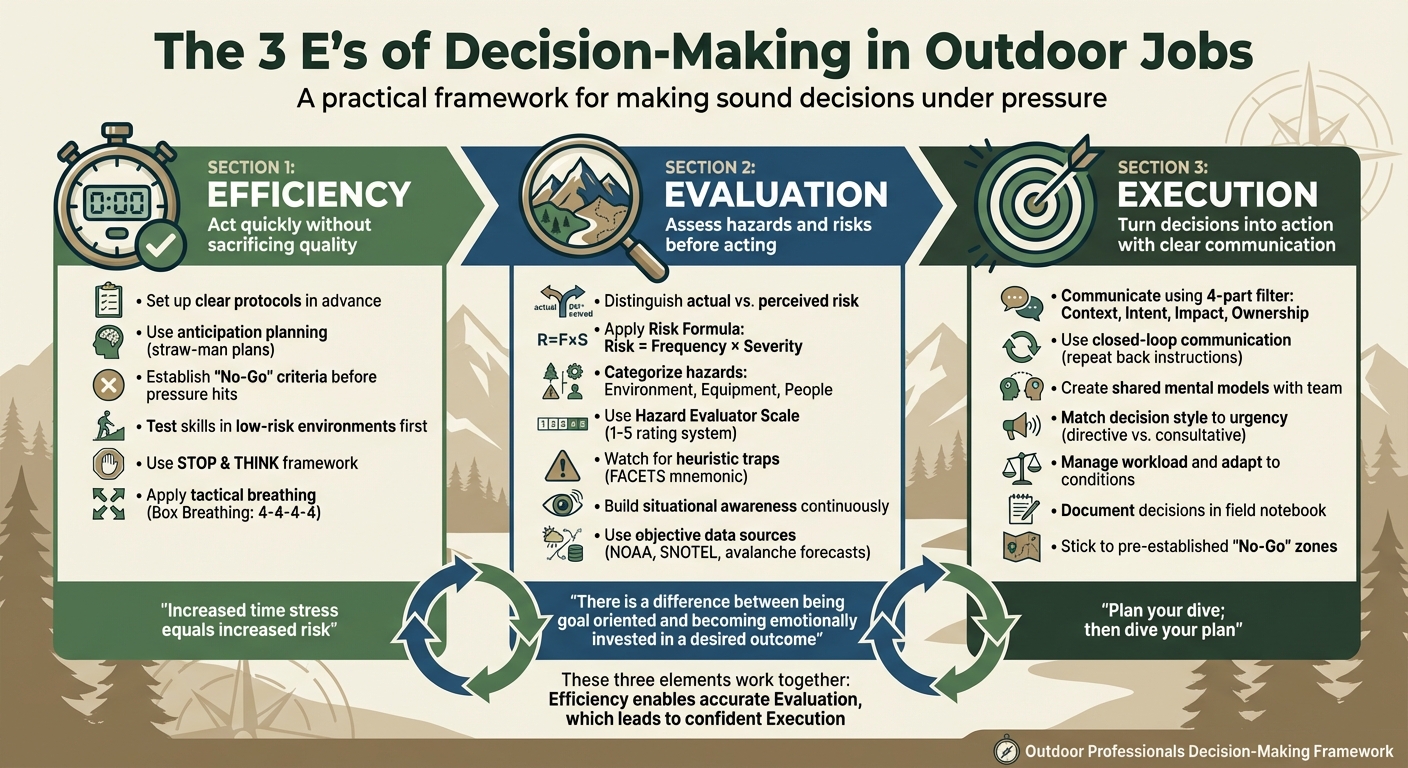
The 3 E's Decision-Making Framework for Outdoor Professionals
Outdoor Recreation Leadership - Situational Awareness Module
sbb-itb-9d004f0
1. Efficiency – Making Decisions Quickly Without Sacrificing Quality
Not sure what outdoor role fits you?
Take our 2-minute career quiz to get matched with outdoor jobs that align with your goals, salary target, and lifestyle.
Efficiency isn’t about rushing - it’s about making smart decisions under pressure. It’s the ability to act quickly without compromising the quality of those decisions, and that starts with solid preparation.
Setting Up Clear Protocols
The best decisions are often made before pressure kicks in. This is where anticipation planning plays a crucial role. By creating "straw-man plans" based on likely scenarios and team capabilities, you reduce the mental strain when quick decisions are needed. These plans aren’t rigid - they’re flexible starting points that can be adjusted as situations evolve.
Paul Nicolazzo, Director of the Wilderness Medicine Training Center, developed The Outcome Model to simplify decision-making in dynamic environments. This model evaluates five key variables: your team, the individuals you’re responsible for, available resources, environmental hazards, and the activity itself. The idea is to bridge the gap between your current situation and your desired outcome. Regular staff check-ins before activity transitions help ensure everyone is aligned on safety and management priorities.
Another critical step is establishing "no-go" criteria ahead of time. For example, Mt. Rainier rangers use a Go/No-Go Weather Matrix to decide when to turn back. This system assigns point values (from 4 to 12) to factors like wind, precipitation, visibility, and forecast trends. Built on years of experience, it offers an objective way to avoid risky decisions influenced by "summit fever" or group pressure.
Once protocols are in place, the next challenge is balancing speed with precision.
Finding the Right Balance Between Speed and Accuracy
Testing and communication are the backbone of efficient decision-making. Test skills in controlled environments before relying on them in high-stakes situations. Nicolazzo highlights this approach: before trusting someone’s abilities in a challenging setting (like a river crossing or technical climb), test their skills in a low-risk environment where mistakes are manageable. This practice provides reliable data for future risk assessments.
In the field, use the "STOP & THINK" framework to stay grounded. Evaluate the current situation, anticipate what it might look like in 10 minutes, and stick to established protocols. Pair this with techniques like closed-loop communication and tactical breathing (Box Breathing: inhale for 4 seconds, hold for 4, exhale for 4, pause for 4) to ensure clear instructions and manage stress.
The bottom line? Safety always trumps educational or itinerary goals. Nicolazzo sums it up perfectly:
"Increased time stress equals increased risk".
If a hazard can’t be managed safely, it’s better to modify or cancel the activity. That’s not failure - it’s efficiency in action.
2. Evaluation – Assessing Situations Before Acting
Evaluation connects recognizing a problem to taking action by identifying hazards and predicting outcomes to avoid accidents. Without it, you're navigating on guesswork - and in outdoor settings, that can be a recipe for disaster.
The distinction between actual risk and perceived risk is critical here. Actual risk comes from concrete dangers, like unstable rocks or fast-rising water. Perceived risk, on the other hand, is shaped by how your group feels about the situation, which can sometimes be far from reality. Balancing both helps ensure safety and keeps everyone focused.
Paul Petzoldt, founder of NOLS, captured this perfectly:
"Rules are for fools... there was no way to write a rulebook that would cover every situation an outdoor leader might encounter".
Guidelines are helpful, but real evaluation requires clear, in-the-moment judgment. It’s about understanding what’s happening right now and how it impacts your team.
How to Conduct Risk Assessments
The formula Risk = Frequency × Severity helps quantify potential dangers. A hazard that’s both highly likely and severe - like a lightning storm at high altitude - poses a much greater risk than something rare and minor, like a twisted ankle on level ground.
Break hazards into three categories: Environment, Equipment, and People. Then, distinguish between:
- Objective hazards: Things outside your control, like avalanches or falling rocks.
- Subjective hazards: Human-related factors, such as poor decision-making or fatigue.
To evaluate threats, use the Hazard Evaluator Scale. Rate each hazard on a scale of 1 to 5 for both Likelihood and Consequence. If the combined score hits 6 or more, you’re dealing with a high-risk situation that may require a change in plans.
| Rating | Likelihood | Consequence |
|---|---|---|
| 5 | Very Certain | Fatality / Total Loss |
| 4 | High Certainty | Severe Injury / Major Loss |
| 3 | Some Certainty | Light Injury / Moderate Loss |
| 2 | Remote Possibility | Inconvenience / Minor Loss |
| 1 | Residual Risk Only | No Real Consequence |
Watch out for heuristic traps - mental shortcuts that can cloud judgment. The FACETS mnemonic (Familiarity, Acceptance, Commitment, Expert Halo, Tracks/Scarcity, Social Proof) is a useful tool to identify these biases.
Martin Volken, an IFMGA guide, offers a sharp reminder:
"There is a difference in risk management between being goal oriented and becoming emotionally invested in a desired outcome".
When emotional investment - like "summit fever" - takes over, it’s nearly impossible to evaluate risks objectively. Recognize when ego might be influencing your decisions.
Building Better Situational Awareness
Situational awareness means constantly reassessing your group, surroundings, and the evolving conditions. As Sierra Madre Search and Rescue puts it, the mountains are always telling a story, and that story is constantly changing.
One way to ensure everyone is on the same page is through Shared Mental Modeling. Use closed-loop communication: when giving instructions, have the person repeat them back to confirm they understood. Foster an environment where anyone - regardless of experience or role - feels empowered to say "STOP" or ask "WHY?".
Rely on objective data sources like NOAA weather reports, SNOTEL monitors, and avalanche center forecasts. Be cautious with social media updates or verbal reports from other hikers - they might be outdated or based on different skill levels.
Take the example of "Giggles", a Wilderness EMT and thru-hiker. In June 2017, she evaluated the snow-heavy Pacific Crest Trail Sierra section. By monitoring weather patterns and assessing snow stability, she determined the risk was manageable with proper gear like an ice ax and crampons. But in May 2019, while on the Continental Divide Trail, she faced avalanche risks ranging from low to considerable in the San Juan Mountains. Lacking essential tools like a beacon, probe, and shovel, she chose to alter her route and avoid the danger altogether.
This is evaluation in practice: knowing the difference between controllable hazards (like choosing to avoid a river crossing) and uncontrollable hazards (like lightning, which requires immediate action). When you can’t control a hazard, you need a backup plan - whether that’s camping in place, finding an alternate route, or ending the trip.
Paul Nicolazzo emphasizes the importance of timing and clarity in decision-making:
"Significant leadership decisions MUST be made when instructors are well rested and MUST be based on an accurate assessment of the staff, students, resources, the activity site, and the actual risk present at the time of the activity".
Evaluation isn’t about overanalyzing - it’s about staying clear-headed and making informed choices. With proper evaluation, you’re ready to take the next step: decisive execution.
3. Execution – Following Through on Your Decisions
Once you've planned thoroughly and evaluated all risks, the final step is execution - the point where decisions turn into action. At this stage, clarity and commitment are key. In outdoor environments, incomplete or poorly executed actions can jeopardize safety. In fact, a decision that's not communicated well or inconsistently followed can sometimes be riskier than making no decision at all.
SCUBA divers have a saying: "Plan your dive; then dive your plan". This highlights the importance of sticking to your course of action once it's set. Of course, if new, objective information comes to light, adjustments may be necessary - but avoid letting fear or second-guessing lead you astray. Execution requires both discipline and adaptability. When conditions shift, reassess with a clear head rather than reacting emotionally.
How to Communicate Decisions to Your Team
Clear communication bridges the gap between a well-thought-out decision and effective action. As Bobbie Goheen, CEO of Synthesis Management Group, explains:
"Strong leadership today isn't just about making good decisions. It's about making your thinking visible in a way others can understand, trust, and move with".
To ensure your decisions are understood and accepted, consider using a four-part communication filter:
- Context: Why is this decision being made now?
- Intent: What is the goal?
- Impact: How will this affect the team?
- Ownership: Who is responsible for what?
Often, resistance arises not from the decision itself but from a lack of context. When people understand the reasoning behind a choice, they're more likely to support it.
To prevent misunderstandings, use closed-loop communication: ask team members to repeat instructions back to confirm they’ve understood. Additionally, ensure everyone is on the same page by fostering a shared mental model - check in with your team before and after activities to align on safety plans and site management.
Strong communication lays the groundwork for effective execution.
Making Sure Decisions Get Implemented
Once decisions are communicated, the next challenge is ensuring they’re carried out fully. Implementation demands constant vigilance. Pay attention to your team, the environment, and any changing conditions. Build in moments to pause and reassess by asking questions like, "What’s the current situation?" and "What might this look like in an hour?"
Your approach to decision-making should match the urgency of the moment. In a crisis - such as a sudden storm - use a directive style to make quick decisions and inform the group. When time allows, and your team has experience, a consultative or consensus-based approach can encourage collaboration and better outcomes. As Paul Petzoldt, founder of NOLS, wisely said:
"Judgment is the greatest safety factor you can have".
Another critical aspect of execution is workload management. Regularly evaluate your team’s condition and adjust tasks to prevent fatigue or burnout. If conditions worsen, adapt swiftly. Document your decisions as you go, noting the problem, options considered, and your chosen course of action in a field notebook. This record not only protects you later but also serves as a learning tool.
Before heading out, establish clear "No-Go" zones - areas or conditions deemed off-limits during the planning phase. This helps counteract the influence of fatigue, ego, or time pressure when you're in the field. Having these boundaries set in advance can prevent poor judgment under stress.
Finally, if stress levels rise, use tactical breathing to regain focus. A simple method is Box Breathing: inhale for 4 seconds, hold for 4 seconds, exhale for 4 seconds, and pause for 4 seconds. This technique helps calm your mind and ensures you communicate with clarity and composure when it matters most.
Execution isn’t about perfection - it’s about staying committed, being clear, and adapting when necessary. When you communicate effectively and follow through with purpose, your decisions turn into actions that keep your team safe and moving forward.
Using the 3 E's in Your Outdoor Career
The 3 E's framework - Efficiency, Evaluation, and Execution - serves as a reliable guide for outdoor professionals. Whether you're leading a backcountry expedition, managing conservation projects, or handling emergencies, these three elements work together to improve decision-making and outcomes. Efficiency ensures you act swiftly without unnecessary stress. Evaluation helps you thoroughly assess the situation. Execution transforms your decisions into coordinated actions that prioritize safety. This section breaks down how to incorporate the 3 E's into your daily work in the outdoors.
When you develop efficiency through practice and preparation, you're less likely to feel overwhelmed, making evaluations more accurate. A thorough evaluation, in turn, leads to more confident execution because risks have been carefully considered. By applying the 3 E's, you not only improve your decision-making in the field but also prepare yourself for leadership roles that require managing high-pressure situations.
Steps to Start Using This Framework
- Pause and Assess: Begin with a "Stop and Think" moment. Take stock of the situation, anticipate what the next hour might bring, and review your available resources. This habit helps shift from reactive thinking to deliberate evaluation.
- Practice Stress Inoculation Training (SIT): Gradually take on more challenging tasks or trips to build resilience. The goal is to make technical skills second nature, so logical thinking remains intact under pressure. If stress starts to creep in, try Box Breathing: inhale for 4 seconds, hold for 4 seconds, exhale for 4 seconds, and pause for 4 seconds. This technique can help restore focus and clarity.
- Communicate Clearly: Before starting an activity, ensure everyone is on the same page. Afterward, debrief to maintain alignment. Use Closed Loop Communication, where the recipient repeats instructions back to confirm mutual understanding.
-
Reflect and Adjust: Use natural breaks during activities to compare actual outcomes with your intended goals. Adjust plans as needed for the next phase. This practice helps avoid "itinerary-driven" stress, which Paul Nicolazzo, Director of the Wilderness Medicine Training Center, cautions against:
"Increased time stress equals increased risk".
Finding Jobs That Build Decision-Making Skills
As you refine your ability to apply the 3 E's, seek roles that challenge and enhance your decision-making. Positions like wilderness trip leader, outdoor guide, field instructor, or search and rescue team member provide regular opportunities to practice these skills in real-world scenarios. These roles often involve leading groups in unpredictable conditions, responding to emergencies, and navigating risks like river crossings or avalanche-prone areas.
To find these opportunities, platforms like Get Outdoor Jobs (https://getoutdoorjobs.com) are invaluable. This site aggregates thousands of outdoor job listings, updated daily, with advanced search filters. Whether you're looking for remote, hybrid, or onsite roles in conservation, adventure guiding, or environmental services, you can tailor your search by location, salary, and job type to find positions that match your goals and help you grow.
When evaluating roles, prioritize those that emphasize leadership, crisis management, and team coordination. These positions provide the experience needed to move from following strict protocols to developing adaptive expertise - the ability to make nuanced decisions in complex, real-time situations. As Paul Petzoldt, Founder of NOLS, wisely said:
"Judgment in my estimation is the greatest safety factor you can have. Not only while the students are taking your course but for their safety after they leave your school."
Conclusion: Building Better Decision-Making Skills for Outdoor Work
The 3 E's framework - Efficiency, Evaluation, and Execution - offers a practical way to improve decision-making in unpredictable outdoor environments. Experiences in the wilderness naturally help refine quick-thinking abilities, making it an excellent training ground for those looking to hone these skills.
Developing strong decision-making requires consistent practice and exposure to real challenges. Many leaders begin as cautious decision-makers due to limited experience. However, by applying the 3 E's repeatedly in real-world scenarios, they gradually build a reservoir of knowledge and confidence. Over time, this experience enables them to make quicker, more assured decisions in advanced roles, whether it's managing conservation teams or coordinating search and rescue missions.
Leadership roles that focus on crisis management and team coordination are particularly effective for fostering these skills. Organizations like NOLS have demonstrated the value of wilderness-based decision-making frameworks by training professionals from NASA, the US military, and Google. Former NOLS instructor Molly Graham highlights the impact of this training:
"Working for NOLS and teaching their curriculum was the most effective management training, and I regularly rely on lessons from that time".
For those looking to grow in the outdoor industry, platforms like Get Outdoor Jobs provide access to thousands of opportunities. You can search for roles in conservation, guiding, and environmental services, filtering by location, salary, and job type. These positions are designed to challenge your abilities and help you develop the expertise that sets top outdoor professionals apart.
Mastering the 3 E's framework not only boosts immediate performance but also ensures long-term career resilience. As Outward Bound Canada states:
"Effective risk management lowers stress levels, reducing the likelihood of stress injuries and burnout".
FAQs
How do I use the 3 E's of decision-making in my outdoor career?
The 3 E's - efficiency, evaluation, and execution - are essential for making smart decisions in outdoor jobs. Here's how they come into play:
- Efficiency: Focus on gathering only the most relevant information quickly. Prioritize tasks to ensure safety and effectiveness without wasting time. Avoid getting stuck in overanalyzing, and build habits that let you act swiftly in ever-changing outdoor conditions.
- Evaluation: Take a moment to assess the situation thoroughly. Consider key factors like weather, terrain, potential risks, and the resources you have on hand. Use good judgment to weigh your options and make thoughtful choices, even when the situation feels uncertain.
- Execution: Once you've made your decision, act with confidence and precision. Stick to safety protocols, keep an eye on how things unfold, and stay flexible enough to adjust if needed.
By putting these principles into practice, you can sharpen your decision-making skills and handle outdoor challenges with greater ease.
What are some common mental traps to avoid when making decisions outdoors?
When navigating outdoor environments, it's important to be mindful of mental shortcuts, or heuristic traps, that can distort judgment. One example is familiarity bias, where relying too much on past experiences can blind you to new risks, especially when conditions are different from what you've previously encountered. Another is commitment bias, often referred to as "summit fever", where a person pushes forward toward a goal despite clear warning signs - like worsening weather or physical fatigue.
Other pitfalls include conformity and authority bias, where individuals either go along with group decisions or blindly follow a leader without critically assessing the situation themselves. There's also the influence of scarcity and social proof, which can lead to rushed decisions based on limited opportunities or the actions of others, rather than careful reasoning. Recognizing these traps and taking the time to make deliberate, well-thought-out choices is essential for staying safe in outdoor adventures.
How can I enhance my awareness of surroundings during outdoor work?
Improving your awareness while working outdoors boils down to three main actions: noticing important details, making sense of what they mean, and predicting what might happen next. This means staying tuned in to your surroundings, interpreting what you see, and thinking ahead about possible changes.
To maintain focus, cut down on distractions such as fatigue, stress, or unclear communication. For example, prioritize open communication with your team and manage your energy to avoid burnout. Make it a habit to stay alert, observe carefully, and frequently reassess your environment so you can adjust to shifting conditions with ease.