
Jobs by AMGA Certification Level

The American Mountain Guides Association (AMGA) certifications are essential for building a career in mountain guiding. They offer a clear pathway for professional growth, starting with entry-level roles like Single Pitch Instructor (SPI) and advancing to the prestigious IFMGA certification, which is recognized internationally. Each certification focuses on specific terrain and skills, from rock climbing to alpine and ski guiding. Here's a quick breakdown:
- Single Pitch Instructor (SPI): Entry-level certification for guiding single-pitch climbs. Pay ranges from $160–$175/day. Primarily seasonal or part-time work.
- Rock Guide: Enables guiding multi-pitch climbs. Daily rates range from $235–$390. A stepping stone to higher certifications.
- Alpine Guide: Focused on glaciated and high-altitude terrain. Pay starts at $165/day, with experienced guides earning $45,000–$60,000 annually.
- Ski Guide: Specializes in backcountry skiing and ski mountaineering. Average salary is $34,000/year, with tips boosting income.
- IFMGA Guide: The highest certification, allowing global guiding. Requires extensive training and costs around $30,000 over a decade. Top earners make over $90,000/year.
Each level offers unique opportunities, responsibilities, and pay scales, catering to different career aspirations in the guiding profession.
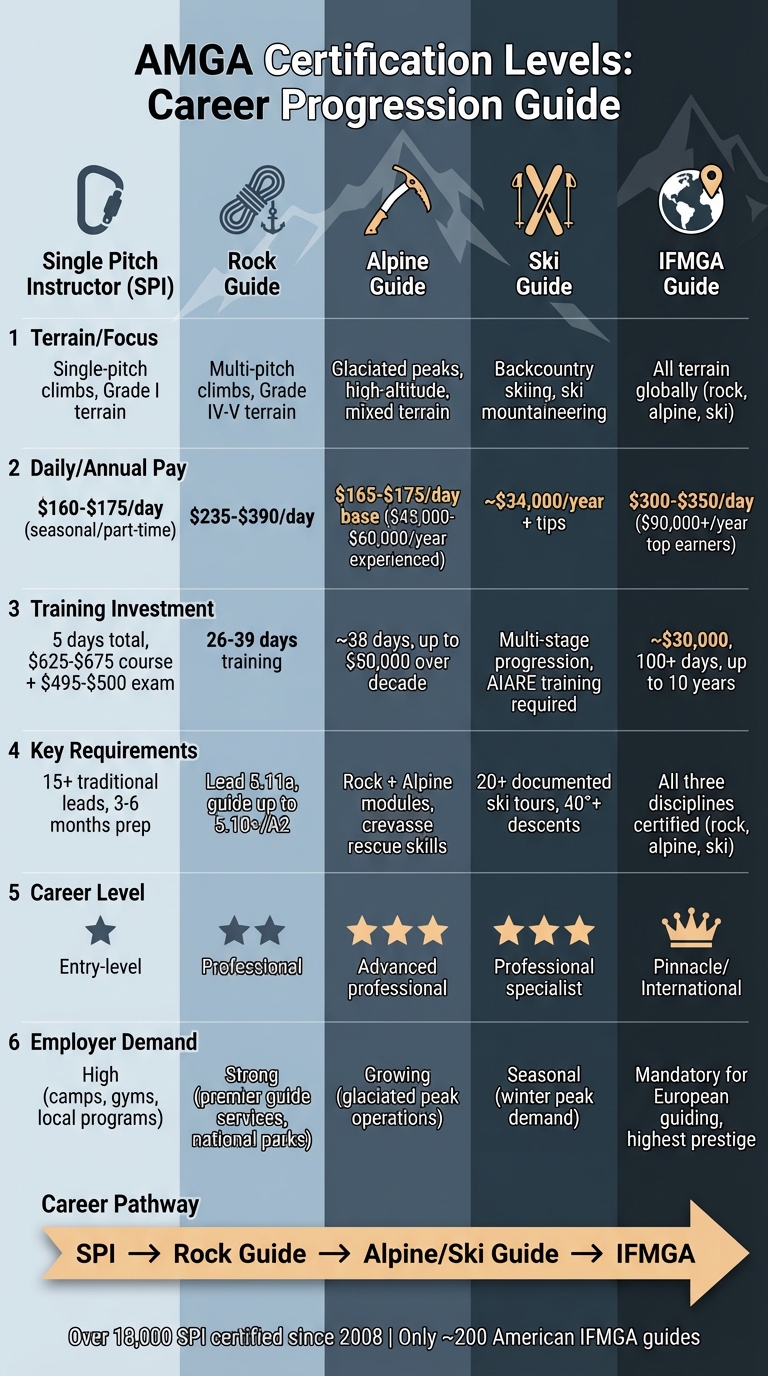
AMGA Mountain Guide Certification Levels: Responsibilities, Pay, and Career Path Comparison
How to become a Rock Climbing Guide | 5 easy steps
sbb-itb-9d004f0
1. Single Pitch Instructor (SPI)
Not sure what outdoor role fits you?
Take our 2-minute career quiz to get matched with outdoor jobs that align with your goals, salary target, and lifestyle.
The Single Pitch Instructor (SPI) certification is the starting point for professional climbing instruction in the U.S. Since its launch in 2008, more than 18,000 individuals have earned this credential, which became internationally recognized by the UIAA in 2009. Below, we outline the key responsibilities, opportunities, and career paths for SPI-certified instructors.
Job Responsibilities
SPIs focus on single-pitch environments - areas where the top can be reached by non-technical means or after a single lead climb. Their duties include both technical and instructional tasks, such as:
- Setting up anchoring systems for group or institutional use
- Managing belay and rappel systems
- Teaching climbing techniques to beginners
- Identifying suitable climbing sites using guidebooks and topos
- Performing rescue techniques in single-pitch scenarios
- Maintaining climbing equipment to industry standards
As Wesley Calkins of Appalachian Climbing School puts it:
"The SPI was never designed to be a standalone credential for running an independent guiding operation. Its original purpose was to prepare instructors to work under the supervision of higher-level guides, like AMGA Rock Instructors, Multi-pitch Instructors or full AMGA Certified Rock Guides."
Employer Demand
SPI-certified instructors are highly valued by various organizations, including commercial guide services, climbing schools, university outdoor programs, and youth camps. Increasingly, land managers and insurance providers view this certification as the baseline requirement for climbing instructors.
For instance, Devils Lake Climbing Guides in Wisconsin hires Assistant Climbing Instructors to work part-time during the shoulder seasons and up to four days a week in summer, offering pay of about $160 per day plus benefits. Similarly, the American Alpine Institute brings on 4–8 new guides annually, with starting pay ranging from $165 to $175 per day. Additional bonuses include $5–$10 for AMGA courses and $50–$80 per night for overnight trips.
Salary Expectations
While the SPI certification primarily leads to seasonal or part-time work, the pay is competitive. Instructors typically earn between $160 and $175 per day, with opportunities for additional income during peak seasons through specialized courses or multi-day trips.
Career Growth Potential
This certification serves as a stepping stone to advanced credentials within the AMGA Rock Program. According to Denver Mountain Guiding, it provides "gateway training to other programs in the AMGA Rock discipline". The SPI certification is valid for three years and can be extended for another three years by completing a higher-level AMGA course. Achieving full certification in any Mountain Guide Program discipline (Rock, Alpine, or Ski) grants permanent SPI status .
Most successful candidates spend 3–6 months preparing for the exam, which requires completing over 15 traditional leads beforehand. The SPI course costs between $625 and $675, with exam fees ranging from $495 to $500. While a Wilderness First Responder certificate isn’t mandatory for the course, many employers require it.
2. Rock Guide
Rock Guide certification represents the peak achievement in the AMGA rock program. Karsten Delap from Pisgah Climbing School describes it as:
"The Rock Guide certification is the pinnacle of the AMGA's rock discipline program, reserved for highly skilled and experienced professionals."
This credential enables guides to lead complex, multi-pitch climbs on Grade IV and V terrain, a major step beyond single-pitch instruction.
Job Responsibilities
Building on single-pitch instruction skills, Rock Guides take on more demanding multi-pitch climbs. They lead technical routes up to Grade V, manage descents, and perform rock rescues. Mastery of advanced techniques, such as short roping, short pitching, and simultaneous belaying, is essential .
Rock Guides also need to excel in route planning and hazard assessment under pressure. They are expected to lead traditional and sport routes at a 5.11a level and guide clients on routes up to 5.10+ and A2 . Additionally, they oversee client orientation, assess movement, and manage risks across varied and challenging rock environments .
Employer Demand
Rock Guide certification is highly sought after by premier guide services, national parks, and AMGA-accredited organizations. According to the AMGA:
"Certifications in rock, alpine, and ski are the most respected guide qualifications in the United States and open doors for a lifetime of exciting and fulfilling work as a guide".
Employers like Alpine Ascents International actively seek experienced Rock Guides with at least five years of experience. These positions often come with competitive pay, gear discounts, education stipends for AMGA courses, and retirement benefits .
Salary Expectations
Rock Guides earn higher wages compared to entry-level instructors. Daily rates range from $235 to $390 or more, depending on experience and certification. In the U.S., the average annual salary for mountain guides is $49,206, with mid-level guides earning around $69,959.
Tips can significantly boost earnings, often accounting for 30–60% of income for some guides. Industry norms suggest gratuities typically range from 10–20% of trip costs. Top earners in the field make upwards of $92,396 annually.
Career Growth Potential
The Rock Guide certification is a stepping stone to advanced opportunities. Completion of the Rock Guide Course is required to enter the Alpine Guide Program and the Ice Instructor Program . Achieving full certification involves 26 to 39 days of formal AMGA training and assessments.
This certification aligns with IFMGA international standards, paving the way to becoming a fully certified American Mountain Guide. This title demands the highest certifications in rock, alpine, and ski disciplines . It allows guides to move from basic instruction to leading complex, multi-day expeditions on challenging terrain . Beyond marking a major career milestone, it also opens doors for further specialization in alpine and ice guiding.
3. Alpine Guide
Alpine Guides take mountain guiding to the next level, building on the skills of Rock Guides to navigate even more demanding and varied mountain environments. This certification, the highest in the AMGA system, qualifies guides to lead on alpine snow, ice, and rock routes across glaciated and non-glaciated peaks.
Job Responsibilities
Alpine Guides are responsible for leading clients through some of the most complex mountain terrains. This includes a mix of rock climbing, snow climbing, glacier travel, waterfall ice climbing, and mixed climbing. In addition to guiding, they handle advanced technical tasks like crevasse rescues, short-roping, and short-pitching in high-altitude conditions . They also teach essential skills such as route planning, avalanche safety, and equipment selection . Constantly assessing hazards, monitoring weather, and managing emergencies in these extreme environments are all part of their role. The level of expertise required makes Alpine Guides highly sought after in the industry.
Employer Demand
The need for certified Alpine Guides is growing as the guiding industry raises its standards. Dave Miller, Owner & Director of International Alpine Guides, highlights this shift:
"The world of guiding is changing and soon it will be very difficult, if not impossible, to get a job guiding on technical mountain terrain without the proper professional training."
For services operating on glaciated peaks, Alpine certification is a must. The AMGA Scope of Practice requires specific training for each type of terrain. Additionally, this certification is the main pathway for U.S. guides aiming for IFMGA status, which opens doors to international guiding opportunities .
Salary Expectations
With their advanced skills, Alpine Guides earn competitive pay. Daily base rates range from $165 to $175. Certification bonuses can add an extra $5–$10 per day, while overnight trips pay an additional $50–$80. On top of that, gratuities average $30–$50 per day. Experienced guides with more than a decade in the field typically earn between $45,000 and $60,000 annually. Those who achieve full IFMGA certification can command daily rates of $300–$350. For instance, the American Alpine Institute in Bellingham, WA reports an average annual salary of $55,893 as of March 2026.
Career Growth Potential
Achieving Alpine Guide certification sets professionals on a path to the highest levels in mountain guiding. The journey starts with the Apprentice Alpine Guide level, which requires completing the Alpine Rock Module and the Alpine Snow and Glacier Module. Full certification is awarded after passing the final Alpine Guide Exam. This progression not only boosts professional credibility but is also a key step toward earning IFMGA status, which requires top credentials in rock, alpine, and ski disciplines.
Guides can further specialize by completing the Ice Instructor Course, focusing on multi-pitch water ice climbing up to WI 4+. The entire certification process spans about 38 days of field training and can cost up to $50,000 over a decade. This investment reflects the dedication required to reach the pinnacle of the guiding profession.
4. Ski Guide
Ski guiding, like other disciplines under the AMGA, builds on fundamental skills and progresses through specialized training modules. Ski Guides lead clients across a variety of backcountry terrains, from non-glaciated slopes to challenging ski mountaineering routes. Their main goal? To find the best snow conditions while carefully managing risks like avalanches and crevasse falls.
The AMGA defines this role as:
"The AMGA Ski Discipline is for ski and splitboard guides who want to find the best possible snow, navigate glaciated and technical terrain on skis, be ready to respond to an injured skier or crevasse fall, and have fun in the mountains with their clients."
Job Responsibilities
Ski Guides are responsible for setting tracks, leading descents, navigating through whiteouts, and performing small-team rescues. A key skill for entry-level guides is locating three buried avalanche transceivers in under 10 minutes. Their work spans various modes, including human-powered touring, heli-skiing, cat-skiing, and ski mountaineering on remote peaks. They also manage glaciated terrain, which often requires short-roping and other technical tools. Advanced guides are expected to handle up to 6,000 vertical feet of ascents and descents in a single day .
These demanding tasks directly impact both compensation and the demand for skilled guides.
Salary Expectations
On average, Ski Guides earn about $34,000 annually, with tips often adding to their income. New guides typically start at around $30,000 per year, while those with a decade of experience can make between $45,000 and $60,000 annually . Tips - ranging from $30 to $50 per day - are a common supplement. Eddie Schoen, an IFMGA Mountain Guide with Rebel Alpine, puts it plainly:
"No one is getting rich in this business. Margins are slim all around. We're all in it because we love the craft and everyone is just trying to make a modest living."
Employer Demand
The rigorous nature of ski guiding has created a strong demand for certified professionals. Increasingly, guiding companies require AMGA certifications rather than relying on recreational experience alone. Land management agencies also recognize AMGA training as a standard, much like Wilderness First Responder certifications .
Most job opportunities are with private guiding operations specializing in ski touring and mountaineering. These jobs are typically found in mountainous regions such as the Pacific Northwest (Mt. Rainier and the North Cascades), the Sierra Nevada (near Mammoth and Tahoe), and the Colorado Rockies . However, because ski guiding is highly seasonal - peaking from mid-December to spring - many guides expand their qualifications into other disciplines, like Rock and Alpine Guiding, to ensure year-round work.
Career Growth Potential
The certification process for Ski Guides starts with the Ski Guide Course, progresses to the Advanced Ski Guide Course & Assistant Exam, and culminates in an 8-day Ski Guide Exam that meets IFMGA standards. Each stage involves increasingly advanced avalanche training. Beginning in the Winter 2026–2027 season, the Ski Guide Course will no longer require a prior Alpine Skills Course as a prerequisite.
Passing the Assistant Exam allows guides to work unsupervised in non-glaciated areas and supervised in glaciated terrain. Completing the final exam certifies guides to IFMGA international standards, opening opportunities for global guiding. As the AMGA highlights:
"AMGA certifications in rock, alpine, and ski are the most respected guide qualifications in the United States and open doors for a lifetime of exciting and fulfilling work as a guide."
To qualify for these courses, aspiring guides must document at least 20 different ski tours, which should include multi-day hut trips and descents on slopes of 40° or steeper.
Advantages and Disadvantages
This section dives into the pros and cons of each certification level, building on the detailed descriptions of their roles.
AMGA certifications come with clear trade-offs. The Single Pitch Instructor (SPI) certification is a straightforward starting point. It requires just 5 days to complete - 3 days of coursework and 2 days for assessment. However, it limits work to Grade I terrain without intermediate belay duties, making it best suited for climbing camps and local guide services. While it’s a great entry-level option, it doesn’t offer early exposure to more advanced or complex climbs.
The Rock Guide certification opens doors to leading multi-pitch climbs and often comes with better pay. However, it demands a significant investment of time and skill - 26 to 39 days of training, plus experience leading climbs rated 5.11a or harder. It’s both physically and technically challenging. As Joe Stock, an IFMGA Mountain Guide, shares: "With each AMGA course and exam, the work and pay became better."[3]
For Alpine and Ski Guides, the challenges are different. These roles are highly technical and often seasonal. Financial returns may not always justify the effort. Eddie Schoen from Rebel Alpine sums it up: "No one is getting rich in this business. Margins are slim all around." While these certifications offer specialized opportunities, earnings tend to be modest.
At the pinnacle is the IFMGA certification, which requires a substantial investment - around $30,000, over 100 days of training, and potentially a decade to complete. Joe Stock, for instance, took 11 years to earn his certification. As of late 2013, fewer than 100 American men and only 10 American women had reached this level. The payoff? It offers the highest earning potential and international reciprocity. Rob Coppolillo, an IFMGA Guide, highlights its importance in Europe: "To guide on big peaks in Europe, you need the pin, no exceptions. Guiding without it can land you in jail."[8]
Here’s a table summarizing the key differences in responsibilities, career growth, pay, and demand across certification levels:
| Certification Level | Primary Job Duties | Career Advancement | Pay Range | Hiring Demand |
|---|---|---|---|---|
| Single Pitch Instructor (SPI) | Leading single-pitch climbs and basic guiding operations | Entry-level; gateway to advanced certifications | Entry-level pay | High demand in gyms and local programs |
| Rock Guide | Guiding complex, multi-pitch climbs requiring technical skills | Professional level; pathway to IFMGA status | Competitive pay | Strong demand for multi-pitch work |
| Alpine Guide | Guiding on glaciers, high peaks, and technical ice/snow terrain | Required for high-altitude guiding | Pay varies by season | High demand for technical alpinism |
| Ski Guide | Guiding backcountry skiing, splitboarding, and heli-skiing | Professional level; requires AIARE training | ~$34,000 annually plus tips | Seasonal demand, especially in winter |
| IFMGA Guide | All-terrain guiding globally across rock, alpine, and ski domains | Highest professional level | Highest earning potential | Mandatory for European guiding |
Conclusion
Choose your AMGA certification based on your career aspirations and the type of terrain you'll be guiding. The Single Pitch Instructor (SPI) certification is a practical starting point for aspiring guides, especially those working at summer camps or local climbing areas. However, if you're looking to turn guiding into a full-time career, advancing beyond this level is essential. As Joe Stock, an IFMGA Mountain Guide, explains:
"Certification is your route to making guiding a career, a real job, with a real wage."
For those focused on multi-pitch rock climbing, the Rock Guide certification sets the professional standard. Meanwhile, Alpine and Ski Guides require expertise in navigating glaciers, high-altitude peaks, and backcountry conditions. Demand for these certifications is growing, particularly as AMGA-accredited businesses increasingly require guides to meet certification benchmarks.
The IFMGA certification represents the pinnacle of guiding credentials, with just over 200 American guides having achieved this level. It's a necessity for guiding on major European peaks. Rob Coppolillo, an IFMGA Guide, underscores this point:
"To guide on big peaks in Europe, you need the pin, no exceptions. Guiding without it can land you in jail."
These certifications signify key steps in a career that combines rigorous training with extensive field experience. Before pursuing any certification, focus on honing your technical skills, decision-making, and route-finding abilities. Additionally, consider a college degree as a safety net, given the physical demands and potential injury risks of the profession.
Each certification unlocks unique career paths. Platforms like Get Outdoor Jobs (https://getoutdoorjobs.com) simplify the search for opportunities, offering thousands of outdoor industry listings daily. Their advanced filters help match your qualifications with jobs based on location, type, and experience level, making it easier to find the right fit for your skills and goals.
FAQs
Which AMGA certification should I pursue first for my guiding goals?
The AMGA (American Mountain Guides Association) suggests beginning your journey with the Aspirant Guide Credential. This certification is an excellent starting point for aspiring guides, as it provides a chance to gain hands-on experience while working under the guidance of an IFMGA (International Federation of Mountain Guides Associations) certified guide.
To earn this credential, you'll need to pass exams in three key areas: alpine climbing, rock climbing, and ski mountaineering. It lays the groundwork for pursuing advanced certifications down the road. Once you've built up enough experience, you can move on to specialized programs like the Rock Guide Course, which helps refine your skills and opens doors to higher-level opportunities in professional guiding.
How long does it usually take to reach IFMGA certification?
Earning an IFMGA certification typically takes between 3 to 6 years. The process involves a minimum of 94 days of training, blending both theoretical lessons and hands-on practice. This rigorous program equips candidates with the skills needed to guide across various disciplines, including alpine, rock, ice, and skiing.
What additional qualifications do employers expect beyond AMGA certifications?
Employers typically seek more than just AMGA certifications when evaluating candidates. They often prioritize adherence to industry standards, a commitment to ethical practices, and compliance with state and federal laws. These factors are particularly critical for accredited guide services and outdoor programs, where safety and professionalism are paramount.