
How Outdoor Leaders Build Emotional Intelligence

Emotional intelligence (EI) is a key skill for outdoor leaders, helping them handle stress, connect with their team, and make better decisions in unpredictable situations. It involves recognizing and managing emotions - both their own and others' - to foster safety and teamwork. Research shows that EI contributes to 58% of a leader's job performance, and 90% of top-performing leaders excel due to high emotional intelligence.
Here’s what you need to know:
- Key EI Components: Self-awareness, self-regulation, empathy, motivation, and social skills.
- Why It Matters: EI helps leaders stay calm, build trust, and guide teams effectively under pressure.
- How to Improve EI: Use tools like the Bar-On EQ-i or reflective practices like journaling and debriefs. Focus on managing stress, understanding team dynamics, and learning from past leadership experiences.
- Practical Tips: Practice naming emotions, use breathing techniques during stress, and observe non-verbal cues to understand your team's emotional state.
Outdoor leadership isn’t just about technical skills - it’s about understanding and managing emotions to create a cohesive, resilient team. Developing EI is a daily practice that can transform how you lead and grow your career in the outdoor industry.
How to self regulate your emotions – Emotional hijacking at Forest School Training
Not sure what outdoor role fits you?
Take our 2-minute career quiz to get matched with outdoor jobs that align with your goals, salary target, and lifestyle.
sbb-itb-9d004f0
How to Assess Your Emotional Intelligence
Taking stock of your emotional intelligence (EI) is like inspecting your gear before an outdoor expedition - it’s the foundation for handling challenges effectively. A proper EI assessment helps you identify strengths and areas for growth that are critical in outdoor leadership.
Using EI Assessment Tools
Several tools can help you get a clear picture of your emotional skills. The Bar-On Emotional Quotient Inventory (EQ-i) evaluates 15 competencies across five key areas of emotional and social functioning. Its shorter version, the EQ-i:S, is frequently used in outdoor leadership research to track how wilderness experiences build emotional skills, particularly in managing stress.
For a quicker option, the LEADx EQ Test offers 45 validated questions and takes only 10–15 minutes to complete. It focuses on four key areas: Self-Awareness, Self-Management, Social Awareness, and Relationship Management. If you’re short on time, try Humessence's Leadership EI tool, which delivers 2–4 minute behavior-based snapshots along with actionable feedback. Evan Watkins, Head of Content at LEADx, explains:
"When every team member can identify, name, and manage emotions in real time, collaboration stops being a personality contest and becomes a performance advantage".
The choice of tool depends on your goals and time constraints. Comprehensive tools like the EQ-i 2.0 provide detailed reports (often requiring a coach to interpret), while quicker tests offer immediate insights you can act on right away. Once you’ve gathered these quantitative insights, take the next step by reflecting on your leadership experiences for a deeper understanding.
Analyzing Your Past Leadership Experiences
Assessment tools are just one part of the puzzle. Real growth comes from examining how you’ve handled leadership situations in the past. Interestingly, only 10–15% of people are genuinely self-aware, even though 95% think they are. Reflecting on past expeditions can help close the gap between how you see yourself and how others experience your leadership.
Look back at challenging moments from previous trips. Focus on key situations - what emotions shaped your decisions, how did these impact the team, and what were the outcomes? Outdoor debrief and feedback sessions are especially valuable for evaluating and building EI. Reviewing these can highlight patterns in how you’ve managed stress and group dynamics.
To take it further, consider keeping an emotion journal. Spend 5–10 minutes each day reflecting on a leadership moment. Write down the specific emotion you felt, what triggered it, any physical sensations (like a tight chest or clenched jaw), and how you responded. This practice can reveal patterns you might otherwise miss in the heat of the moment. Additionally, ask for feedback from peers or mentors - 360-degree input often uncovers blind spots that self-assessment alone can’t address.
Techniques for Building Emotional Intelligence Outdoors
Once you've assessed your baseline emotional intelligence (EI), the next step is putting that awareness into action. The outdoors offers a unique setting to develop EI skills because it places you in dynamic, often unpredictable situations. A study involving 72 students in Wilderness Education Association courses found that wilderness-based leadership programs significantly improved emotional intelligence levels. Below are some practical ways to strengthen your EI in outdoor environments.
Developing Self-Awareness Through Reflection
Self-awareness begins with tuning in to your internal responses as they happen. Recognizing and naming emotions as they arise can help you manage them more effectively. For instance, if you notice a tight stomach or clenched jaw, pause and identify the emotion: "This is frustration" or "I'm feeling fear right now." This simple acknowledgment creates a moment of clarity between the trigger and your reaction.
One effective practice is "Weather Check-Ins." Start each day by encouraging your group to observe the natural environment - cloud formations, wind changes, or temperature shifts. This practice naturally transitions into recognizing the "emotional weather" within your team. Pair this with a few minutes of silence or a short walk in nature before beginning the day’s activities. Another helpful tool is a trigger log. After each activity, jot down the situation, your emotional response, and any related past experiences. Over time, this process can help you respond more calmly to similar triggers in the future.
As Cory Richards, an explorer and photographer, explains:
"EI is developed like muscle memory built over moments of resistance and reflection".
By sharpening your self-awareness, you’ll be better prepared to manage stress and navigate the challenges of outdoor leadership.
Building Resilience and Self-Management
Outdoor activities often come with unexpected challenges - sudden weather changes, trail detours, or multi-day expeditions. These situations force you to adapt quickly, strengthening both resilience and self-management skills. Technical challenges, like navigating rapids or crossing icy terrain, require a calm and focused approach. As outdoor leader Patrick Sipp describes:
"It takes nerves of steel and total focus to lead a team under these conditions".
Instead of viewing fear or discomfort as setbacks, approach them as opportunities to grow. For example, when faced with a steep climb or a difficult route, slow your breathing and remind yourself that this discomfort is part of the learning process. Jason Whiting, founder of Adventure Education Solutions, highlights this idea:
"Emotional intelligence is not a soft skill; it is a survival skill".
Mistakes, like taking a wrong turn or missing a critical cue during a team activity, can serve as immediate lessons. Use these moments to regroup, adapt, and refine your self-regulation skills for handling high-pressure scenarios.
Improving Empathy and Social Awareness
Understanding your team’s emotional state requires constant observation and sensitivity. Pay attention to non-verbal cues - such as the heaviness of a step, a weary sigh, or a glance filled with optimism. Take a moment to ask yourself: What am I feeling? What are others feeling? How do I know this? These real-time observations are key to improving empathy.
Group debriefs and feedback sessions after challenging activities are invaluable for fostering empathy. These discussions give team members a chance to share their emotional experiences, which can help defuse tension and build alignment. Speaking emotions out loud often reduces their intensity, creating a space for mutual understanding. Strengthening empathy through these practices enhances team cohesion - an essential quality for effective outdoor leadership.
Applying Emotional Intelligence in Outdoor Leadership Situations
Five Components of Emotional Intelligence in Outdoor Leadership
EI in Action: Scenario Examples
Outdoor leadership often requires leaders to interpret subtle signals and respond with precision. Take the 1,000-mile expedition through the Okavango Delta in June 2024, for example. Steve Boyes, the leader of the journey, showcased this ability under grueling conditions. While navigating unfamiliar waterways and steering clear of dangerous wildlife, Boyes kept a close eye on his team’s emotional well-being. He noticed small but telling signs - a tired sigh, a hesitant step - and used them to gauge the group’s morale. In a critical moment, he remained composed, which inspired confidence in the team. By asking, "Which way feels right to you?" he not only shared decision-making responsibilities but also fostered trust and collaboration, turning a potential conflict into a moment of unity.
Another story from June 2024 highlights an instructor at Adventure Education Solutions helping a student overcome fear on a climbing wall. Instead of pressuring the student to climb or dismissing their feelings, the instructor acknowledged the fear, named it, and guided the student through calming techniques like controlled breathing. This approach helped the student regain control and face the challenge, proving the power of identifying and managing emotions. As the instructor demonstrated, naming emotions can reduce their intensity, allowing individuals to move forward.
These examples underline the importance of self-awareness and empathy in outdoor scenarios. They also show how understanding and applying the components of emotional intelligence (EI) can transform tense moments into opportunities for growth and teamwork.
Balancing EI Components for Leadership Success
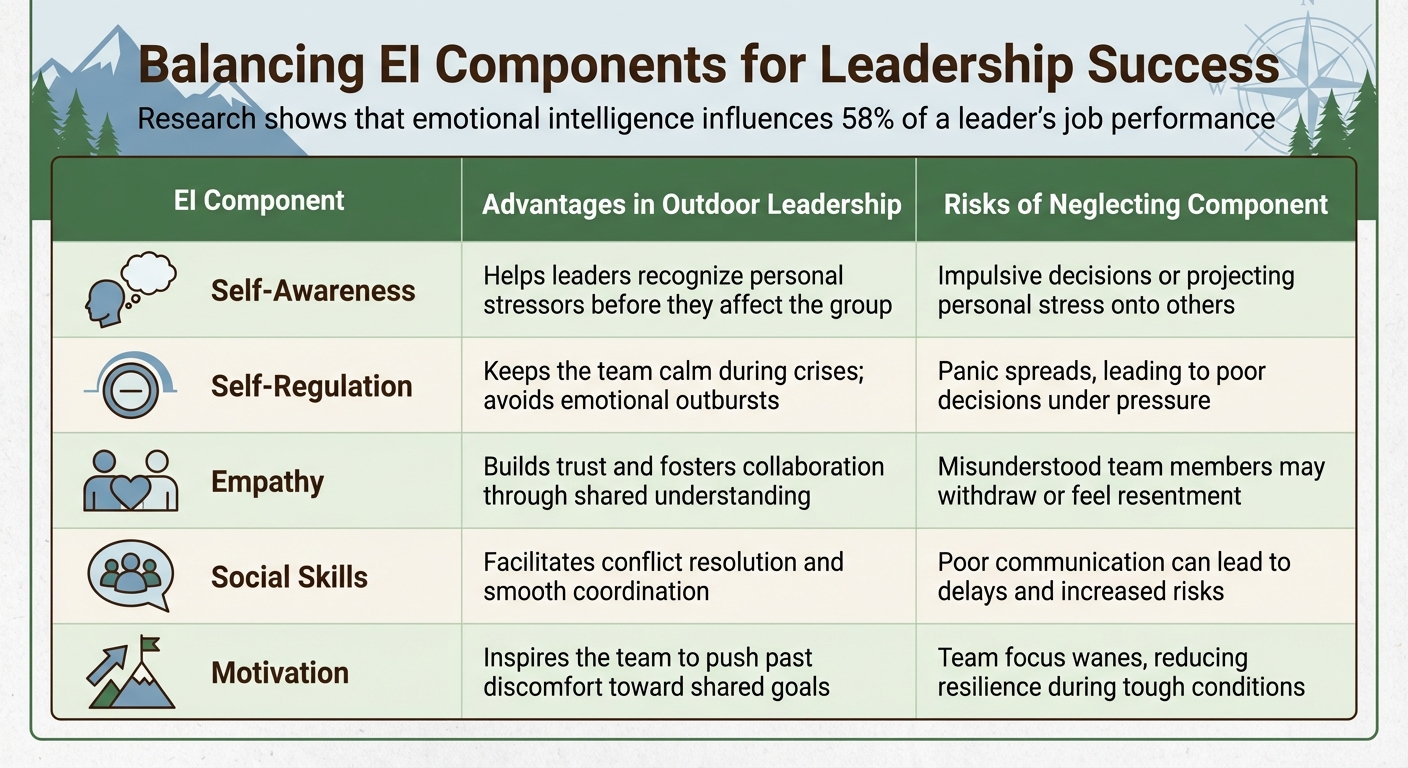
The examples above highlight how emotional intelligence plays a central role in outdoor leadership. Research suggests that emotional intelligence influences 58% of a leader’s job performance. To lead effectively, it’s important to understand how each EI component contributes to success - and what happens when they’re overlooked.
| EI Component | Advantages in Outdoor Leadership | Risks of Neglecting Component |
|---|---|---|
| Self-Awareness | Helps leaders recognize personal stressors before they affect the group | Impulsive decisions or projecting personal stress onto others |
| Self-Regulation | Keeps the team calm during crises; avoids emotional outbursts | Panic spreads, leading to poor decisions under pressure |
| Empathy | Builds trust and fosters collaboration through shared understanding | Misunderstood team members may withdraw or feel resentment |
| Social Skills | Facilitates conflict resolution and smooth coordination | Poor communication can lead to delays and increased risks |
| Motivation | Inspires the team to push past discomfort toward shared goals | Team focus wanes, reducing resilience during tough conditions |
The interplay of these components is crucial. For instance, when a team member speaks sharply or acts out, an emotionally intelligent leader looks deeper. Instead of reacting to the behavior, they consider the underlying cause - often exhaustion or uncertainty - and address it directly. This approach not only defuses tension but also preserves the sense of safety and trust that’s essential for high-stakes teamwork. By focusing on emotions beneath the surface, leaders can keep their teams aligned and resilient in even the most challenging environments.
Conclusion
Key Takeaways for Outdoor Professionals
Throughout this discussion, one thing stands out: practicing emotional intelligence (EI) consistently can transform how teams operate in outdoor settings. In fact, EI is more than just a leadership tool - it’s a critical survival skill in the wild. Research highlights that in outdoor environments, EI takes on an even greater role, with wilderness-based leadership programs showing a measurable boost in participants' emotional intelligence levels. In unpredictable situations, being able to read emotions and regulate responses can make all the difference between success and failure.
The five core components of EI - self-awareness, self-regulation, empathy, motivation, and social skills - work together to create a leader who can anticipate and address team needs before issues escalate. Explorer Cory Richards captures this idea perfectly:
"Leaders who can feel their team as much as they feel the task see farther, hold steadier, and create deeper cohesion".
This ability to "feel the team" helps leaders identify signs of fear, fatigue, or uncertainty early on, turning potential safety risks into opportunities to build trust and maintain team cohesion under pressure.
Developing EI isn’t a one-time effort - it’s a daily practice. Techniques like the 4-7-8 breathing method during stressful moments, reflective journaling after expeditions, and regular team feedback sessions (at least every quarter) are practical ways to strengthen your leadership skills. A study involving 72 students in Wilderness Education Association courses further supports this, showing that wilderness-based leadership programs are effective at improving EI.
Armed with these strategies, you’re better prepared to navigate the challenges of outdoor leadership with confidence.
Next Steps for Career Growth
Take your outdoor leadership to the next level by applying these EI skills to your career. Emotional intelligence isn’t just essential for leading in the wilderness - it’s also a powerful asset for advancing your career. Platforms like Get Outdoor Jobs (https://getoutdoorjobs.com) can help you find opportunities where your EI skills are highly valued. From expedition leadership to environmental education and conservation management, the site offers thousands of updated job listings tailored to the outdoor industry.
Consider this: 92% of employees believe that showing empathy is crucial for retaining talent, and about 65% of employers rate emotional intelligence as equally important as IQ when assessing leadership potential. By continuing to build your EI, you’re not just enhancing your ability to lead - you’re laying a strong foundation for a career that makes a lasting impact in the outdoor world.
FAQs
Which EI skill should I build first as an outdoor leader?
The first key skill in emotional intelligence to work on is self-awareness. This is all about recognizing and understanding your own emotions. Why does it matter? Because when you know what you're feeling and why, you're better equipped to manage those emotions and make smarter decisions. Think of self-awareness as the groundwork for other emotional intelligence skills - like self-regulation, empathy, and social skills - that are crucial for leading effectively, especially in outdoor environments.
How can I practice EI during a trip without slowing the group down?
Practicing emotional intelligence (EI) during a trip doesn’t have to slow anyone down. It starts with staying self-aware and empathetic in the moment. For example, staying calm and composed in stressful situations - like tackling tricky terrain or resolving group tensions - can make a huge difference.
You can also support your teammates by actively listening to their concerns and responding with empathy. These small but impactful actions not only strengthen group morale but also help you grow as a leader, all while keeping the journey on track.
How do I use EI to handle conflict or fear in the field?
To navigate conflict or fear using emotional intelligence (EI), start by honing three key skills: self-awareness, self-regulation, and empathy. First, identify and understand your own emotions - this awareness is the foundation for responding thoughtfully rather than reacting impulsively. Next, practice self-regulation by staying calm and composed, even in tense situations. Finally, approach others with empathy by actively listening to their concerns and validating their feelings.
Encouraging open communication and creating a safe space for emotional expression can help build trust and ease tensions. Over time, consistent practice in developing EI can transform conflicts into opportunities for understanding and growth, while also strengthening team dynamics.