
Top 7 Outdoor Jobs for Climate Resilience

Looking for a career that tackles climate challenges while working outdoors? Here are seven roles that focus on reducing climate risks and preparing communities for environmental changes. These jobs combine fieldwork with meaningful impact, offering opportunities in conservation, renewable energy, and restoration.
Key Roles:
- Conservation Planners: Develop strategies to restore ecosystems and manage land use.
- Renewable Energy Project Managers: Oversee solar and wind installations to reduce emissions.
- Sustainable Forestry Specialists: Manage forests to absorb carbon and prevent wildfires.
- Climate Adaptation Field Technicians: Perform hands-on restoration and wildfire prevention tasks.
- Coastal Resilience Coordinators: Protect shorelines from rising seas and extreme storms.
- Wildlife Resilience Biologists: Monitor and protect habitats to support biodiversity.
- Rangeland Restoration Managers: Restore damaged lands and manage grazing practices.
These careers are growing quickly, with positions like wind turbine technicians expected to increase by over 58% in the coming years. Salaries range from $43,680 for field technicians to $86,940 for federal conservation roles, with opportunities for advancement in each field.
Ready to make an impact? Platforms like Get Outdoor Jobs help you find roles that match your skills and interests, making it easier to join the movement toward a more climate-resilient future.
Not sure what outdoor role fits you?
Take our 2-minute career quiz to get matched with outdoor jobs that align with your goals, salary target, and lifestyle.
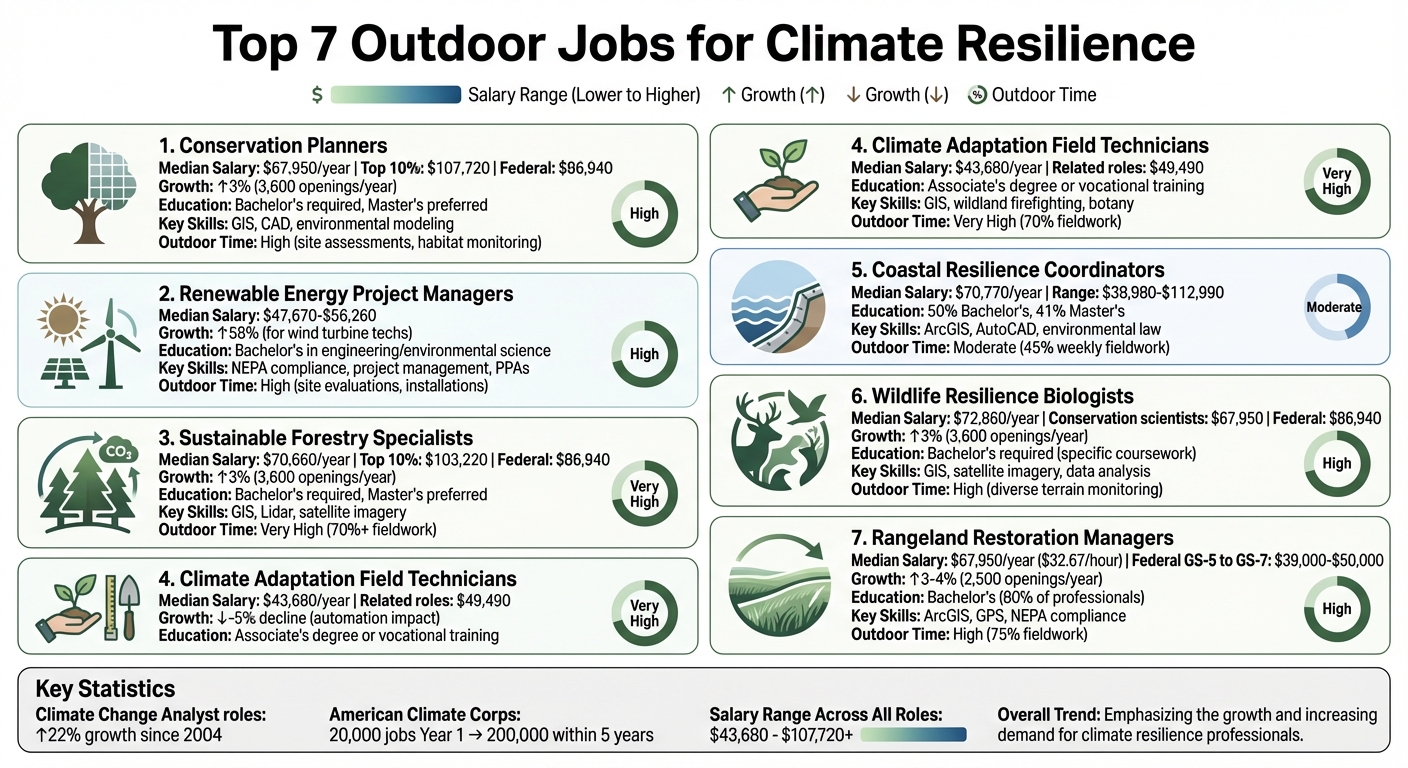
7 Outdoor Climate Resilience Jobs: Salaries, Growth & Requirements Comparison
1. Conservation Planners
Outdoor Involvement and Fieldwork
Conservation planners play a crucial role in maintaining and restoring ecosystems. Their work often takes them outdoors, where they assess sites, monitor habitats, and manage restoration efforts across various landscapes like forests, wetlands, and rangelands. They gather essential data to understand how ecosystems respond to pressures such as climate change, pollution, and human activity. This hands-on approach helps shape strategies for restoring damaged areas, which can include replanting native trees or controlling invasive species. The fieldwork they conduct is the backbone of creating effective climate resilience plans.
Relevance to Climate Resilience Efforts
Part of their responsibilities includes conducting environmental impact studies to evaluate how ecosystems are affected by climate change and exploring ways to mitigate those effects. They also act as intermediaries between developers, government agencies, and environmental organizations, ensuring that land-use decisions align with climate resilience goals. This work is especially significant as communities face increasing risks from wildfires and extreme weather events.
Required Skills and Qualifications
To become a conservation planner, a bachelor's degree in environmental science, conservation, or natural resource management is the minimum requirement, though many senior positions prefer candidates with a master’s degree. Technical expertise in tools like GIS, CAD, and environmental modeling is a must, along with strong communication, organizational, and conflict resolution skills. Practical experience gained through internships or related jobs is essential, as is a solid understanding of federal and state environmental regulations, including EPA standards.
Potential Salary and Career Growth
The median annual salary for conservation planners is $67,950 as of May 2024. While the lowest 10% earn less than $45,260, the top 10% make over $107,720. Federal roles tend to offer higher pay, with a median salary of $86,940, compared to $72,010 in professional services. The field is expected to grow by 3%, with approximately 3,600 job openings annually from 2024 to 2034. Career progression often leads to senior roles involving budget management, personnel oversight, and the development of long-term conservation strategies. The highest-paying regions include the District of Columbia ($96,100), Hawaii ($91,800), and Maryland ($91,560).
sbb-itb-9d004f0
2. Renewable Energy Project Managers
Outdoor Involvement and Fieldwork
Renewable energy project managers play a key role in overseeing solar and wind installations, guiding projects from initial planning through to commissioning. At the start, they perform site evaluations, analyzing factors like solar irradiance, land usage, and grid connectivity. During construction, their responsibilities include coordinating onsite installations, managing contractor schedules, and ensuring quality control. They also review technical surveys - covering areas like geotechnical conditions, wetlands, and local heritage - to confirm that sites meet all suitability criteria. Once installations are complete, they conduct onsite testing to verify system performance and continue monitoring and troubleshooting to maintain optimal energy output. This blend of fieldwork and technical oversight ensures renewable projects deliver on their promise of sustainable energy.
Relevance to Climate Resilience Efforts
By ensuring the success of renewable energy projects, these managers contribute directly to reducing greenhouse gas emissions and advancing climate mitigation goals. Their work bridges the gap between technical teams and field crews, guaranteeing compliance with environmental regulations such as the National Environmental Policy Act (NEPA). They also oversee environmental impact assessments and implement mitigation measures to protect local ecosystems throughout the transition to renewable energy. With the renewable energy sector continuing to grow, these professionals are increasingly in demand, playing a critical role in shaping a cleaner and more sustainable future.
Required Skills and Qualifications
Most renewable energy project managers hold a bachelor’s degree in environmental science, engineering, or a related field, though many senior roles prefer candidates with a master’s degree. Senior-level positions often require at least seven years of professional experience, including three to five years in energy project leadership. A strong understanding of NEPA, permitting processes, and renewable energy systems is essential. Proficiency in project management tools like Microsoft Project, along with financial skills to handle budgets and power purchase agreements (PPAs), is also critical. Certifications such as Professional Wetland Scientist (PWS), American Institute of Certified Planners (AICP), or HAZWOPER can further enhance career prospects.
Potential Salary and Career Growth
Renewable energy project management offers solid career opportunities and competitive pay. For example, solar photovoltaic installers earn a median wage of $47,670, while wind turbine service technicians see median wages of $56,260. Career advancement can lead to roles like Solar Project Developer, Solar Fleet Manager, or Director of Environmental Assessment, Permitting & Compliance. Additionally, the demand for climate change analysts has risen by 22% nationwide since 2004, reflecting the growing focus on sustainability.
"Hiring and job availability are extremely dependent on the state of the economy... Get involved in issues/projects that interest you. There are a lot of great environmental sustainability projects going on all around us and many of these projects will gladly accept more help." - Rajan L. Brown, Landscape Designer and Construction Manager at Heaviland Industries.
3. Sustainable Forestry Specialists
Outdoor Involvement and Fieldwork
Sustainable forestry specialists dedicate much of their time outdoors, managing forests that play a crucial role in absorbing carbon dioxide and combating climate change. Their work involves tasks like conducting controlled burns to minimize wildfire risks, overseeing reforestation efforts, and managing forest watersheds to prevent soil erosion and safeguard water supplies. To monitor forest health and track changes in ecosystems over time, they rely on advanced tools like GIS, Lidar, and satellite imagery. This job demands significant physical endurance, as specialists often cover long distances through dense forests and rugged terrain, regardless of weather conditions. These on-the-ground efforts help strengthen ecosystems, making them more resilient to climate challenges.
Relevance to Climate Resilience Efforts
Sustainable forestry practices are a key part of addressing climate change. Forests cover about one-third of the continental United States, making them vital for reducing environmental impacts. Beyond supplying wood and paper products, forests play a critical role in removing carbon dioxide from the atmosphere, which helps to slow global warming. By protecting biodiversity and maintaining productive soils, forestry specialists ensure that forests continue to support wildlife and foster growth, even under increasing environmental pressures. A great example of this work is Houston City Forester Victor Cordova's 2009 initiative, where volunteers planted 20,000 trees, transforming a grassy median into an urban forest. This project not only increased resilience to tree diseases but also supported urban wildlife. These strategies align with broader climate efforts by preserving ecosystems that shield communities from extreme weather and environmental decline.
"Forested areas have abundant plant life, which absorbs carbon dioxide from the atmosphere... forests are important for removing some of it from the atmosphere so it will not contribute to further global warming." - Bureau of Labor Statistics
Required Skills and Qualifications
To enter this field, a bachelor’s degree in forestry, natural resources, or environmental science is typically required. For mid-level positions, a master’s degree in forest sciences or management is often preferred. Specialists need expertise in GIS, remote sensing, spatial analysis, and computer modeling to accurately map and inventory forest resources. A strong understanding of biology, ecology, and soil science is also essential for maintaining forest health. Since 16 states require foresters to be licensed or credentialed, it’s important to check specific state requirements. Additionally, earning the "Certified Forester" designation from the Society of American Foresters can enhance career prospects and credibility.
Potential Salary and Career Growth
Foresters earn a median annual salary of $70,660, with the top 10% making over $103,220. Conservation scientists working in federal government roles report a higher median salary of $86,940. Job opportunities for conservation scientists and foresters are expected to grow by 3% between 2024 and 2034, with approximately 3,600 openings each year. Career advancement often leads to specialized roles like silviculturists, who earn an average annual salary of $122,674. Specialists may also branch into high-demand areas such as wildfire management, urban forestry, or carbon offset verification, offering further opportunities for career growth.
4. Climate Adaptation Field Technicians
Outdoor Involvement and Fieldwork
Climate adaptation field technicians spend the majority of their time - about 70% of their workday - outdoors, tackling hands-on restoration and monitoring tasks. Their duties range from planting seedlings for reforestation to thinning forests with power saws to reduce wildfire risks. They also create firebreaks to help control wildfire spread. Using tools like diameter tapes and increment borers, they assess forest health and feed the collected data into GIS software to guide management decisions. The job is physically demanding, often requiring technicians to navigate rough terrain while carrying heavy equipment. Additionally, they identify diseased plants and apply chemical treatments to protect vegetation from pests. This on-the-ground work is a critical component of climate adaptation strategies.
Relevance to Climate Resilience Efforts
Field technicians play a key role in turning plans for natural climate solutions into action. Their work spans areas like coastal restoration, watershed management, and reclaiming mined lands, all of which help reduce environmental risks. Wildfire mitigation is particularly vital as fires grow more severe and frequent. Technicians address this by performing prescribed burns and clearing excess brush to maintain forest health. Their efforts have tangible impacts - examples include establishing carbon sequestration plots and implementing stormwater management systems. These projects highlight how technicians transform climate adaptation theories into meaningful ecosystem improvements.
Required Skills and Qualifications
Most employers look for candidates with an associate's degree or equivalent post-secondary training in fields like forestry, environmental technology, or natural science. Skills in GIS, remote sensing, and modeling are essential. Field-specific expertise - such as land surveying, botany, tree identification, and wildland firefighting techniques - is typically gained through vocational forestry programs that emphasize hands-on fieldwork. Entry-level technicians usually undergo one to 12 months of on-the-job training under experienced supervisors. Beyond technical skills, strong critical thinking and communication abilities are necessary for tasks like report writing and collaborating with landowners or government agencies. These foundational skills often lead to opportunities for advancement in conservation careers.
Potential Salary and Career Growth
The median annual salary for climate adaptation technicians is $43,680, while those in related roles, like environmental science and protection technicians, earn about $49,490. However, a 5% decline in technician roles is projected between 2024 and 2034, mainly due to advancements in automation and remote sensing. That said, technicians with bachelor's degrees can move into higher-paying roles, such as conservation scientists (median salary: $67,950) or foresters (median salary: $70,660). Additionally, the demand for climate change analysts has grown by 22% nationwide since 2004, reflecting an increasing need for specialized expertise in climate adaptation fields.
5. Coastal Resilience Coordinators
Outdoor Involvement and Fieldwork
Coastal resilience coordinators split their time between the office and the outdoors, tackling tasks like site assessments, collecting environmental samples, and inspecting remediation sites in all kinds of weather conditions. Nearly half - about 45% - of professionals in restoration roles spend time outdoors at least once a week. The fieldwork isn’t for the faint of heart; it often involves hiking through wetlands, wading in estuaries, and navigating remote shorelines to evaluate the success of resilience projects. These coordinators also rely on tools like GIS software and environmental planning platforms, such as HEC-RAS, to map coastal changes and predict future scenarios. This hands-on work is critical to their mission of protecting coastal communities.
Relevance to Climate Resilience Efforts
Using insights gained from fieldwork, coastal resilience coordinators design and manage restoration projects that serve as natural shields against climate challenges. Much like conservation planners and renewable energy managers, they transform technical data into practical, nature-based solutions. For instance, restoring marshes and dunes helps safeguard communities from rising sea levels and storm surges. Additionally, they conduct environmental impact studies to evaluate how climate change is affecting coastal ecosystems and turn this data into actionable management plans. Their work is becoming increasingly important as extreme weather events grow more frequent and severe, posing serious risks to coastal areas.
Required Skills and Qualifications
About half of coastal resilience coordinators hold bachelor’s degrees, while 41% have earned master’s degrees. Popular fields of study include biology, geography, environmental science, and natural resource management. Advanced roles, such as Climate Adaptation Strategist or Director, often require a master’s degree in areas like environmental engineering or climate change adaptation. Technical expertise is a must - skills in ESRI ArcGIS, AutoCAD, and remote sensing technology are essential for mapping and modeling coastal changes. Coordinators also need a strong understanding of environmental laws, such as the California Coastal Act, and should be skilled in grant writing to secure funding for their projects.
Potential Salary and Career Growth
Coastal resilience coordinators working as climate change analysts earn an average annual salary of $70,770, with a typical range from $38,980 to $112,990. Senior roles in conservation and resilience offer salaries between $85,000 and $110,000, while top-tier policy and leadership positions can pay between $162,000 and $181,000. Career paths often start with entry-level technician or fellowship roles, progressing to analyst positions, then strategist roles, and eventually director-level jobs. Certifications, like the Climate Resilience Certificate for Professionals from Antioch University, can help professionals move into higher-paying strategist positions more quickly.
6. Wildlife Resilience Biologists
Outdoor Involvement and Fieldwork
Wildlife resilience biologists spend much of their time outdoors, navigating diverse landscapes like mountains, deserts, wetlands, and prairies. Their work often involves hiking through challenging terrain to gather data and monitor ecosystems. Tools like GIS, satellite imagery, and lidar play a key role in their efforts, helping them track habitat changes and wildlife movement. These technologies are indispensable for protecting species across environments ranging from national forests to expansive grasslands. Collaboration is another cornerstone of their work - they team up with engineers, timber management specialists, and recreation planners to create land-use strategies that consider climate resilience.
Relevance to Climate Resilience Efforts
The hands-on nature of this fieldwork directly supports climate resilience efforts. Wildlife resilience biologists focus on natural solutions to combat climate-related challenges. They manage forests and watersheds to minimize the effects of extreme weather, while also addressing issues like invasive species and wildfires - both of which have become more severe due to shifting environmental conditions. The Bureau of Labor Statistics highlights the growing need for professionals in this field:
"Forests and rangelands... foresters and conservation scientists will likely be needed to mitigate growing humanitarian and environmental impacts of forest fires".
Active management techniques, such as controlled burns and brush clearing, are increasingly emphasized to maintain ecosystem health. These strategies help stabilize ecosystems under the pressure of climate threats. The U.S. Forest Service underscores the importance of their work:
"Your main responsibility as a Forest Service wildlife biologist will be wildlife habitat - managing, protecting, rehabilitating, and enhancing it".
Required Skills and Qualifications
To enter this field, a bachelor’s degree in biological science, natural resource management, forestry, or ecology is essential. Federal positions have additional requirements, including coursework: 9 semester hours in wildlife subjects, 12 in zoology, and 9 in botany. For higher-level roles like strategists or directors, a master’s degree in areas such as environmental engineering or climate adaptation is often necessary. Technical skills in GIS, remote sensing, computer modeling, and data analysis are critical. Strong communication abilities are equally important, as biologists routinely collaborate with state agencies, private landowners, and the public. These qualifications open doors for advancement in both federal and state agencies.
Potential Salary and Career Growth
In May 2024, the median annual salary for zoologists and wildlife biologists was $72,860, while conservation scientists earned $67,950. Federal government roles offer even higher median pay, averaging $86,940 annually. Entry-level positions in agencies like the U.S. Forest Service typically start at GS-5 or GS-7 on the General Schedule (GS) pay scale. Around 35% of Forest Service wildlife biologists advance to the GS-11 level, with 23% moving into higher grades. Between 2024 and 2034, employment for conservation scientists and foresters is expected to grow by 3%, translating to roughly 3,600 job openings each year. Meanwhile, climate change analyst roles - a closely related area - have seen a 22% rise in job openings nationwide since 2004.
7. Rangeland Restoration Managers
Outdoor Involvement and Fieldwork
About 75% of rangeland restoration managers spend their time outdoors, often braving various weather conditions. Their work takes them to remote areas where they measure vegetation, evaluate soil stability, and monitor the overall health of rangelands. These tasks often involve physically demanding activities like climbing, lifting, and long-distance walking. To support their efforts, they use tools such as ESRI ArcGIS and GPS software for mapping and tracking restoration progress. On the ground, they employ techniques like controlled burns, herbicide application, and reseeding to maintain land productivity. However, this role isn’t all rugged fieldwork - around 65% of their time is spent indoors, focusing on GIS mapping, analyzing data, and preparing environmental impact reports. This unique mix of outdoor and indoor responsibilities makes their role critical in addressing climate challenges.
Relevance to Climate Resilience Efforts
Rangeland restoration managers play a key role in protecting ecosystems by restoring damaged lands and preventing erosion. Their work ensures soil remains stable, vegetation thrives, and watersheds and wildlife habitats stay intact. They also address wildfire risks and combat invasive species. Beyond ecological tasks, they manage grazing permits and establish technical standards to balance economic needs with environmental conservation. The Department of the Interior highlights the importance of their expertise:
"the ideal candidate can apply their professional knowledge of rangeland management principles and concepts to effectively solve problems or modify strategies that affect a wide array of ecological processes".
Additionally, they mediate between ranchers and conservationists, ensuring land use practices align with both preservation and agricultural goals.
Required Skills and Qualifications
A bachelor’s degree is typically required for this field, with about 80% of professionals holding one. Relevant areas of study include rangeland management, botany, soil conservation, and forestry. Federal roles often require at least 42 semester hours in plant, animal, and soil sciences, with 18 of those hours focused on range management. Skills in GIS tools, GPS software, and analytical programs like BehavePlus or SAS are essential. Familiarity with federal regulations, particularly the National Environmental Policy Act (NEPA), is also critical for reviewing grazing permits and ensuring compliance. Strong negotiation and conflict resolution abilities are vital for working with diverse groups.
Potential Salary and Career Growth
In 2024, conservation scientists, including rangeland managers, earned a median annual salary of roughly $67,950, or about $32.67 per hour. Federal positions follow a clear progression, starting at GS-5 to GS-7 levels (approximately $39,000–$50,000, depending on location) and advancing to GS-12 or GS-13 for more senior roles. Job growth in this field is projected at 3% to 4% between 2024 and 2034, with nearly 2,500 openings annually. Career paths often lead from technical roles to managerial, research, or policy-focused positions. Federal agencies like the Bureau of Land Management and the U.S. Fish and Wildlife Service are some of the largest employers in this sector.
Best Jobs in Climate Change
How to Find Climate Resilience Jobs on Get Outdoor Jobs

Get Outdoor Jobs makes it easier to discover roles in climate resilience, spanning conservation, renewable energy, and restoration. You can search by specific job titles like Environmental Restoration Planners, Climate Change Policy Analysts, or Sustainability Specialists. If you know the O*NET codes, you can use those to pinpoint precise positions.
The Green Topics filter is another handy tool. It lets you narrow your search to areas like "Climate change", which includes 12 primary occupations, or "Conservation", covering 25 distinct roles. If you're interested in Energy & Natural Resources careers, you can refine further to focus on Conservation & Land Management. Plus, geographic filters allow you to search by city, state, or ZIP code, with an adjustable radius - for example, limiting results to jobs within 25 miles of your location.
To find roles that align with your experience, use the Job Zone filter, which ranges from level 1 (entry-level) to level 5 (extensive experience). You can also filter by education and training programs, such as Climate Science, Ecology, or Natural Resources Management. Look out for jobs marked with the "Bright Outlook" designation - these indicate fields that are growing quickly and have strong hiring demand. The platform also highlights major federal initiatives, like the American Climate Corps, which aims to employ 20,000 people in its first year and grow to 200,000 within five years. This program focuses on paid roles in areas like solar panel installation, wildfire management, wetland restoration, home weatherization, and other climate-related work, with a goal of channeling 40% of its benefits to disadvantaged communities.
To keep things fresh, job listings are updated daily, ensuring you have access to the latest opportunities. Whether you're looking for technical roles in renewable energy, hands-on restoration work, or policy-driven positions, the platform's filters help you sort through thousands of listings with ease and precision.
Conclusion
Climate resilience jobs go beyond safeguarding communities and economies - they’re about shaping a future that can withstand the challenges of our changing planet. From battling rising sea levels to combating intensifying wildfires, outdoor professionals are working tirelessly to build infrastructure, restore ecosystems, and implement solutions that not only capture carbon but also drive economic stability. These roles focus on two critical areas: mitigation, which reduces greenhouse gas emissions, and adaptation, which minimizes risks from climate impacts. Together, they’re key to ensuring our collective survival.
The job market reflects this urgency, with strong growth across various sectors. For example, Climate Change Analysts are seeing more opportunities, while conservation scientists and foresters are expected to fill thousands of upcoming positions. Renewable energy sectors, like wind and solar, are also experiencing rapid expansion, highlighting the demand for skilled workers. These roles offer more than just purpose - they provide competitive pay, with median annual salaries ranging from $49,490 for environmental technicians to $96,820 for environmental engineers.
If you’re ready to step into this vital work, platforms like Get Outdoor Jobs simplify the process. With daily updates and specialized filters, you can find positions tailored to your experience, education, and location. Whether you’re exploring opportunities with the American Climate Corps or focusing on fields like conservation or renewable energy, the platform helps you connect your skills to roles where they can have the greatest impact.
Each of these positions plays a critical role in protecting our environment and supporting communities. As the world shifts from debating climate change to implementing real solutions, the time to get involved is now. These careers not only offer stability and specialized training but also the chance to make a tangible difference. Start your search today and become part of the movement toward a more resilient future.
FAQs
What qualifications do you need for a job in climate resilience?
To pursue a career in climate resilience, you'll generally need a bachelor's degree in areas like environmental science, biology, natural resource management, or forestry. For certain positions - especially those focused on data analysis, leadership, or specialized planning - a master's degree or coursework in subjects such as climate adaptation, sustainability, or renewable energy might be preferred.
However, education alone isn't enough. Practical skills play a big role, too. Employers often value experience with GIS (geographic information systems), project management, and data-driven decision-making. Being able to communicate effectively - both in writing and speaking - is crucial for breaking down complex data into actionable strategies or working with communities. Gaining hands-on experience through internships, volunteer opportunities, or entry-level jobs with environmental organizations, government agencies, or renewable energy companies can give you an edge. Additionally, professional certifications like LEED Green Associate or Certified Ecologist can enhance your qualifications and improve your job prospects.
How do outdoor jobs focused on climate resilience help protect the environment?
Outdoor jobs focused on climate resilience are essential for turning environmental strategies into tangible actions. Professionals such as conservation planners, sustainable forestry specialists, and renewable energy project managers play a hands-on role in reducing greenhouse gas emissions, restoring ecosystems, and helping communities adapt to extreme weather challenges. Their work often involves tasks like replanting forests, managing watersheds, and installing renewable energy systems. These efforts not only improve air and water quality but also help capture carbon and protect biodiversity.
Beyond environmental impact, these roles contribute to building stronger, more sustainable economies. For instance, renewable energy project managers oversee the development of solar and wind farms, reducing reliance on fossil fuels. Meanwhile, sustainable forestry specialists implement practices like selective logging to ensure forests remain healthy and continue to store carbon. From restoring wetlands to weatherproofing homes, these jobs deliver measurable benefits to the environment while promoting long-term care for natural resources. If you're eager to make a difference, check out thousands of outdoor job opportunities in climate resilience on Get Outdoor Jobs.
What are the salary ranges and job growth prospects for outdoor climate resilience careers?
The demand for outdoor climate resilience careers is booming across the United States, thanks to growing investments in renewable energy, natural climate strategies, and environmental planning. Jobs like solar technicians, wind turbine technicians, and environmental planners are leading the charge in this green job market, with average salaries often topping $70,000 annually. As climate-focused initiatives expand, many of these roles are expected to see steady growth.
Salaries in this sector can vary based on the role and level of experience. For instance, Climate Change Analysts typically earn between $39,000 and $113,000 per year. Sustainable forestry specialists and GIS analysts generally bring in $40,000 to $90,000 or more. Renewable energy project managers and wind turbine technicians also enjoy competitive pay, with average earnings ranging from $56,000 to $98,000 annually. In high-demand positions like petroleum engineers or construction managers working on clean energy projects, salaries can exceed $100,000.
This field offers not only strong job growth but also competitive pay, making it an attractive option for those passionate about sustainability. If you're ready to take the next step, explore job opportunities tailored to your skills and interests on Get Outdoor Jobs.