
Remote Work vs. Onsite Roles: Time Management Tips

Struggling with time management? Whether you work remotely or onsite, balancing productivity and personal life can be tough. Each setup has unique challenges:
- Remote Work: Flexible, but blurred boundaries and constant digital interruptions can lead to burnout.
- Onsite Work: Structured, but commuting, rigid schedules, and physical demands can drain energy.
Key Takeaways:
- Remote roles demand self-discipline to avoid overworking and distractions like notifications or home chores.
- Onsite jobs require managing physical fatigue, unpredictable conditions, and time lost to commutes.
Quick Tips:
- Remote Workers: Use time blocking, set boundaries, and take regular breaks to stay focused and energized.
- Onsite Workers: Plan around fixed schedules, tackle tough tasks early, and use commutes for mental prep.
For hybrid roles, combine the best of both worlds: collaborate onsite and focus deeply on remote days. Tailored strategies can help you stay productive and maintain work-life balance.
Not sure what outdoor role fits you?
Take our 2-minute career quiz to get matched with outdoor jobs that align with your goals, salary target, and lifestyle.
Clocking Success: Time Management Strategies for Remote and Hybrid Careers
sbb-itb-9d004f0
Time Management Challenges in Remote and Onsite Roles
Managing time effectively comes with its own set of hurdles, whether you're working remotely or onsite. These challenges vary significantly between the two setups, and understanding them is key to finding strategies that fit your specific situation.
Challenges for Remote Professionals
Remote work blurs the line between professional and personal life. Without a clear "end of the day", 27% of remote workers admit they never fully disconnect from work - even on weekends. Adding to this, remote employees check email 40% more often outside regular hours compared to their onsite counterparts. This constant connectivity can quickly lead to burnout.
Then there’s the issue of digital interruptions. While remote work offers flexibility, it also introduces a flood of distractions - Slack messages, email alerts, and video calls. Research shows that recovering focus after an interruption takes 23 minutes on average. That means a single notification can derail nearly half an hour of productive work.
Home life distractions further complicate things. Family interruptions, caring for pets, or coordinating with colleagues across time zones can throw off your workflow. This is especially challenging for outdoor professionals who manage conservation projects or field teams remotely.
Another major hurdle is the sedentary nature of remote work. Unlike onsite roles that involve physical activity, remote jobs often mean hours of sitting in front of a screen. This can lead to both physical and mental fatigue. For outdoor professionals transitioning from active fieldwork to desk jobs, the change can be particularly tough - 44.4% reported a decline in mental health after making this shift.
Challenges for Onsite Professionals
Onsite roles come with their own unique time management struggles, often tied to physical and environmental factors.
Commuting is a major time sink. During the pandemic, U.S. workers saved an estimated 89 million hours per week by eliminating daily commutes. Onsite professionals, however, still contend with traffic jams, public transit delays, and travel logistics, eating into their personal and professional time.
Rigid schedules are another challenge. Unlike remote workers who can plan tasks around their energy peaks, onsite professionals must adhere to fixed shifts dictated by workplace hours or seasonal demands. This lack of flexibility can amplify stress, particularly when job demands outpace the time available. Research even shows that onsite workers report higher stress levels compared to their remote counterparts.
Physical demands also take a toll. For example, a park ranger walking trails all day or a field technician working in extreme weather faces physical exhaustion that can impact both fieldwork and administrative tasks. Unlike the sedentary challenges of remote work, onsite professionals must juggle both physical and mental fatigue.
Finally, unpredictable field conditions can throw even the best-laid plans into chaos. Sudden weather changes, equipment breakdowns, unexpected wildlife encounters, or emergencies can disrupt schedules and create a sense of lost control. This unpredictability is directly linked to heightened stress levels.
Comparing the Challenges
The table below highlights the key differences in time management challenges between remote and onsite roles:
| Challenge Category | Remote Professionals | Onsite Professionals |
|---|---|---|
| Primary Time-Waster | Digital notifications & home chores | Commuting & fixed shift transitions |
| Boundary Issues | Difficulty "logging off" mentally | Physical exhaustion from fieldwork |
| Distractions | Family, pets, household tasks | Environmental factors, interpersonal interruptions |
| Flexibility | High (requires self-discipline) | Low (dictated by site/weather conditions) |
| Health Impact | Sedentary behavior & screen fatigue | Physical strain & environmental exposure |
Each work environment presents its own set of challenges, underscoring the importance of tailored time management strategies to address these unique needs.
Time Management Strategies for Remote Outdoor Professionals
Working remotely offers flexibility, but without structure, it can lead to longer hours with less productivity. Here’s how to organize your time effectively.
How to Structure Your Day
To make remote work productive, align tasks with your energy levels. Tackle high-focus activities like writing proposals or planning during your most energetic periods, and save routine tasks for times when your energy dips.
Time blocking is a great way to implement this. Dedicate 90–120 minutes for focused work, as even a single interruption can take up to 23 minutes to regain your focus.
"I block time between meetings for focused work and short breaks - and set my Slack to 'heads down' so others know I'm unavailable".
Plan for 75% of your workday to be task-focused, leaving the rest for unexpected issues or mental breaks. Start and end your day with rituals to separate work from personal time. For example, change into work clothes or take a short walk to signal the start of your day, and review your achievements at the end of the day while setting priorities for tomorrow.
Consider breaking away from the traditional 9-to-5 schedule. Use "windowed work" to balance focused work blocks with personal activities like a midday hike, leveraging the flexibility of remote work to stay productive.
Once your day is structured, the next step is minimizing distractions and setting clear boundaries.
Reducing Distractions and Setting Boundaries
Digital distractions are a major productivity killer, with 80% of workers keeping communication apps open, which hinders focus. Combat this by batching your email and messaging checks to just 2–3 times a day.
Create a dedicated workspace separate from relaxation areas. A simple visual cue, like a closed door or a note asking others to knock, can help reduce interruptions. For mental distractions, use the "parking lot" method: jot down stray thoughts on a notepad to revisit later without disrupting your workflow.
Set firm "clock-out" routines to protect your personal time. Studies show that one in three remote employees works over eight hours daily, and 87% work nearly two hours later than usual when working remotely. Shut down your computer and silence notifications at the end of your workday to maintain boundaries.
"Small business owners should adjust their expectations for how work will be handled when working from home... Focus on outcomes, not input".
This shift to an outcome-based mindset helps you set realistic boundaries with yourself and your team, ensuring work-life balance.
Next, let’s look at how to maintain your energy and health while working remotely.
Staying Healthy and Energized
Remote work can keep you indoors, even if you love the outdoors. To stay active, incorporate movement into your day. Take phone calls while standing or walking, and try walking meetings to spark creativity.
Take five-minute micro-breaks every 60–90 minutes to stretch or step outside. Research shows that 94% of employees feel refreshed and more productive after regular breaks.
Reduce screen fatigue by following the 20-20-20 rule: every 20 minutes, look at something 20 feet away for 20 seconds.
Match tasks to your energy levels. Use peak energy periods for deep work like strategic planning, and save routine tasks for lower-energy moments. If focus feels elusive after 15 minutes, pause to assess whether you’re tired, distracted, or tackling the wrong task.
Changing your environment can also help. Work from a patio or a library occasionally to refresh your focus.
Staying active and managing your energy are essential for sustaining productivity in remote roles. Small adjustments to your routine can make a big difference.
Time Management Strategies for Onsite Outdoor Professionals
Working onsite in the outdoor industry comes with its own set of challenges - rigid schedules, long commutes, and unpredictable environments. Here are some practical strategies to help navigate these hurdles effectively.
Planning Around Fixed Schedules and Commutes
Did you know the average American spends about 76 minutes commuting each day? That’s a lot of time that could feel wasted - unless you put it to good use. Instead of zoning out, use your commute to mentally map out your day. Think about your priorities, set goals, and prepare yourself for the tasks ahead. This small habit can make your transition from home to work smoother and even improve how you feel about your job.
"The idea that we need to work to transition from our home role to our work role is not always intuitive... It turns out that transitioning between roles takes time and effort."
- Francesca Gino, Professor, Harvard Business School
At the end of your shift, take five minutes to jot down tomorrow's to-dos. This helps you finish the day with a clear mind and start the next one with purpose. Also, consider the 75% rule - plan your schedule with some breathing room for delays or unexpected hiccups.
Managing Time in Changing Conditions
Outdoor work often means dealing with surprises - whether it’s the weather, equipment malfunctions, or last-minute changes. To stay ahead, set aside "firefighting blocks" - 1 to 2-hour windows dedicated to handling unexpected tasks. Tools like the Eisenhower Matrix can help you decide what needs immediate attention versus what can wait.
Start your day by tackling the toughest or most weather-sensitive tasks - what some call "eating the frog." This ensures critical work gets done before conditions shift. For efficiency, group similar tasks together (batch processing) to minimize the mental strain of constantly switching gears.
Balancing Physical and Mental Demands
Outdoor jobs demand a lot physically and mentally, so aligning tasks with your natural energy peaks is key. For most people, physical energy is highest between 8:00 AM and 12:00 PM - use this time for heavy lifting or physically demanding tasks. Save the paperwork or other administrative duties for later when your energy starts to dip.
Short breaks make a big difference too. Every 60–90 minutes, take a quick five-minute pause to stretch or rest. These micro-breaks can help stave off fatigue and keep you sharp. Be realistic about what you can accomplish in a day - overloading your schedule only leads to burnout. Finally, end your workday with a simple shut-down ritual. Whether it’s reviewing what you achieved or just taking a moment to unwind, this habit signals that it’s time to rest and recharge for tomorrow.
Remote vs. Onsite Time Management: A Direct Comparison
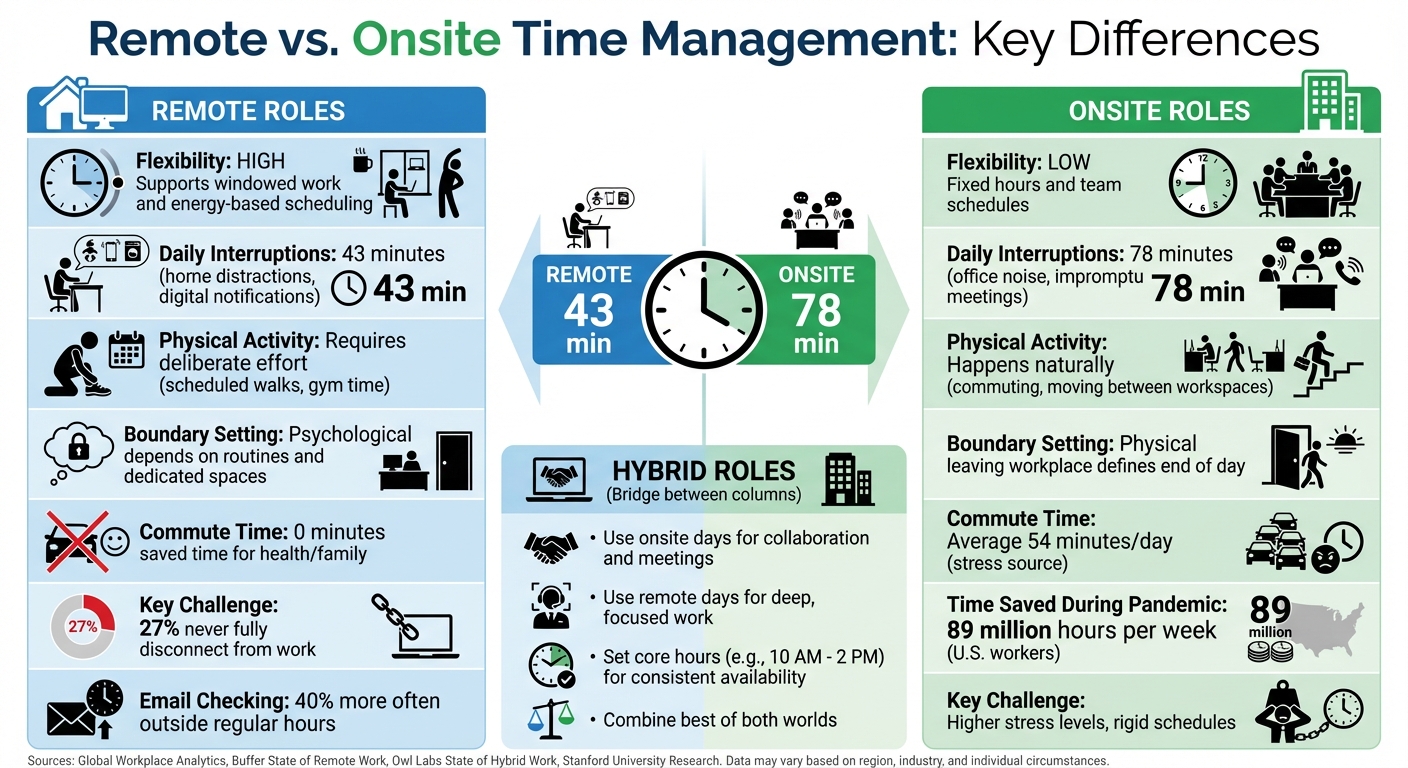
Remote vs Onsite Work Time Management Comparison
Comparison Table: Remote vs. Onsite Roles
Managing time effectively looks very different in remote and onsite roles, especially for outdoor professionals. Remote workers lose about 43 minutes daily to distractions like family interruptions, household tasks, or social media. By contrast, onsite workers face 78 minutes of interruptions each day, often from unplanned meetings, chatty coworkers, or general office noise. That’s nearly double the time lost, though the nature of these distractions varies.
One clear edge for remote workers is their flexibility. They can plan demanding tasks during their natural energy highs - what experts call "windowed work" - instead of sticking to a rigid 9-to-5 schedule. Onsite workers, however, have less control. Their day is shaped by fixed hours, commutes (averaging 54 minutes daily), and team availability. Yet, onsite roles offer a perk remote workers often struggle with: built-in boundaries. When the workday ends, leaving the office signals a clear stop. Remote workers, on the other hand, must actively create boundaries, which can be tricky.
| Factor | Remote Roles | Onsite Roles |
|---|---|---|
| Flexibility | High; supports "windowed work" and energy-based scheduling | Low; follows fixed hours and team schedules |
| Interruptions | Home distractions and digital notifications (approx. 43 mins/day) | Office noise and impromptu meetings (approx. 78 mins/day) |
| Physical Activity | Requires deliberate effort (e.g., scheduled walks or gym time) | Often happens naturally (commuting or moving between workspaces) |
| Boundary Setting | Psychological; depends on routines and dedicated spaces | Physical; leaving the workplace defines the end of the day |
| Commute Time | None; saved time can go toward health or family | Average 54 minutes/day; often a source of stress |
These differences highlight why hybrid roles are becoming so popular - they aim to combine the best parts of both setups.
Time Management for Hybrid Roles
Hybrid roles come with their own set of challenges, but they also offer a chance to strike a balance between remote flexibility and onsite structure. To make the most of this setup, it’s essential to be strategic. Use your onsite days for collaboration - think team meetings, brainstorming sessions, or face-to-face check-ins. Save your remote days for deep, focused work, like tackling complex projects or strategic planning. This approach minimizes the mental juggling between teamwork and solo concentration.
Another key strategy is setting core hours - a consistent period, like 10:00 AM to 2:00 PM, where you’re always available for meetings regardless of location. Outside of these hours, you can enjoy greater flexibility. On remote days, protect your focus time by updating your status in tools like Slack or Teams (e.g., "Deep work until 11:30 AM"). This mimics the effect of a closed office door. Don’t skip transition rituals either. Even when working remotely, starting your day with a morning walk or dressing for work can help signal the shift into “work mode”.
If you're considering hybrid opportunities in the outdoor industry, platforms like Get Outdoor Jobs (https://getoutdoorjobs.com) can help you search for roles tailored to your preferred work style, whether remote, hybrid, or onsite.
Conclusion: Main Points and Next Steps
Time management isn’t a one-size-fits-all concept - it’s deeply influenced by whether you work remotely or onsite. As highlighted earlier, your strategy should align with your specific work environment. For remote workers, creating a personalized structure through routines and energy-based scheduling is key, while onsite professionals often rely on the fixed schedules dictated by their physical surroundings. At the heart of both approaches is the idea of aligning your most demanding tasks with your natural energy peaks, which serves as a cornerstone for improving productivity in any setting.
Each approach has its own set of benefits and challenges that require boundaries tailored to the situation. For instance, remote work eliminates the daily commute, saving U.S. workers an estimated 89 million hours every week. However, it also comes with the risk of overworking, as 27% of remote employees report they never fully disconnect from their jobs.
Whether you thrive in the flexibility of remote work or the structure of an onsite role, adopting targeted strategies can significantly boost both productivity and work-life balance. Simple yet effective techniques like the 75% Rule - leaving some breathing room in your schedule - or the 3-2-1 Rule - dedicating 3 hours to deep work, 2 hours to collaboration, and 1 hour to administrative tasks each day - can make a noticeable difference. Transition rituals, such as taking a 15-minute walk or changing into work-specific clothing, can also help you mentally shift into work mode.
If you’re ready to take the next step in your career, consider exploring opportunities that align with your preferred work style. Platforms like Get Outdoor Jobs (https://getoutdoorjobs.com) can help you find roles tailored to your needs, offering advanced search filters for remote, hybrid, and onsite positions. With thousands of updated listings daily, you can chart a career path that complements your time management strategies and personal goals.
FAQs
What are some effective strategies for remote workers to set boundaries and avoid burnout?
Remote workers can take steps to avoid burnout by drawing clear lines between their work and personal lives. A good starting point is setting up a dedicated workspace. Whether it’s a spare room, a desk, or even a quiet corner, having a specific area for work can help create a mental divide between professional tasks and home life while keeping distractions at bay.
Another key strategy is to stick to consistent work hours. Define clear start and end times for your workday, schedule focused work blocks on your calendar, and turn off work-related notifications once your day is over. This routine ensures you have time to unwind and recharge, which is essential for long-term productivity.
Lastly, prioritize open communication with your team. Let colleagues know when you’re available and when you’re offline, use status updates to signal focus time, and don’t be afraid to decline unnecessary meetings or tasks. These habits can help you maintain balance and stay efficient without stretching yourself too thin.
For those interested in remote jobs within the outdoor industry that value work-life balance, check out Get Outdoor Jobs. They offer thousands of remote-friendly opportunities tailored to outdoor careers.
How can onsite workers in the outdoor industry manage physical fatigue effectively?
Managing physical fatigue is a key part of staying safe and effective for onsite workers in the outdoor industry. Start your day with a quick warm-up or some mobility exercises to get your body ready for action. During your shift, aim to take short breaks every 60–90 minutes to stretch, hydrate, and reset your posture. Switching tasks with teammates can also help prevent overuse injuries, especially when dealing with repetitive or physically demanding work. When lifting, remember to bend at your hips, keep the load close to your body, and use tools like dollies or lift straps to ease the strain. Don’t overlook the importance of supportive, comfortable footwear - it’s a game-changer when you’re on your feet for hours.
Equally important are good sleep and nutrition habits. Try to get 7–9 hours of quality sleep each night, eat balanced meals packed with protein and complex carbs, and cut back on caffeine later in the day to avoid disrupting your rest. If you’re working in hot or extreme weather, staying hydrated is non-negotiable. Wear lightweight, breathable clothing, and take breaks in shaded spots to fend off heat stress. By following these steps, you’ll keep your energy up and stay safe and productive throughout your shift.
Looking for outdoor job opportunities that align with your skills and focus on safety? Explore the listings on Get Outdoor Jobs for roles that match your expertise and values.
What are the best strategies for balancing teamwork and focused work in a hybrid role?
Balancing teamwork and focused work in a hybrid role takes some thoughtful planning. A good starting point is establishing core collaboration hours - dedicated times for meetings, brainstorming sessions, or quick check-ins with your team. Outside of these hours, prioritize your focus time by blocking it on your calendar, silencing notifications, and setting up a quiet, distraction-free workspace. Treat these focus periods as if they were critical appointments to ensure you stay on track.
Leverage asynchronous tools like shared documents or recorded updates to maintain communication without overloading your day with meetings. When meetings are unavoidable, keep them concise, stick to an agenda, and always conclude with clear next steps. It’s also a smart move to regularly assess how you’re using your time. If focused work accounts for less than 60% of your productive hours, it might be time to tweak your schedule.
For those working in outdoor-related industries, platforms like Get Outdoor Jobs make it easier to find hybrid roles that align with your need for flexibility and balance.