
10 Seasonal Jobs by Region in the US

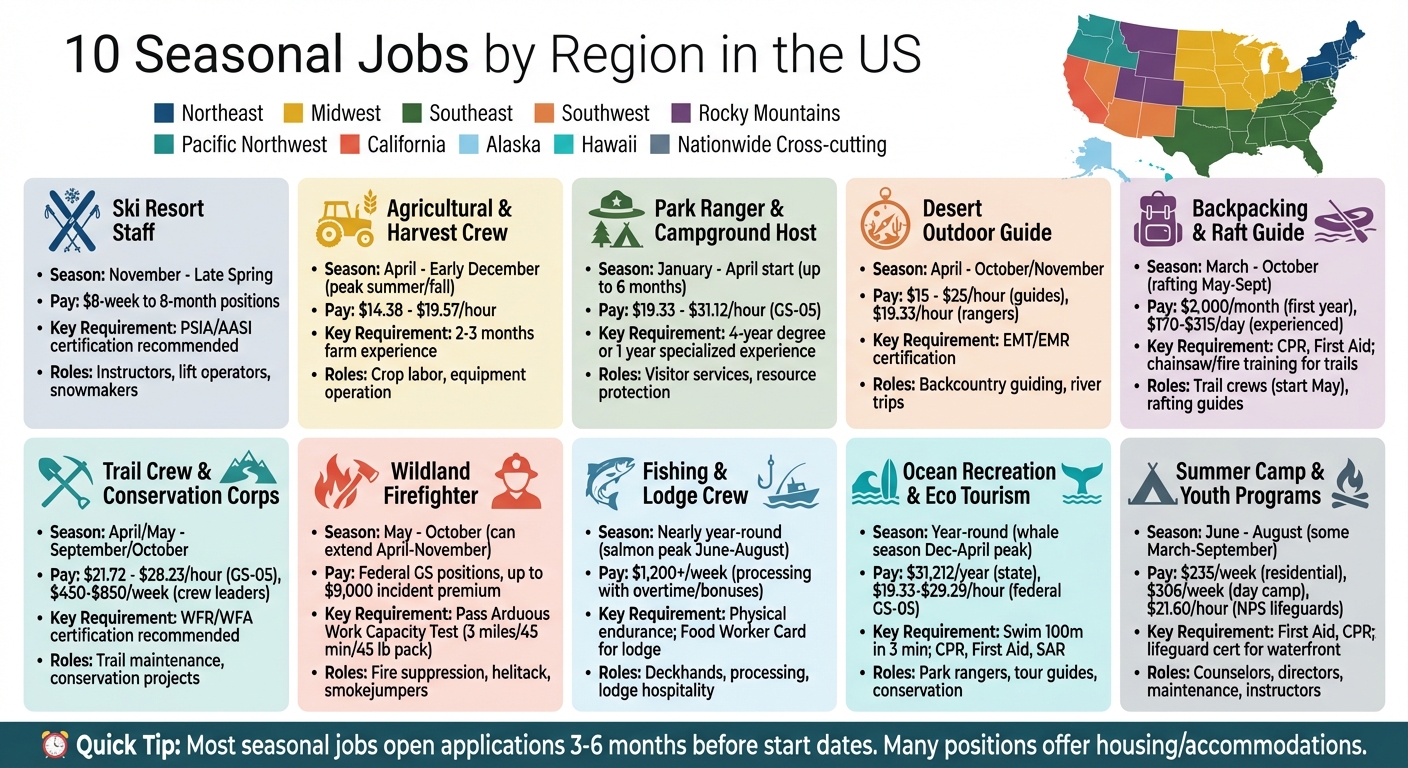
Looking for seasonal work in the U.S.? Here's a breakdown of outdoor jobs by region, covering work schedules, pay ranges, and key requirements. Whether you're into skiing, agriculture, guiding, or park services, this guide helps you plan your seasonal work year-round.
Key Highlights:
- Northeast: Ski resorts hire from November to spring; roles include instructors, lift operators, and snowmakers.
- Midwest: Agriculture peaks in summer and fall; jobs span crop labor to equipment operation.
- Southeast: Seasonal park ranger roles start in January; positions include visitor services and resource protection.
- Southwest: Guiding jobs run April–October; EMT certifications often required.
- Rocky Mountains: Backpacking and rafting guides work March–October; trail crews begin in May.
- Pacific Northwest: Trail crews and conservation corps operate April–October; certifications like Wilderness First Responder recommended.
- California: Wildland firefighting jobs last May–October; physical fitness and fire training are key.
- Alaska: Fishing and lodge crew work nearly year-round; summer salmon harvest peaks June–August.
- Hawaii: Ocean recreation jobs are year-round; whale season boosts demand December–April.
- Nationwide: Summer camps run June–August; roles include counselors, directors, and maintenance staff.
Quick Tip:
Plan ahead - most seasonal jobs open applications months before the start date. Housing can be a challenge in gateway towns, so consider roles offering accommodations.
Not sure what outdoor role fits you?
Take our 2-minute career quiz to get matched with outdoor jobs that align with your goals, salary target, and lifestyle.
For detailed job cycles, pay rates, and certifications, read on!
10 Seasonal Outdoor Jobs by US Region: Work Schedules, Pay Ranges, and Key Requirements
1. Northeast Ski Resort Staff
Typical season and climate conditions
Ski resorts in the Northeast generally operate from November through late spring, with some, like Sugarloaf in Maine, extending their seasons even further. The region's weather can be unpredictable, with natural snowfall varying significantly and icy conditions being common. For example, Stowe Mountain Resort in Vermont sees an average of 333 inches of snow annually, while Killington boasts over 750 acres of terrain and a 3,050-foot vertical drop.
Many resorts, such as Bretton Woods - ranked No. 1 in the East for snow quality and grooming in 2025 - rely heavily on snowmaking to maintain reliable conditions. As Andy DeBrunner from Vail Resorts puts it:
"Snowmakers are absolutely essential to the success and growth of the ski industry and hold the keys to making the guest experience as memorable as possible".
This mix of natural and artificial snow environments creates a unique backdrop for a variety of specialized roles.
Key prerequisites and skills
The ever-changing winter conditions in the Northeast call for adaptable skills across multiple areas. Job opportunities include mountain operations roles like snowmakers, lift operators, groomers, and snowcat drivers. Other areas of work include guest services, such as ski instructors, snow patrollers, and daycare providers, as well as administrative roles in HR, finance, and event planning.
Most positions are entry-level and range from 8 weeks to 8 months in duration. For those interested in becoming ski instructors, earning a PSIA/AASI certification is highly recommended. Some resorts, like Okemo, even offer paid training programs for beginners, making it easier to break into the field.
Regional highlights and opportunities
The Northeast's unique climate supports a thriving network of ski resorts and year-round employment opportunities. The region is home to around 60 ski resorts across Maine, New Hampshire, and Vermont. New Hampshire alone features over 20 major ski areas, offering a dense concentration of job openings. Additionally, resorts such as Sunday River and Sugarbush have diversified their operations to include summer activities like mountain biking and golf, ensuring year-round employment options.
Job cycle strategies for year-round employment
For those looking to maintain steady income throughout the year, transitioning between seasonal roles is a smart strategy. Many workers shift from winter positions at ski resorts to summer jobs with organizations like the National Park Service or the New York State Department of Environmental Conservation. These agencies typically start hiring for roles such as Assistant Forest Rangers, lifeguards, and campground aides in May.
sbb-itb-9d004f0
2. Midwest Agricultural and Harvest Crew
Typical Season and Climate Conditions
The Midwest agricultural season spans from April to early December, covering the entire cycle from planting to harvest. Illinois, for example, ranks second in the nation for corn and soybean production, contributing an impressive $120.9 billion to its economy. Different crops have varying peak times - like asparagus in April and seed corn detasseling from late June to early August. The fall harvest of pumpkins and squash can stretch into December, while winter brings tasks such as fruit tree pruning (December to March) and tobacco stripping in southern Indiana (December to February).
Summers in the Midwest can be especially tough for workers, with temperatures soaring past 100°F, high humidity, heavy rains, and exposure to significant amounts of pollen. For instance, Miller Shore Management recently hired seed corn workers in Bluffs, Illinois, offering $19.57 per hour. These seasonal shifts create unique challenges for workers and demand a specific set of skills to navigate the region’s agricultural demands.
Key Prerequisites and Skills
Given the demanding nature of Midwest agriculture, workers need to develop specific skills to succeed. Most jobs in this field require at least 2–3 months of prior farm experience. The physical demands can be intense, often involving lifting up to 70 lbs, walking long distances, and performing repetitive tasks in bent or stooped positions for extended periods.
Key skills include operating tractors and other machinery, using manual tools like shovels and shears, and performing basic equipment maintenance. Legal authorization to work in the U.S. is mandatory, and workers should expect drug testing and background checks. While many skills can be learned on the job, having a pesticide applicator license or a valid driver’s license can open doors to higher-paying roles, such as equipment operator or supervisor.
Regional Highlights and Opportunities
The Midwest offers a range of agricultural opportunities beyond traditional fieldwork. Illinois, for instance, ranks among the top five states for the market value of hogs, pigs, and nursery products. Wages in the region vary, with general crop laborers in Ohio earning around $14.38 per hour, while specialized seed corn positions in Illinois can pay up to $19.57 per hour. Some tasks even offer piece-rate compensation, such as $10.00 per unit.
Employment for agricultural equipment operators is projected to grow by about 8% between 2024 and 2034. Additionally, programs like the National Farmworker Jobs Program, managed by United Migrant Opportunity Services in collaboration with state agencies, provide training and job placement services for migrant and seasonal farmworkers. These initiatives and opportunities allow workers to strategically extend their income throughout the year.
Job Cycle Strategies for Year-Round Employment
To maintain a steady income beyond the main harvest season, workers can transition into related fields. For example, greenhouse work often begins as early as January. Bonnie Plants, LLC, recently advertised for greenhouse workers in St. Elmo, Illinois, offering $15.48 per hour for a season running until June 2026. Livestock and hog operations also require year-round staffing.
Another option is to shift into state park maintenance during the off-season. Skills like tractor operation, equipment repair, and pesticide application are highly transferable. In Michigan, for instance, over 1,300 seasonal park workers are hired annually, with some positions offering up to 2,000 work hours per year along with state benefits.
For more seasonal outdoor job opportunities in agriculture and related fields, visit Get Outdoor Jobs (https://getoutdoorjobs.com).
3. Southeast Park Ranger and Campground Host
Typical Season and Climate Conditions
Seasonal jobs in the Southeast usually kick off between January and April, lasting up to six months (or a maximum of 1,039 hours). The region offers a variety of work settings, ranging from coastal areas like Gulf Islands and Cape Hatteras to mountainous locations such as the Blue Ridge Parkway and Shenandoah National Park.
"Work is performed both indoors and outdoors in all types of weather." - National Park Service Southeast Region
Coastal roles often involve high humidity and intense sun exposure, while mountain positions may include snowy conditions and challenging terrain. Rangers split their time between indoor tasks at visitor centers and outdoor activities like guided walks, backcountry patrols, and amphitheater programs, all while dealing with weather extremes - from scorching heat to freezing cold. These conditions require a versatile skill set, as detailed below.
Key Prerequisites and Skills
For GS-05 roles, candidates need a four-year degree in fields such as natural resource management, history, or earth sciences, or at least one year of specialized experience (e.g., working as a park guide or environmental educator).
The physical demands can be intense. Rangers often stand for long hours, navigate rugged terrain, and carry heavy equipment in challenging conditions. In Florida State Parks, which manage 175 sites across nearly 800,000 acres, rangers perform tasks like controlled burns using drip torches, planting trees, and removing non-native species. Applicants must be U.S. citizens, pass a background check, and hold a valid state driver’s license.
Regional Highlights and Opportunities
Applications for seasonal positions in the National Park Service Southeast Region opened in late 2025, with start dates expected between January and April 2026. Opportunities include roles at Gulf Islands National Seashore (FL/MS), Blue Ridge Parkway (NC/VA), Cape Hatteras National Seashore (NC), and Martin Luther King, Jr. National Historical Park (GA). Seasonal Interpretive Rangers can earn between $19.33 and $31.12 per hour, depending on their GS level, and receive a uniform allowance.
North Carolina State Parks also offers seasonal roles for park attendants, naturalists, and maintenance crews in its Mountain, Piedmont, and Coastal regions. New Florida State Park rangers participate in a weeklong "Ranger Academy" to develop their skills and receive orientation. Housing availability varies widely across Southeast parks - some provide on-site options, but others face housing shortages due to high demand in tourist-heavy areas. Reaching out to specific parks early to inquire about housing is highly recommended.
Job Cycle Strategies for Year-Round Employment
Southeast parks align with broader seasonal hiring patterns, making it possible for rangers to transition between roles throughout the year. Many seasonal rangers secure year-round work by following the seasons - spending winter and spring in southern or coastal parks and moving to northern or higher-altitude parks during the summer. To retain non-competitive rehire eligibility, employees must limit their hours to 1,040 within their service year. This strategy helps outdoor professionals gain steady experience while staying in sync with regional demand.
For more information on seasonal park ranger and campground host jobs in the Southeast, visit Get Outdoor Jobs (https://getoutdoorjobs.com).
4. Southwest Desert Outdoor Guide
Typical Season and Climate Conditions
Outdoor guiding jobs in the Southwest usually run from April through October or November, but factors like weather, project needs, and funding can sometimes shift these dates. This region, home to iconic destinations such as Grand Canyon National Park, Bandelier National Monument, Mesa Verde, and Death Valley, brings its own set of challenges. Summers can be scorching, with temperatures on the South Rim climbing into the low 90s°F, while winters can plunge to single digits, with higher elevations receiving over 100 inches of snow. The work often involves hiking rugged, steep terrain under these extreme conditions.
Key Prerequisites and Skills
Most guiding positions require some level of medical certification. At a minimum, you’ll need EMT or EMR credentials, though some locations, like Canyonlands (Monticello), demand full EMT certification. For example, Bryce Canyon accepts EMR certification, while CPR, First Aid, and AED certifications are standard requirements across most roles.
The physical demands are no joke. Guides frequently carry backpacks weighing up to 50 pounds while navigating tough terrain and unpredictable weather. In addition, many roles require experience with 4-wheel drive vehicles to handle rugged desert roads - an essential skill in remote spots like the Mojave Desert Network or Grand Canyon-Parashant National Monument. For river guides, operating small watercraft is a must, with training programs typically lasting about four weeks.
Regional Highlights and Opportunities
The Southwest offers a mix of guiding opportunities, from water-based activities to backcountry adventures and desert ecology projects. For instance, Glen Canyon National Recreation Area features water-focused roles on Lake Powell and the Colorado River. Meanwhile, positions in Joshua Tree and Death Valley often involve monitoring desert springs and studying rare vegetation. River guides can expect hourly wages ranging from $15 to $25, factoring in base pay and tips, while park ranger roles (GS-05) offer starting pay around $19.33 per hour.
Some parks, like Canyonlands, offer split-season roles that run from March to June and then again from late August to November. The Grand Canyon even provides employee RV sites for just $50 per month, which includes water, sewer, and trash services - a huge perk given the high living costs in nearby towns. If you’re eyeing a summer position, application windows typically open between November and early January, so planning ahead is key. These roles not only offer a chance to explore the stunning Southwest but also open doors to similar opportunities in other challenging terrains.
5. Rocky Mountains Backpacking and Raft Guide
Typical Season and Climate Conditions
Outdoor work in the Rocky Mountains stretches from March to October, with rafting season hitting its stride between May and September. Trail crew positions usually start in May. The rivers are at their wildest in May and June, fueled by the melting snow. Known for its sunshine, Colorado enjoys about 300 days of clear skies annually. However, at elevations above 12,000 feet, temperatures drop significantly compared to the valleys. By October, daytime highs often reach the 60s or 70s, but chilly nights can bring the first snow to the upper peaks.
Trail crew and backpacking jobs are no walk in the park - workers might cover up to 15 rugged miles a day while hauling heavy packs. For perspective, Rocky Mountain National Park alone has over 350 miles of trails that need constant upkeep.
Key Prerequisites and Skills
Physical endurance is non-negotiable. Trail crew members must handle heavy lifting and might find themselves doing field masonry or carpentry while carrying 30-pound packs at high altitudes. Basic first-aid and CPR certifications are mandatory, and certain roles may require specialized skills like chainsaw operation or wildland fire training.
For rafting guides, understanding USGS water data and cubic feet per second (CFS) river flows is critical for assessing rapid difficulty. The Arkansas River, Colorado's most popular for rafting, and Clear Creek, its steepest commercial run, demand technical expertise and quick-thinking. These skills are essential for navigating the region’s diverse and sometimes challenging conditions.
Regional Highlights and Opportunities
Rocky Mountain National Park draws over 4 million visitors each year, creating a consistent need for seasonal workers. Xanterra helps ease housing concerns by offering on-site accommodations for $101.50 per week, deducted directly from paychecks. Seasonal roles at the YMCA of the Rockies start at $14.81 an hour. For rafting guides, first-year earnings average $2,000 per month before tips, while experienced multi-day guides can make between $170 and $315 daily. Some outfitters sweeten the deal with benefits like 401(k) matching and health insurance stipends after 50 paid days.
Job Cycle Strategies for Year‑Round Employment
To keep income flowing year-round, many summer guides transition to winter jobs at ski resorts like Winter Park or Breckenridge, which operate from late November to early April. For example, Devil's Thumb Ranch offers employees a 50% discount on Winter Park season passes. The National Park Service hires for winter roles from July to August, with jobs running from October to February. To retain eligibility for rehiring without reapplying, seasonal workers must keep their yearly hours under 1,040. Diversifying into roles like CDL shuttle driving or wildland firefighting can also help create a steady, year-round income stream.
6. Pacific Northwest Trail Crew and Conservation Corps
Typical Season and Climate Conditions
Trail crew and conservation corps jobs in the Pacific Northwest usually run from April or May through September or October, depending on elevation and weather patterns. For instance, the Pacific Northwest Trail Association's Performance Trail Crew operates from mid-June to mid-August. Meanwhile, federal seasonal workers at parks like Olympic and North Cascades typically begin between April and May, though snow conditions or funding can sometimes delay these start dates.
"The typical seasonal entry-on-duty period for North Cascades National Park is April-May, but can be variable during these months due to weather conditions, project needs, or funding." - USAJOBS
In areas such as Marblemount (North Cascades), crews experience up to 84 inches of rain annually. Summers bring daytime highs in the 80s–90s°F, with cooler evenings around 50°F. Crews often camp for stretches of four to fifteen days, hiking up to 15 miles daily while carrying 40–50 lb packs. Federal positions are capped at 1,039 working hours per year. These demanding conditions require a mix of physical endurance and technical know-how.
Key Prerequisites and Skills
Physical fitness is a must for navigating steep, rugged terrain during long workdays. On top of that, technical skills play a big role - expect to handle tools like crosscut saws, chainsaws, and pulaskis, along with tasks like rock work and masonry. Backcountry skills are equally critical, including primitive camping, outdoor cooking, and navigating without cell service.
Certifications like Wilderness First Responder (WFR) or Wilderness First Aid (WFA) can qualify you for more advanced roles. For federal positions at places like Olympic National Park, competition is high, with up to 250 applications per role. Demonstrating backpacking experience and holding relevant certifications can make your application stand out. Entry-level federal trail positions (GS-05) offer hourly pay ranging from $21.72 to $28.23, while crew leaders with organizations like the Student Conservation Association may earn $450–$850 per week.
Regional Highlights and Opportunities
These positions not only provide seasonal work but also open doors to broader outdoor career paths. The Pacific Northwest boasts 24.9 million acres of national forest across Oregon and Washington, including 16 National Forests and over 3,000 recreation areas that attract approximately 16 million visitors each year. Many trail crews focus on the Pacific Northwest National Scenic Trail, celebrated as one of the "newest and wildest" trails in the U.S.. Assignments might take you through coastal rainforests, high desert plateaus, or elevations ranging from 1,600 feet to Mount Rainier's towering 14,000 feet.
Some assignments, like those in Stehekin, Washington - accessible only by boat or plane - or Hozomeen, reached via a 40-mile gravel road from British Columbia, offer truly remote experiences. Beyond trail work, the region supports over 1,500 fire positions across Alaska, Oregon, and Washington, presenting additional seasonal job options. The variety of roles and conditions makes it possible to find continuous employment even after the peak season.
Job Cycle Strategies for Year-Round Employment
The Pacific Northwest Trail Association conducts interviews for crew leaders from January to May and for crew members from February to June. Federal roles typically post openings between October and February for the next summer season. To stay employed during the off-season, many trail workers transition to wildland firefighting or winter jobs at ski resorts in the Cascades. The Forest Service also hosts annual "Fire Hire" events across Oregon, Washington, and Alaska, so keeping an eye on USAJOBS and the Forest Service Outreach Database for event dates is a smart move. Staying under the 1,040-hour annual limit for federal seasonal work ensures your non-competitive rehire status, making it easier to return each year.
For up-to-date trail work opportunities in the Pacific Northwest, check out Get Outdoor Jobs (https://getoutdoorjobs.com).
7. California Wildland Firefighter and Forestry Technician
Typical Season and Climate Conditions
In California, wildland fire season generally stretches from May to September or October. However, in areas like the Eldorado National Forest, fire activity can kick off as early as April and extend into November. Federal seasonal firefighting jobs typically last about six months, capped at 1,039 hours per season. These roles demand exceptional physical endurance, as firefighters face extreme heat and navigate steep, rugged terrain during prolonged fire incidents.
"Wildland firefighters may be required to work long hours in challenging and changing conditions, such as high temperatures and steep terrain." - US Forest Service
Recruitment for these positions begins months before the fire season. Most agencies post job openings between November and early January for the upcoming year.
Key Prerequisites and Skills
Physical fitness is non-negotiable. Applicants must pass the annual "Arduous" Work Capacity Test, which involves hiking 3 miles on flat terrain in under 45 minutes while carrying a 45-pound pack. Additionally, candidates must meet specific medical standards for arduous duty roles and pass a drug test within 90 days of their start date, including screening for THC.
For entry-level positions, you’ll need to complete basic fire training courses and earn certifications like ICS-100, ICS-200, and ICS-700. Federal jobs in this field are listed under the 0456 (Wildland Fire Management) or 0462 (Forestry Technician) job series. Starting September 27, 2025, federal resumes are limited to two pages. To improve your chances, consider reaching out directly to fire modules in specific forests or parks via cold calls or emails.
Regional Highlights and Opportunities
California, known federally as Region 5 (Pacific Southwest Region), offers a variety of firefighting roles beyond traditional fire suppression. Specialized positions include:
- Helitack crews: Helicopter-based firefighting teams.
- Smokejumpers: Parachute-based firefighters.
- Wildland Fire Modules: Crews focused on ecological fire management.
The National Park Service employs about 400 permanent and 600 seasonal fire personnel. Elite teams, such as the Arrowhead Hotshots based in Sequoia and Kings Canyon National Parks, represent some of the top opportunities in the region.
| Position Type | Duration | Benefits |
|---|---|---|
| Temporary Seasonal | Less than 6 months | Includes annual and sick leave |
| Permanent Career-Seasonal | 26 to 48 weeks | Full benefits, including retirement and health insurance |
| Permanent Full-Time | 52 weeks | Full benefits with year-round employment |
Understanding these job types can help you plan your career path and transition into more stable, year-round roles.
Job Cycle Strategies for Year-Round Employment
To find openings, search USAJobs.gov between October and November using keywords like "wildland firefighter" or "forestry technician", and filter results by the 0456 job series. Many seasonal workers move into permanent career-seasonal positions, which offer full benefits while requiring work for 26 to 48 weeks annually.
Consider applying for the Wildland Firefighter Apprentice Program, which accepts applications from August to October. Exploring specialized roles like Fire Dispatch, Fuels Management, or GIS can also help secure consistent, year-round work. Agencies often use Direct Hire Authority to quickly fill critical vacancies, streamlining the process for transitioning into permanent roles.
The new 2025 pay scales include Incident Premium Pay of up to $9,000 annually. For current job openings in California wildland firefighting, check out Get Outdoor Jobs (https://getoutdoorjobs.com).
8. Alaska Fishing and Lodge Crew
Typical Season and Climate Conditions
Alaska’s fishing industry operates almost year-round, with specific seasons for different species. The summer salmon harvest kicks off in mid-May and runs through early October, peaking between mid-June and late August. During this time, commercial fishermen haul in an impressive 150 to 200 million salmon, starting with the Copper River runs in mid-May.
But fishing opportunities don’t stop with summer. Winter and spring bring their own action. The Pollock "A" season stretches from late January to April, while various crab fisheries are active in late fall and winter. Groundfish, like halibut and blackcod (sablefish), are harvested from March 1 through November 1.
Working conditions can be tough. Expect cold, wet, and remote environments. June and July offer extended daylight hours, which means longer workdays, while May and September often bring more favorable weather. The industry employs over 65,000 people across five main regions: Southeast (Area 1), Prince William Sound (Area 2), Kodiak Island (Area 3), Aleutian Islands (Area 4), and Bristol Bay (Area 5). Adapting to the seasonal weather and varying daylight hours is crucial for success in this field.
"Commercial fishing is rated as one of the most hazardous occupations in America." - Alaska Department of Labor and Workforce Development
Key Prerequisites and Skills
Physical endurance is a must for both fishing and lodge work. Seafood processing involves long hours in cold, wet conditions, while deckhands need skills like net repair, wheel watching, hauling nets, and rigging. Onshore processing plants typically employ teams ranging from 75 to 350 workers.
For lodge and hospitality roles, you’ll need an Alaska Food Worker Card within 30 days of being hired. If you’re serving alcohol, completing the Alaska Training for Alcohol Professionals (TAP) class is required. Wilderness guides must have certifications such as WFR, Swiftwater Rescue, and CPR. Marine engineers working on fishing vessels need U.S. Coast Guard-endorsed ratings.
Entry-level processing jobs, like slimers and packers, are the easiest way to get started without prior experience. During peak seasons, seafood processing workers can earn over $1,200 per week, thanks to hourly pay, overtime, and bonuses.
Regional Highlights and Opportunities
The scale of Alaska’s fishing industry provides plenty of opportunities. The workforce includes 32,000 fishermen and 25,000 processing workers, spread across offshore vessels and more than 70 onshore plants.
Lodge and tourism jobs run from May through September, while commercial fishing and processing offer nearly year-round cycles. Factory trawlers and longliners harvest halibut and groundfish between March and November. There’s also increasing demand for dive fishery harvesters in Southeast Alaska to collect sea urchins, geoduck clams, and sea cucumbers.
Job Cycle Strategies for Year-Round Employment
If you’re aiming for steady, year-round work, it’s all about timing. Start with the summer salmon season (May–September), then transition to fall king crab or groundfish seasons (October–November). After that, winter Pollock or cod seasons (January–April) can keep you employed. The Pollock "A" season on factory trawlers is a great option for high winter earnings.
Begin your job search 3–6 months before the season starts, though mid-season openings often pop up due to turnover. Entry-level processing roles can lead to full-time management or technical positions, offering year-round pay and benefits. Many employers provide perks like free or subsidized room and board, as well as free transportation from the hiring location for those who complete their contracts.
For up-to-date Alaska fishing and lodge job opportunities, visit Get Outdoor Jobs (https://getoutdoorjobs.com).
9. Hawaii Ocean Recreation and Eco Tourism Jobs
Typical Season and Climate Conditions
Hawaii offers work opportunities all year, though the nature of the jobs shifts with the seasons. The islands experience two main seasons: a dry summer from June to August and a wetter winter from November to March. These seasonal changes directly influence ocean conditions. For instance, winter brings massive waves to the northern shores, making it a prime time for professional surf competitions and guiding big-wave surfers. On the flip side, summer calms the northern waters, creating ideal conditions for snorkeling, diving, and beginner-friendly water sports.
One of the biggest draws for eco-tourism in Hawaii is the humpback whale migration, which peaks between December and April. In 2012, the state’s seven national parks attracted 5.1 million visitors, generating over $314 million in revenue and supporting 3,700 jobs. These seasonal shifts not only affect tourism trends but also shape the skills and certifications needed for success in Hawaii's eco-tourism and outdoor job market.
Key Prerequisites and Skills
For state park rangers, physical fitness is non-negotiable. Applicants must swim 100 meters in under 3 minutes and hike a mile within 20 minutes. Certifications like CPR, First Aid, and Search and Rescue (SAR) training are standard requirements. Protective park ranger roles demand additional qualifications, such as a National Park Service law enforcement commission or completion of a 650-hour Seasonal Law Enforcement Training Program.
Guides play an essential role in protecting Hawaii’s unique wildlife. They must enforce strict distancing rules, such as keeping 100 feet from Hawaiian monk seals and 15 feet from green sea turtles. Beyond regulations, private employers value candidates who embody the "Aloha Spirit", emphasizing respectful and service-oriented leadership. Strong interpretive skills are also critical for leading guided tours, cultural demonstrations, and educational programs that delve into Hawaiian history, geology, and ecosystems. Pay varies, with state park rangers starting at $31,212 annually, while federal GS-05 positions offer hourly rates between $19.33 and $29.29.
Regional Highlights and Opportunities
Hawaii’s state parks cover nearly 30,000 acres across five major islands, offering a wide range of job opportunities. Volcano geotourism has been gaining popularity, increasing the need for rangers trained in volcanic safety and vog (volcanic gas) education. High-traffic areas like the Kalalau Trail now require permits up to a year in advance, creating more positions in visitor management and enforcement.
Programs like Kupu and the Hawaii Youth Conservation Corps provide pathways to permanent roles through workforce development. Meanwhile, private companies such as North Shore EcoTours combine guided tours with conservation efforts like invasive species removal and habitat restoration. The "Hawaii Stays With You" campaign highlights "kuleana" (responsibility), increasing demand for guides who can educate visitors on cultural and environmental responsibility - skills that support steady, year-round employment.
Job Cycle Strategies for Year-Round Employment
To maintain steady work throughout the year, many employees in Hawaii transition between federal, state, and private sector roles. Federal seasonal jobs typically run from April to October and are capped at 1,039 hours. During the off-season, workers often take on temporary state-level roles or join the private eco-tourism sector. The Hawaii Department of Land and Natural Resources frequently offers 89-day non-civil service appointments to help bridge employment gaps.
Specialized certifications like Wilderness First Responder (WFR), USCG Captain's licenses, or SCUBA Rescue Diver credentials can open doors to year-round management roles. When applying for federal positions through USAJOBS, it’s critical to use the platform’s resume builder and include details like exact start/end dates (month/year) and hours worked per week. However, prospective workers should be prepared for challenges such as housing shortages and high living costs in key gateway towns. For the latest opportunities in Hawaii’s ocean recreation and eco-tourism sectors, check out Get Outdoor Jobs (https://getoutdoorjobs.com).
10. Nationwide Summer Camp and Youth Outdoor Programs
Typical Season and Climate Conditions
Summer camps generally run from June through August, though some youth programs extend their schedules from March to September. Recruitment for these roles often kicks off as early as October, with application windows typically spanning October to February. For instance, the New York State Department of Environmental Conservation camps accept applications from January 1 through February 28. Similarly, the National Park Service reviews summer applications between October and February via USAJOBS.
During the summer months, high sun exposure and extended daylight hours dominate. While these conditions are perfect for outdoor learning, they also require staff who can handle prolonged outdoor activities. Scouting America operates 420 Scout camps, 60 council high-adventure programs, and three national high-adventure bases across various climates, ranging from the humid forests of the East to the arid deserts of the Southwest. These predictable seasonal windows provide structured timelines for those looking to plan their careers in outdoor education.
Key Prerequisites and Skills
Given the clear seasonality of these roles, preparation is essential. First Aid and CPR certifications are mandatory for nearly all youth outdoor programs. For waterfront positions, lifeguard certification is required, and some coastal programs even have specialized surf-lifeguard tests, such as a timed 550-yard swim to be completed in under 10 minutes. High-adventure roles often demand skills in climbing, ziplining, and mountain biking.
Age requirements differ depending on the program. Local Scout camps typically hire staff starting at 15 or 16 years old, while high-adventure bases usually require candidates to be at least 18. Physical fitness is another key factor, as some roles involve hiking up to 15 miles a day with a pack or operating technical equipment.
Regional Highlights and Opportunities
Across regions, competitive pay and benefits make these positions attractive. A 2010 American Camp Association survey found that seasonal residential camp staff earned an average of $235 per week (room and board included), while day camp staff averaged $306 per week. Seasonal roles with the National Park Service offer even higher pay - lead recreation assistants (lifeguards) earn $21.60 per hour, and maintenance worker leaders make between $24.55 and $28.62 per hour.
"You get to be outside all the time. You have a great sense of purpose and community when you work at the Park Service." - Forrest Shafer, National Park Ranger
The demand goes beyond counselors. Camps also need directors, cooks, medical staff, maintenance teams, and instructors for specialized activities. Many of these positions include free or discounted housing, though availability may be limited.
Job Cycle Strategies for Year-Round Employment
Outdoor professionals often find ways to stay employed year-round by alternating between seasonal roles. For example, many work at summer camps during warmer months and transition to ski resorts in the winter. Programs like Meramec Adventure Ranch offer career paths that can lead guides into full-time management roles after completing a 10-week program. Similarly, the YMCA of the Rockies provides seasonal roles lasting up to 8 months, paired with leadership development programs.
Advanced certifications, such as Wilderness First Responder (WFR) or USCG Captain's licenses, can open doors to higher-level guiding or permanent management positions. For those pursuing full-time roles, private for-profit camp directors can earn salaries as high as $100,000 annually. If you're looking for the latest job opportunities in summer camps and youth outdoor programs, visit Get Outdoor Jobs (https://getoutdoorjobs.com).
Environmental Summer Jobs (Science, Outdoors, Recreation & more!)
Conclusion
Timing your job search to align with regional climate patterns can make a big difference in landing the right seasonal position. For example, the Northeast's chilly winters fuel ski resort hiring from October through April, while the Southwest’s milder winters open up opportunities for desert guiding in spots like Death Valley and the Grand Canyon. As spring arrives and snowmelt swells rivers in the Rockies and Pacific Northwest, demand spikes for skilled river guides. Meanwhile, summer’s longer days bring a nationwide need for park rangers, lifeguards, and camp counselors. Agricultural work also follows its own seasonal rhythm, with harvests and planting cycles varying by region.
However, housing can be a tough hurdle in pricey gateway towns. Some workers have turned to creative solutions like van living or booking extended-stay campsites on nearby public lands. Many seasonal employees now move between roles throughout the year to maintain steady income. This approach requires thoughtful preparation, as most summer job postings go live between September and December of the previous year, and federal hiring processes can take up to three months.
Navigating these seasonal shifts is essential for building a stable outdoor career. That’s where Get Outdoor Jobs (https://getoutdoorjobs.com) comes in. This platform simplifies your search by offering thousands of updated seasonal job listings, complete with advanced filters to help you find roles by state, season, or environment - whether it’s National Parks or ski resorts. You can even filter for positions offering room and board, a crucial perk in high-cost areas. With email alerts and premium features, you’ll never miss an application window, giving you the tools to plan your career in the great outdoors with confidence.
FAQs
What are the best ways to find housing for seasonal jobs?
Finding housing for seasonal jobs can feel tricky, but it’s definitely doable with the right plan. One of the easiest ways to simplify the process is to look for jobs that include on-site housing or offer some type of housing assistance. Many employers, especially those in industries like resorts or national parks, offer affordable accommodations as part of their job packages. If that’s not an option, start your search early - ideally 2–3 months before the season kicks off. Check out short-term rental websites, sublet listings, or options with month-to-month leases.
Another great tip is connecting with other seasonal workers. Online forums and social media groups can be excellent places to find potential roommates and split housing costs. Just make sure to review lease terms, confirm how far the place is from your job site, and ask your employer if they have any recommendations for local housing. Sticking to a budget for rent, utilities, and related expenses will also help you stay financially prepared.
For an easier search, consider using platforms like Get Outdoor Jobs. They often feature positions that come with housing or provide resources for finding nearby accommodations. By planning ahead and taking advantage of these tools, you can secure a place that’s safe, convenient, and affordable for your seasonal gig.
How can I work seasonal jobs year-round without gaps in employment?
To keep steady employment while working seasonal jobs, focus on planning ahead, developing adaptable skills, and being open to relocating. Start by mapping out the seasonal job calendar - think summer trail maintenance in the Rockies or winter conservation projects in Florida - and apply early, as many employers hire months in advance. While on the job, inquire about off-season roles or permanent positions within the same organization.
Being willing to move with seasonal demand can also make a big difference. For instance, you could head to warmer states like Arizona or California during the winter months. Websites like Get Outdoor Jobs are great tools to search for opportunities by season, location, and even housing availability, helping you secure your next role before your current one wraps up.
Don’t underestimate the power of networking, either. Build connections with other seasonal workers to swap advice on job openings, housing leads, and training opportunities. By staying proactive and flexible, you can carve out a continuous career in the outdoor industry without facing lengthy employment gaps.
What certifications are most useful for seasonal outdoor jobs?
Certifications play a crucial role in securing seasonal outdoor jobs, as they prove you have the skills to work safely in demanding environments. Many positions, such as camp staff, trail crews, park aides, and adventure guides, often require a Wilderness First Responder (WFR) certification, along with First Aid and CPR training.
For more specialized roles, additional certifications may be necessary. For instance:
- Avalanche safety training (AIARE) and Professional Ski Instructors of America (PSIA) certifications are highly valued for ski patrol or resort positions.
- Instructors for activities like rock climbing, whitewater rafting, or scuba diving typically need credentials specific to their field.
- Wildland firefighters must complete fire-line training, pass a physical fitness test, and earn an Incident Qualification Card (Red Card).
Tailoring your certifications to the specific job and region not only ensures safety but also makes you stand out as a strong candidate for seasonal roles.